


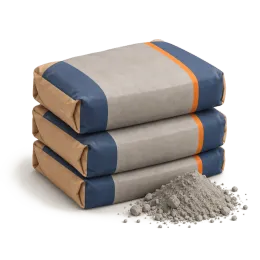
Key numbers
- 80 lb bag: 0.60 ft³ = 0.022 yd³ = 17 L
- 60 lb bag: 0.45 ft³ (12.7 L); 40 lb: 0.30 ft³ (8.5 L)
- 45 × 80 lb bags make one cubic yard (27 ft³)
- One 80 lb bag covers 1.8 ft² at 4 in thick, 2.4 ft² at 3 in
On this page
- How to use the 80 lb Bag of Concrete Cubic Feet
- How much concrete does an 80 lb bag make?
- Cubic feet in every bag size
- How much do several 80 lb bags make?
- How much area does one 80 lb bag cover?
- Why is an 80 lb bag only 0.6 cubic feet?
- Litres and metric bag sizes
- Common mistakes with bag yields
- Bag volume vs the other bag pages
- Frequently asked questions
How to use the 80 lb Bag of Concrete Cubic Feet
- 1Enter your numbersFill in number of bags, bag size or pour thickness (in).
- 2Check the assumptionsYields from the QUIKRETE Concrete Mix (No. 1101) data sheet. Sakrete lists the same yields except 90 lb = 0.66 ft³.
- 3Read the resultsThe calculator shows cubic feet, cubic yards, litres, cubic metres or area covered at 4 in, updated as you type.
- 4Use the resultRound up to what your supplier sells, and keep a little extra for waste.
Results update as you type. Back to the calculator ↑
How much concrete does an 80 lb bag make?
An 80 lb bag of concrete mix makes about 0.60 cubic feet, or 17 litres, of mixed concrete. That figure is the manufacturer’s yield, printed on the QUIKRETE Concrete Mix (No. 1101) data sheet, and Sakrete lists the same 0.6 ft³ for its 80 lb High-Strength Concrete Mix.
The yield is the volume of concrete you get after adding water and mixing, not the size of the bag. It is the number every bag count on this site starts from:
Volume (ft³) = number of bags × yield per bag
So 10 bags of 80 lb make 10 × 0.60 = 6.0 ft³. To go the other way, divide the volume you need by the yield and round up.
Cubic feet in every bag size
Premix is sold in five common sizes. This table converts each one to the units people actually plan with: cubic feet, cubic yards, litres, and the area one bag covers at a typical 4 in slab thickness.
| Bag size | Yield (ft³) | Yield (yd³) | Yield (litres) | Covers at 4 in (ft²) | Bags per cubic yard | Buy per yard |
|---|---|---|---|---|---|---|
| 40 lb | 0.300 | 0.0111 | 8.5 | 0.90 | 90.0 | 90 |
| 50 lb | 0.375 | 0.0139 | 10.6 | 1.13 | 72.0 | 72 |
| 60 lb | 0.450 | 0.0167 | 12.7 | 1.35 | 60.0 | 60 |
| 80 lb | 0.600 | 0.0222 | 17.0 | 1.80 | 45.0 | 45 |
| 90 lb | 0.675 | 0.0250 | 19.1 | 2.03 | 40.0 | 40 |
Yields are from the QUIKRETE data sheet. Sakrete’s figures match for 40, 60 and 80 lb; its 90 lb bag is listed at 0.66 ft³, not 0.675, and Sakrete does not make a 50 lb concrete mix. If you use another brand, check the yield on the bag: specialty mixes such as fast-setting or high-strength products can differ.
Worked example: how many 80 lb bags for 10 cubic feet?
- 10 ft³ ÷ 0.60 ft³ per bag = 16.7 bags → buy 17
- Add 10% for spillage and an uneven base: 11 ft³ ÷ 0.60 = 18.3 → buy 19 bags
- In metric: 10 ft³ = 0.283 m³, or about 283 litres
How much do several 80 lb bags make?
Once you know one bag makes 0.60 ft³, the rest is multiplication. This table answers “how much will my bags fill” for common counts, including the depth people pour most often.
| 80 lb bags | Cubic feet | Cubic yards | Cubic metres | Covers at 4 in (ft²) | Covers at 6 in (ft²) |
|---|---|---|---|---|---|
| 1 | 0.6 | 0.02 | 0.017 | 1.8 | 1.2 |
| 2 | 1.2 | 0.04 | 0.034 | 3.6 | 2.4 |
| 5 | 3.0 | 0.11 | 0.085 | 9.0 | 6.0 |
| 10 | 6.0 | 0.22 | 0.170 | 18.0 | 12.0 |
| 20 | 12.0 | 0.44 | 0.340 | 36.0 | 24.0 |
| 30 | 18.0 | 0.67 | 0.510 | 54.0 | 36.0 |
| 45 | 27.0 | 1.00 | 0.765 | 81.0 | 54.0 |
| 50 | 30.0 | 1.11 | 0.850 | 90.0 | 60.0 |
| 60 | 36.0 | 1.33 | 1.019 | 108.0 | 72.0 |
A 4 × 4 ft pad 4 in thick is 16 ft² of surface, so it takes just under 9 bags; a 10 × 10 ft slab at 4 in needs 56. For bag counts by project size, use the concrete bag calculator.
How much area does one 80 lb bag cover?
One 80 lb bag covers 1.8 square feet at 4 inches thick. Coverage is the yield spread at a chosen thickness, so it shrinks as the pour gets deeper:
Area (ft²) = yield (ft³) × 12 ÷ thickness (in)
- At 2 in (the minimum thickness QUIKRETE lists for Concrete Mix): 3.6 ft² per bag
- At 3 in: 2.4 ft²
- At 4 in: 1.8 ft²
- At 6 in: 1.2 ft²
For thinner toppings under 2 in, Concrete Mix is the wrong product: its coarse stone needs depth. Use a sand mix or resurfacer and the yield printed on that bag.
Why is an 80 lb bag only 0.6 cubic feet?
Because mixed concrete is dense: QUIKRETE gives about 140 lb per cubic foot for its bagged mix. Eighty pounds of dry cement, sand and stone, plus about 6 pints (2.8 L) of water to start and up to 9 pints (4.3 L), fills a little over half a cubic foot.
That density also tells you what a mixed bag weighs in the form: about 0.60 × 140 = 84 lb, a bit more than the dry bag because of the water. A full cubic yard of bagged concrete (45 bags) is 3,600 lb of dry mix to lift, which is why most people switch to ready-mix vs bagged concrete comparisons once a job passes about a yard.
Litres and metric bag sizes
Outside the US, concrete is sold in 20 kg, 25 kg and 30 kg bags. The 80 lb bag (36.3 kg) yields 17 litres, which is 0.017 m³, so a cubic metre takes about 59 bags. Sakrete publishes two metric yields on the same data sheet: a 25 kg bag makes 0.41 ft³ (about 11.6 L) and a 30 kg bag 0.50 ft³ (about 14.2 L).
| Bag | Litres per bag | Bags per m³ (exact) | Buy per m³ with 10% extra |
|---|---|---|---|
| 40 lb (18.1 kg) | 8.5 | 117.7 | 130 |
| 60 lb (27.2 kg) | 12.7 | 78.5 | 87 |
| 80 lb (36.3 kg) | 17.0 | 58.9 | 65 |
Common mistakes with bag yields
- Using the bag weight as volume. An 80 lb bag is not a cubic foot. You need 1.67 bags per cubic foot.
- Mixing up yards and feet. 0.60 ft³ is 0.022 yd³. Forty-five bags make one yard, not 27.
- Skipping waste. Forms bulge and bases dip. Add 10% and round up to a whole bag.
- Assuming every 90 lb bag is the same. QUIKRETE lists 0.675 ft³, Sakrete 0.66 ft³. Over 40 bags that is 0.6 ft³ of difference.
- Adding extra water to stretch a bag. More water gives slightly more volume but weaker concrete. Follow the water range on the bag.
Bag volume vs the other bag pages
This page answers one question: how much concrete is in one bag. To go from a slab size to a bag count, use the concrete bag calculator. To convert a yardage into bags, see how many bags of concrete in a yard. For brand-specific yields, use the QUIKRETE calculator or the Sakrete calculator, and for loading a truck or trailer, bags per pallet.
Brand names are used descriptively; this site is independent and not affiliated with QUIKRETE or Sakrete.
FAQ
Frequently asked questions
How many cubic feet is an 80 lb bag of concrete?
About 0.60 cubic feet (17 litres) once mixed, according to the QUIKRETE Concrete Mix data sheet. Sakrete lists the same 0.6 ft³ for its 80 lb High-Strength Concrete Mix. That is 0.022 cubic yards per bag.
How much concrete is in a 60 lb bag?
A 60 lb bag makes about 0.45 cubic feet (12.7 litres) of concrete. You need 60 of them for one cubic yard, compared with 45 bags of 80 lb, and 78.5 bags per cubic metre.
How many square feet does an 80 lb bag of concrete cover?
At 4 in thick, one 80 lb bag covers 1.8 ft². At 3 in it covers 2.4 ft² and at 6 in it covers 1.2 ft². Multiply the yield (0.60 ft³) by 12 and divide by the thickness in inches.
How many 80 lb bags of concrete make a cubic foot?
1.67 bags. Each 80 lb bag yields 0.60 ft³, so one cubic foot takes 1 ÷ 0.60 = 1.67 bags; buy 2. Ten cubic feet takes 16.7 bags, so buy 17, or 19 with 10% extra.
How many cubic feet is a 40 lb bag of concrete?
About 0.30 cubic feet (8.5 litres), half an 80 lb bag. It takes 90 bags of 40 lb to make a cubic yard, so the 40 lb size suits small repairs and single posts rather than slabs.
How many bags of concrete is 1 cubic metre?
58.9 bags of 80 lb concrete (buy 59), 78.5 bags of 60 lb or 117.7 bags of 40 lb. One cubic metre is 35.31 ft³ and each 80 lb bag yields 0.60 ft³. Add 10% for waste.
Why does an 80 lb bag only make 0.6 cubic feet?
Because concrete is heavy. Bagged mix weighs about 140 lb per cubic foot once mixed (QUIKRETE figure), so 80 lb of dry mix plus about 6–9 pints of water fills only a little over half a cubic foot.
Is a 90 lb bag of concrete 0.675 or 0.66 cubic feet?
It depends on the brand. QUIKRETE lists 0.675 ft³ for its 90 lb Concrete Mix (regional availability) and Sakrete lists 0.66 ft³ for its 90 lb High-Strength Concrete Mix. Use the yield printed on your bag.
3 Sources
- QUIKRETE Concrete Mix (No. 1101) data sheet: yields 40 lb 0.30 ft³, 50 lb 0.375, 60 lb 0.45, 80 lb 0.60, 90 lb 0.675; density ≈140 lb/ft³; water per bag
- Sakrete High-Strength Concrete Mix technical data sheet: 40 lb 0.30 ft³, 60 lb 0.45, 80 lb 0.6, 90 lb 0.66
- NIST SP 811 Appendix B.9: 1 ft³ = 0.02831685 m³; 1 yd³ = 0.7645549 m³
Last reviewed October 11, 2026 by M Bilal. Found an error? Tell us.