


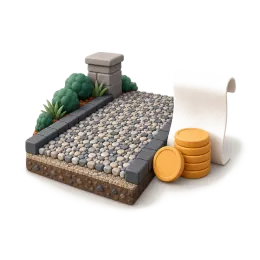
Key numbers
- Formula: L (ft) × W (ft) × depth (in) ÷ 324 = cubic yards
- Typical planning values (calculator defaults, not a standard): crusher run ≈ 1.6 tons/yd³ (≈1.9 t/m³), #57 stone ≈ 1.35 tons/yd³; use your supplier's weight per yard
- Per yard ↔ per ton: $10 per ton ≈ $16 per yard of crusher run at the 1.6 tons/yd³ default
- Add 10% or more for compaction and spreading
- Ask your supplier for their weight per yard: local stone varies, and Ohio DOT uses 3,800 lb (1.9 tons) per yd³ as its pay conversion factor for crushed stone
On this page
- How to use the Gravel Driveway Cost
- How much does a gravel driveway cost?
- Gravel for common driveway sizes
- Long and rural driveways: 250 ft to a quarter mile
- How is driveway gravel priced?
- Parking pads, turnarounds and top-ups
- Site work: excavation, fabric and drainage lines
- What makes a gravel driveway cost more?
- Gravel driveway in metric
- Common mistakes when pricing a gravel driveway
- Gravel driveway cost vs related calculators: which one to use
- How do I get accurate gravel driveway quotes?
- Frequently asked questions
How to use the Gravel Driveway Cost
- 1Describe the areaChoose Rectangle (length × width), Circle (diameter) or Known area if you already have the square footage.
- 2Pick your unitsUse US (feet and inches) or Metric (meters and centimeters). Switching converts the numbers you typed, so the area stays the same.
- 3Enter the depthType how deep the crusher run / road base should be, 6 in is a common starting point for this job.
- 4Choose the materialPick crusher run / road base, crushed stone (#57), gravel (mixed) or pea gravel. Each uses its own weight per cubic yard to work out tons.
- 5Allow for settlingChoose the extra: none, 5%, 10% (the default) or 20% for a base you will compact.
- 6Read and price the resultsSee cubic yards, cubic feet, cubic meters, US tons and metric tonnes. Enter your supplier's price per ton for the total cost.
Results update as you type. Back to the calculator ↑
How much does a gravel driveway cost?
A gravel driveway costs the stone plus getting it in place: delivery, excavation, geotextile fabric where needed, spreading and compaction. Gravel is sold by the ton or by the cubic yard, so the size and depth of the drive fix the quantity, and your supplier’s price sets the cost. We do not publish a national average price because stone prices vary with the material, the region and the haul distance.
Tons = L (ft) × W (ft) × depth (in) ÷ 324 × 1.10 × tons per yd³
Gravel driveway cost = tons × price per ton + delivery per load × loads + excavation + fabric + spreading and compaction + drainage
The calculator above starts with crusher run at 6 in deep. Enter your driveway size and your price per ton, and it returns cubic yards, tons and the total cost. Switch the material to #57 crushed stone, gravel or pea gravel to compare.
Worked example: 100 × 12 ft driveway, 6 in deep
- 100 × 12 × 6 ÷ 324 = 22.22 yd³ (16.99 m³)
- Add 10% for compaction: 24.44 yd³
- Crusher run at 1.6 tons/yd³: 39.1 tons (35.5 tonnes)
- Cost: 39.1 × your price per ton. Every $10 per ton adds $391, plus delivery and spreading
Gravel for common driveway sizes
This table gives the stone for common driveway sizes at 4 and 6 in deep, with 10% extra included. Tons use typical loose weights of 1.6 tons per yard for crusher run and 1.35 for #57 stone; your supplier’s figure may differ.
| Driveway | Depth | Cubic yards (+10%) | m³ (no extra) | Crusher run (tons) | Crusher run (tonnes) | #57 stone (tons) |
|---|---|---|---|---|---|---|
| 50 × 10 ft | 4 in | 6.79 | 4.72 | 10.9 | 9.9 | 9.2 |
| 50 × 10 ft | 6 in | 10.19 | 7.08 | 16.3 | 14.8 | 13.8 |
| 50 × 12 ft | 4 in | 8.15 | 5.66 | 13.0 | 11.8 | 11.0 |
| 50 × 12 ft | 6 in | 12.22 | 8.50 | 19.6 | 17.7 | 16.5 |
| 100 × 10 ft | 4 in | 13.58 | 9.44 | 21.7 | 19.7 | 18.3 |
| 100 × 10 ft | 6 in | 20.37 | 14.16 | 32.6 | 29.6 | 27.5 |
| 100 × 12 ft | 4 in | 16.30 | 11.33 | 26.1 | 23.7 | 22.0 |
| 100 × 12 ft | 6 in | 24.44 | 16.99 | 39.1 | 35.5 | 33.0 |
| 150 × 12 ft | 4 in | 24.44 | 16.99 | 39.1 | 35.5 | 33.0 |
| 150 × 12 ft | 6 in | 36.67 | 25.49 | 58.7 | 53.2 | 49.5 |
| 200 × 12 ft | 4 in | 32.59 | 22.65 | 52.1 | 47.3 | 44.0 |
| 200 × 12 ft | 6 in | 48.89 | 33.98 | 78.2 | 71.0 | 66.0 |
| 100 × 20 ft | 4 in | 27.16 | 18.88 | 43.5 | 39.4 | 36.7 |
| 100 × 20 ft | 6 in | 40.74 | 28.32 | 65.2 | 59.1 | 55.0 |
In metric: 100 mm (about 4 in) of crusher run is roughly 0.19 tonnes per square metre, and 150 mm about 0.29 tonnes, before extra.
Long and rural driveways: 250 ft to a quarter mile
Long drives are where the price per ton matters most, because small differences multiply over hundreds of tons. The table shows a 12 ft wide drive, plus a 10 ft option at 500 ft, with 10% extra, and what every $10 of your price per ton adds.
| Driveway | Depth | Cubic yards (+10%) | Crusher run (tons) | #57 stone (tons) | Per $10/ton (crusher run) |
|---|---|---|---|---|---|
| 250 × 12 ft | 4 in | 40.74 | 65.2 | 55.0 | $652 |
| 250 × 12 ft | 6 in | 61.11 | 97.8 | 82.5 | $978 |
| 500 × 10 ft | 4 in | 67.90 | 108.6 | 91.7 | $1,086 |
| 500 × 10 ft | 6 in | 101.85 | 163.0 | 137.5 | $1,630 |
| 500 × 12 ft | 4 in | 81.48 | 130.4 | 110.0 | $1,304 |
| 500 × 12 ft | 6 in | 122.22 | 195.6 | 165.0 | $1,956 |
| 1,320 × 12 ft (¼ mile) | 4 in | 215.11 | 344.2 | 290.4 | $3,442 |
| 1,320 × 12 ft (¼ mile) | 6 in | 322.67 | 516.3 | 435.6 | $5,163 |
At these quantities, ask suppliers for a per-ton price that includes delivery and spreading, and for a quarry-direct price if you can haul or have a contractor haul. On a quarter-mile drive at 4 in, each $1 per ton is worth about $344, so it pays to get several quotes. Width matters too: each extra foot of width on a 100 ft drive at 6 in is about 3.26 tons, so a 12 ft drive uses 20% more stone than a 10 ft drive of the same length.
How is driveway gravel priced?
Quarries and landscape yards price gravel per ton or per cubic yard, and charge for delivery. Check which unit your quote uses before you compare. For national average prices per ton and a per-ton ↔ per-yard conversion table, see gravel cost per ton.
- Per ton. Multiply the tons from the table or calculator by the price.
- Per cubic yard. Use the cubic yards (with extra) instead. The price box in the calculator above takes a price per ton, so multiply the yards it shows by a per-yard quote yourself, or convert the quote with the table below.
- Delivery. Usually a per-load charge that depends on distance and truck size. Ask how many tons the truck carries, then divide your total by that payload to get the number of loads.
- Spreading and compaction. Dumping in piles is cheapest. Having the driver tailgate-spread the stone, or hiring a skid steer and roller, costs more but saves days of work.
Converting per-yard and per-ton prices
To compare a yard that quotes per ton with one that quotes per yard, convert with the stone’s weight per yard. Use your supplier’s figure when they give one; the typical weights below are the site’s defaults.
| Material | Tons per yd³ (typical planning value; confirm with supplier) | $10 per ton equals | $10 per yd³ equals |
|---|---|---|---|
| Crusher run / road base | 1.6 | $16.00 per yd³ | $6.25 per ton |
| Gravel (mixed) | 1.4 | $14.00 per yd³ | $7.14 per ton |
| Pea gravel | 1.4 | $14.00 per yd³ | $7.14 per ton |
| #57 crushed stone | 1.35 | $13.50 per yd³ | $7.41 per ton |
Price per yard = price per ton × tons per yard. Price per ton = price per yard ÷ tons per yard. The tons to cubic yards converter does the same with any density.
Crusher run or #57: compare per yard, not per ton
The driveway is filled by volume, but stone is often sold by weight. Because crusher run is denser, the same 24.44 yd³ for a 100 × 12 ft drive at 6 in is 39.1 tons of crusher run but 33.0 tons of #57 stone. A lower price per ton for crusher run can still cost more in total. Convert both quotes to price per yard before choosing.
Worked example: two-layer driveway, 100 × 12 ft
- Base: 4 in of #57 stone = 100 × 12 × 4 ÷ 324 × 1.10 = 16.30 yd³, about 22 tons at 1.35
- Top: 2 in of crusher run = 100 × 12 × 2 ÷ 324 × 1.10 = 8.15 yd³, about 13 tons at 1.6
- Total: 35 tons over 6 in, against 39.1 tons for 6 in of crusher run alone
- Cost: 22 × the #57 price + 13 × the crusher run price, plus delivery for each material
The layered build is lighter in tons only because #57 is less dense; it is the same volume. Whether it costs less depends on your two prices. For a 50 × 10 ft drive the same layers are 9.2 tons of #57 and 5.4 tons of crusher run; for a 200 × 12 ft drive, 44 tons and 26.1 tons. The driveway gravel calculator covers layer depths and stone choice in more detail.
Parking pads, turnarounds and top-ups
Price the extras with the same formula, then add them to the driveway total before you order, so they come on the same loads.
- Parking pad 10 × 20 ft at 6 in: 4.07 yd³ with extra, about 6.5 tons of crusher run.
- Two-car pad 20 × 20 ft at 6 in: 8.15 yd³, about 13 tons.
- 24 × 24 ft pad at 6 in: 11.73 yd³, about 18.8 tons.
- Circular turnaround, 30 ft across, at 6 in: 707 ft², 14.4 yd³, about 23 tons.
Gravel drives also need topping up as stone is pushed aside and pressed into the ground. One ton of crusher run covers about 203 ft² at 1 in deep, 101 ft² at 2 in and 51 ft² at 4 in (at 1.6 tons per yard, before the 10% extra). A 1 in top-up on a 100 × 12 ft drive is about 6.5 tons; 2 in is about 13 tons. A 1 in top-up on a 200 × 12 ft drive is also about 13 tons. Ask your supplier how often local drives need it, and budget that as a recurring cost when you compare gravel with concrete or asphalt.
Site work: excavation, fabric and drainage lines
On a new drive the stone is often less than half the job. These lines are priced by volume, area or length, so you can measure them yourself and check each quote.
Excavation and spoil. If the drive is dug down so the finished gravel sits near ground level, the soil removed has the same volume as the stone that replaces it. Digging out 6 in on a 100 × 12 ft drive is 22.22 yd³ measured in place; 4 in is 14.81 yd³, and a 200 × 12 ft drive dug 6 in is 44.44 yd³. Soil weight varies with type and moisture, so ask the hauler for their tons per yard if they charge by weight. Soil bulks up when it is dug, so it fills more truck space than its in-place volume. Ask whether the contractor will haul it off or spread it on site, since spreading avoids a disposal charge.
Geotextile fabric. Priced per square foot or per roll. Measure the drive area, add the pads and turnaround, and add the overlap the manufacturer specifies at each seam. A 100 × 12 ft drive with a 20 × 20 ft pad is 1,600 ft² before overlaps.
Drainage. Culverts are priced per pipe length plus installation, so measure each ditch crossing where the drive meets the road or crosses a swale. Ask your local road department whether a driveway permit or a minimum culvert size applies at the road edge; that rule varies by town and county.
Compaction. Each layer is spread and rolled. Ask whether the quote includes a roller or plate compactor, and whether the price assumes one lift or several. Thin lifts compact better but take more passes.
Decision rule: if the ground is firm and already drains, you may only need to strip turf and lay stone. If you see standing water or soft clay after rain, budget for fabric, a deeper base and drainage before you compare stone prices.
What makes a gravel driveway cost more?
Depth, the condition of the ground and how far the stone travels matter most.
- Depth. Every inch adds a quarter of a 4 in drive’s stone. New drives on soft ground often need a deeper base in layers.
- Excavation. Removing turf and topsoil and grading for drainage.
- Fabric. Geotextile under the stone helps stop it sinking into clay. It is priced by area: a 100 × 12 ft drive is 1,200 ft² plus overlaps at the seams.
- Material. Crusher run, #57 stone and decorative gravel are priced differently. Pea gravel is round and shifts under tires, so it is a poor driving surface.
- Drainage. Culverts at ditches and crowned surfaces so water runs off.
- Access and haul distance. Long hauls raise the delivery charge per load, and soft or narrow sites can limit truck size, which means more loads.
- Upkeep. Gravel drives need topping up and regrading over time, which belongs in a long-term comparison with concrete.
Build in layers
A common approach is a base of larger crushed stone, then a compacted top layer of crusher run. Calculate each layer with its own depth and material, then add the tons together.
Gravel driveway in metric
Outside the US, driveway stone is usually sold by the tonne and quoted per cubic metre. Crusher run at 1.6 tons per yard is about 1.9 tonnes per m³, so tonnes = m³ × 1.9.
- 20 × 3 m at 100 mm: 6 m³, 6.6 m³ with 10% extra, about 12.5 tonnes.
- 30 × 3 m at 150 mm: 13.5 m³, 14.85 m³ with extra, about 28.2 tonnes.
- 50 × 3.5 m at 150 mm: 26.25 m³, 28.88 m³ with extra, about 54.8 tonnes.
Multiply the tonnes by your price per tonne, or the m³ with extra by your price per cubic metre.
Common mistakes when pricing a gravel driveway
- Comparing per-ton prices for different stones. #57 at 1.35 tons per yard and crusher run at 1.6 fill the same drive with 33.0 and 39.1 tons; compare per yard.
- Leaving out the 10% for compaction. A 100 × 12 ft drive at 6 in is 35.6 tons of crusher run before extra and 39.1 tons with it; the 3.6 tons you skip turn into a thin drive or a second delivery charge.
- Using a generic density. The same 24.44 yd³ is 33.0 tons at 1.35, 34.2 at 1.4, 39.1 at 1.6 and 41.6 at 1.7 tons per yard (typical planning values). Ask your supplier for their figure.
- Forgetting pads and turnarounds. A 20 × 20 ft parking pad at 6 in adds about 13 tons, a third of a 100 × 12 ft drive.
- Ordering by length alone on long drives. Going from 10 to 12 ft wide on a 500 ft drive at 4 in adds about 21.7 tons.
- Not counting delivery loads. The delivery line is per load, so divide your tons by the truck’s payload before you compare quotes.
Gravel driveway cost vs related calculators: which one to use
- This calculator: the cost of a gravel driveway in tons or yards at your price per ton, with delivery and site work.
- Driveway gravel calculator: how much stone, layer by layer, when you are not pricing it yet.
- Concrete driveway cost: the same drive in concrete, for an install-cost comparison.
- Gravel calculator: gravel for paths, patio bases, French drains and shed pads.
- Tons to cubic yards: convert a quote between tons and yards with any density.
How do I get accurate gravel driveway quotes?
Measure the drive, choose the depth and material, then call suppliers with the quantity.
- Measure length and width, including turnarounds and parking pads, and run the driveway gravel calculator.
- Ask two or three suppliers for the price per ton or per yard of each layer’s stone, their weight per yard, the truck payload and delivery charges.
- If you are hiring out the work, ask for itemized quotes: excavation, fabric, stone, spreading, compaction and drainage.
- Enter your price per ton above to see the total.
FAQ
Frequently asked questions
How much gravel do I need for a 100 ft driveway?
A 100 × 12 ft driveway needs 14.81 yd³ at 4 in deep or 22.22 yd³ at 6 in. With 10% extra that is about 26.1 tons or 39.1 tons of crusher run at a typical 1.6 tons per yard (check your supplier's weight). A 10 ft wide drive needs 21.7 or 32.6 tons.
How many tons of gravel do I need for my driveway?
Multiply length × width × depth in inches, divide by 324 for cubic yards, add 10%, then multiply by your supplier's weight per yard (this calculator assumes a typical 1.6 tons per yard for crusher run or 1.35 for #57 stone). A 50 × 10 ft drive at 4 in needs about 10.9 tons of crusher run at that default.
How much does a ton of gravel cost?
Prices depend on the stone, your region and delivery distance, so ask two or three quarries or landscape yards. Whatever the price, a 100 × 12 ft drive at 6 in uses about 39.1 tons of crusher run, so each $10 per ton adds $391.
How much gravel for a 500 ft driveway?
A 500 × 12 ft driveway needs 74.07 yd³ at 4 in, about 130.4 tons of crusher run with 10% extra, or 195.6 tons at 6 in. At 10 ft wide it is 108.6 or 163 tons. Each $10 per ton adds $1,304 at 4 in.
How much gravel for a quarter-mile driveway?
A quarter mile is 1,320 ft. At 12 ft wide and 4 in deep that is 195.56 yd³, about 344.2 tons of crusher run with 10% extra; at 6 in it is 516.3 tons. Each $10 per ton adds about $3,442 at 4 in.
How do I convert a gravel price per yard to per ton?
Divide the price per yard by the stone's tons per yard. For crusher run at an assumed 1.6 tons per yard, $10 per yard is $6.25 per ton, and $10 per ton is $16 per yard. Use your supplier's weight, not a generic one.
Is crusher run or #57 stone cheaper for a driveway?
Compare the price per yard, not per ton. Crusher run typically weighs about 1.6 tons per yard and #57 about 1.35 (ask your supplier), so a 100 × 12 ft drive at 6 in is 39.1 tons of crusher run but 33.0 tons of #57 for the same 24.44 yd³.
How deep should a gravel driveway be?
Depth depends on your soil and traffic. For gravel roads, the University of Wisconsin PASER manual says a gravel layer of at least 6 in is normally required, with more on poor soils or under heavy loads. Ask your contractor what is used locally for driveways. Going from 4 in to 6 in adds 50% to the tonnage: a 100 × 12 ft drive goes from 26.1 to 39.1 tons.
How much does a layered gravel driveway take?
For a 100 × 12 ft drive, an example 4 in base of #57 stone is about 22 tons and a 2 in crusher run top layer about 13 tons, both with 10% extra: 35 tons in total. Price each layer at its own rate.
How much gravel to top up a gravel driveway?
A 1 in top-up on a 100 × 12 ft driveway is 4.07 yd³ with 10% extra, about 6.5 tons of crusher run; 2 in is about 13 tons. One ton of crusher run covers about 101 ft² at 2 in deep (at 1.6 tons per yard, before the 10% extra).
How much does widening a gravel driveway add?
Each extra foot of width on a 100 ft driveway at 6 in deep adds about 3.26 tons of crusher run with 10% extra. Going from 10 to 12 ft wide adds about 6.5 tons, so 2 × 3.26 × your price per ton.
How many truckloads of gravel for a driveway?
Divide the tons by the payload your supplier's truck carries; they will tell you. A 100 × 12 ft drive at 6 in is 39.1 tons of crusher run, so the number of loads, and the delivery charge per load, depends on that truck size.
How much gravel per square metre for a driveway?
At 100 mm deep, 1 m² holds 0.1 m³, about 0.19 tonnes of crusher run at 1.9 t/m³. At 150 mm it holds 0.15 m³, about 0.29 tonnes. Add 10% for compaction and use your supplier's density.
What is the best gravel for a driveway?
Angular crushed stone that locks together. Many drives use larger crushed stone at the base and crusher run (crushed stone with fines) on top, which compacts hard. Rounded pea gravel moves under tires, so it is better for paths.
Is a gravel driveway cheaper than concrete?
Usually, to install. A 12 × 100 ft drive needs about 26.1 tons of crusher run at 4 in, or 14.81 yd³ of concrete plus forms and finishing. Gravel needs topping up and regrading over the years, so compare long-term costs too.
3 Sources
- NIST SP 811, Appendix B.9: conversion factors for volume and mass (cubic yard, cubic foot, short ton)
- University of Wisconsin Transportation Information Center: PASER Manual, Gravel Roads (gravel layer thickness)
- Ohio DOT Construction and Material Specifications, Item 617: aggregate Table 617.06-1: weight-to-volume conversion factors (crushed stone 3,800 lb/yd³; crushed gravel 3,900 lb/yd³). The page's 1.6 and 1.35 tons/yd³ figures are typical planning values, not from this source.
Last reviewed October 9, 2026 by M Bilal. Found an error? Tell us.