


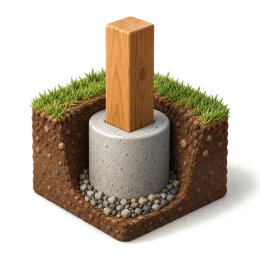
Key numbers
- Formula: π × (hole dia ÷ 2)² × depth − post area × depth
- 4×4 post, 10 × 24 in hole: 0.92 ft³ = 1.5 × 80 lb bags
- 6×6 post, 12 × 36 in hole: 1.73 ft³ = 2.9 × 80 lb bags
- 100 ft fence, posts 8 ft apart: 14 posts = 22 × 80 lb bags
- QUIKRETE Concrete Mix yields: 80 lb ≈ 0.60 ft³, 60 lb ≈ 0.45, 50 lb ≈ 0.375, 40 lb ≈ 0.30; 90 lb (regional) ≈ 0.675. Other brands differ; check your bag
On this page
- How to use the Fence Post Concrete Calculator
- How do you calculate concrete for a fence post?
- How many bags of concrete per fence post?
- Post hole volume: how much does an empty hole hold?
- How many bags for chain link and round metal posts?
- How deep should a fence post hole be?
- How wide should a fence post hole be?
- Gate posts, corner posts and end posts
- How many bags of concrete for a whole fence?
- Gravel in the bottom of a post hole
- Metric post holes: litres and bags
- Flagpoles, light poles and mailbox posts
- Deck post and mailbox post holes: bags per hole
- Fast-setting or regular concrete for fence posts?
- Common mistakes when estimating fence post concrete
- Fence post calculator vs related calculators: which one to use
- Frequently asked questions
How to use the Fence Post Concrete Calculator
- 1Pick your unitsEvery dimension has its own unit menu (in, ft, yd, cm or m); changing one converts that number so the size stays the same. The US / Metric switch sets all fields to feet and inches or meters and centimeters and resets them to typical values.
- 2Enter the dimensionsType the hole diameter (default inches), hole depth (default inches), post size (square) (default inches) or number of posts. Measure the inside of the forms and the depth in several places.
- 3Set waste and quantityUse the waste slider (0 to 20%, default 10%) and allow more on uneven ground. If you have several identical pours, enter how many.
- 4Read the resultsSee the volume in cubic yards, cubic feet and cubic meters, the ready-mix order rounded up to ¼ yard, the number of 90, 80, 60, 50 and 40 lb bags rounded up, and the weight at the density you choose (150, 145 or 140 lb/ft³).
- 5Price it and save itPick a pricing basis (per cubic yard, per cubic meter or per bag of the highlighted size) and enter your local price for a material cost. Use Add to project to total several pours, and Copy link to share the exact result.
Results update as you type. Back to the calculator ↑
How do you calculate concrete for a fence post?
Work out the volume of the round hole, then subtract the part the post fills. What is left is the concrete. The calculator does this for any number of posts.
Concrete (ft³) = π × (hole diameter ÷ 2)² × depth − post width × post width × depth
Use the post’s actual size, not its name. A 4×4 is 3.5 × 3.5 in and a 6×6 is 5.5 × 5.5 in. Then divide by the bag yield: about 0.60 ft³ for an 80 lb bag, 0.45 ft³ for 60 lb, 0.375 ft³ for 50 lb and 0.30 ft³ for 40 lb. These are the yields on the QUIKRETE Concrete Mix data sheet; other mixes can differ, so check the bag you buy.
Measure the hole at its widest point, because post-hole diggers and augers often cut wider than their nominal size. Enter only the depth that will be concrete: if you put gravel in the bottom, subtract it. Enter 0 for the post size when you want the full hole volume, for example when the post goes in a sleeve or on a bracket later.
Worked example: 10 posts, 4×4, 10 in × 24 in holes
- Hole: π × (5 ÷ 12)² × 2 = 1.09 ft³
- Post: (3.5 ÷ 12)² × 2 = 0.17 ft³
- Concrete per post: 0.92 ft³ (26 litres)
- 10 posts: 9.21 ft³ → 16 × 80 lb bags, 21 × 60 lb or 25 × 50 lb
How many bags of concrete per fence post?
For a typical 4×4 fence post, plan on 1 to 3 bags of 80 lb concrete. The table gives bags per post for common hole sizes. Bag counts are exact fractions; round up the total for the whole fence, not each post.
| Post | Hole (dia × depth) | Concrete per post | 80 lb bags | 60 lb bags | 50 lb bags | 40 lb bags |
|---|---|---|---|---|---|---|
| 4×4 | 8 × 24 in | 0.53 ft³ (15 L) | 0.88 | 1.17 | 1.41 | 1.76 |
| 4×4 | 8 × 36 in | 0.79 ft³ (22 L) | 1.32 | 1.76 | 2.11 | 2.64 |
| 4×4 | 10 × 24 in | 0.92 ft³ (26 L) | 1.53 | 2.05 | 2.46 | 3.07 |
| 4×4 | 10 × 30 in | 1.15 ft³ (33 L) | 1.92 | 2.56 | 3.07 | 3.84 |
| 4×4 | 10 × 36 in | 1.38 ft³ (39 L) | 2.30 | 3.07 | 3.68 | 4.60 |
| 4×4 | 12 × 24 in | 1.40 ft³ (40 L) | 2.33 | 3.11 | 3.74 | 4.67 |
| 4×4 | 12 × 36 in | 2.10 ft³ (60 L) | 3.50 | 4.67 | 5.60 | 7.00 |
| 4×6 | 12 × 36 in | 1.96 ft³ (55 L) | 3.26 | 4.34 | 5.21 | 6.52 |
| 6×6 | 12 × 30 in | 1.44 ft³ (41 L) | 2.40 | 3.20 | 3.84 | 4.79 |
| 6×6 | 12 × 36 in | 1.73 ft³ (49 L) | 2.88 | 3.84 | 4.60 | 5.75 |
| 6×6 | 14 × 36 in | 2.58 ft³ (73 L) | 4.29 | 5.73 | 6.87 | 8.59 |
For 10 posts, multiply and round up once: 10 4×4 posts in 10 × 30 in holes need 11.51 ft³, which is 20 × 80 lb or 31 × 50 lb bags. A mailbox post is the same math at small scale: a 4×4 in an 8 × 24 in hole takes 0.53 ft³, so one 80 lb bag or two 50 lb bags.
Post hole volume: how much does an empty hole hold?
Use the full hole volume when you pour a footing first and fix a post bracket on top, set the post in a sleeve, or want to know how much soil will come out. It is π × radius² × depth, with no post subtracted.
| Hole diameter | 18 in deep | 24 in deep | 30 in deep | 36 in deep | 42 in deep | 48 in deep |
|---|---|---|---|---|---|---|
| 6 in | 0.29 ft³ (8 L) | 0.39 ft³ (11 L) | 0.49 ft³ (14 L) | 0.59 ft³ (17 L) | 0.69 ft³ (19 L) | 0.79 ft³ (22 L) |
| 8 in | 0.52 ft³ (15 L) | 0.70 ft³ (20 L) | 0.87 ft³ (25 L) | 1.05 ft³ (30 L) | 1.22 ft³ (35 L) | 1.40 ft³ (40 L) |
| 10 in | 0.82 ft³ (23 L) | 1.09 ft³ (31 L) | 1.36 ft³ (39 L) | 1.64 ft³ (46 L) | 1.91 ft³ (54 L) | 2.18 ft³ (62 L) |
| 12 in | 1.18 ft³ (33 L) | 1.57 ft³ (44 L) | 1.96 ft³ (56 L) | 2.36 ft³ (67 L) | 2.75 ft³ (78 L) | 3.14 ft³ (89 L) |
Two patterns are worth remembering. Depth scales the volume in a straight line, so 36 in holds exactly 1.5 times what 24 in holds. Diameter scales it by the square, so a 12 in hole holds 1.44 times what a 10 in hole holds at the same depth. An oversized auger bit costs more concrete than a few extra inches of depth.
How many bags for chain link and round metal posts?
Round posts fill less of the hole than a square 4×4, so the concrete per hole is a little higher. Subtract the post as a circle: π × (post diameter ÷ 2)² × depth. Round chain link posts come in several diameters, and terminal posts (ends, corners, gates) are usually larger than line posts. Measure your posts or check the sizes in your fence kit; the diameters below are examples.
| Example round post (OD) | 8 × 24 in hole | 10 × 30 in hole | 12 × 36 in hole |
|---|---|---|---|
| 1⅝ in | 0.67 ft³ · 1.12 × 80 lb | 1.33 ft³ · 2.21 × 80 lb | 2.31 ft³ · 3.85 × 80 lb |
| 1⅞ in | 0.66 ft³ · 1.10 × 80 lb | 1.32 ft³ · 2.19 × 80 lb | 2.30 ft³ · 3.83 × 80 lb |
| 2⅜ in | 0.64 ft³ · 1.06 × 80 lb | 1.29 ft³ · 2.14 × 80 lb | 2.26 ft³ · 3.77 × 80 lb |
| 2⅞ in | 0.61 ft³ · 1.01 × 80 lb | 1.25 ft³ · 2.08 × 80 lb | 2.22 ft³ · 3.70 × 80 lb |
| 4 in | 0.52 ft³ · 0.87 × 80 lb | 1.15 ft³ · 1.91 × 80 lb | 2.09 ft³ · 3.49 × 80 lb |
The post size barely matters here: in a 10 × 30 in hole, the difference between a 1⅝ and a 2⅞ in post is 0.08 ft³, about an eighth of an 80 lb bag. The hole size decides the order. The calculator takes a square post size, so for a round post enter 0.89 × its diameter (a square with the same area): 2.1 in for a 2⅜ in post. For thin posts you can also enter 0; in a 10 × 30 in hole that overstates a 1⅝ in post by about 3%.
How deep should a fence post hole be?
A common rule of thumb is to bury one-third to one-half of the post’s height above ground. QUIKRETE’s post-setting instructions put it as a hole one-third of the post’s overall length plus 6 in for a gravel base. In cold climates, the deciding number is your local frost depth: the bottom of the concrete should sit below it so freezing soil cannot lift the post. Your building department can tell you that depth, and some towns have fence rules of their own.
| Fence height above ground | Hole depth (⅓ to ½ rule) | Post length to buy |
|---|---|---|
| 3 ft | 12 to 18 in | 4 to 4.5 ft |
| 4 ft | 16 to 24 in | 5.33 to 6 ft |
| 5 ft | 20 to 30 in | 6.67 to 7.5 ft |
| 6 ft | 24 to 36 in | 8 to 9 ft |
| 8 ft | 32 to 48 in | 10.67 to 12 ft |
Posts come in set lengths, so the depth often ends up as the post length you can buy minus the fence height. A 6 ft privacy fence on 8 ft posts gets 24 in holes; on 10 ft posts it can go 36 to 48 in. Solid fences catch more wind than open picket or chain link, which is one reason builders choose the deep end of the range for them.
How wide should a fence post hole be?
QUIKRETE’s post-setting instructions call for a hole about three times the post width (check your post or fence maker’s instructions too): 10 to 12 in for a 4×4 and around 16 in for a 6×6. A wider hole puts more concrete around the post but uses bags quickly. For a 4×4 at 24 in deep, going from a 10 in to a 12 in hole adds 0.48 ft³ per post. On a 14-post fence that is 11.2 extra 80 lb bags.
Measure the hole you dug, not the auger label. If the sides caved in or the bottom flares out, use the widest diameter, or split the hole into two parts and add them. A 10 in hole that bells out to 14 in for its last 6 in holds 0.26 ft³ more than a straight hole, almost half an 80 lb bag.
Gate posts, corner posts and end posts
Gate posts carry the swinging weight of the gate, and corner and end posts take the pull of the whole run, so builders usually give them wider, deeper holes and often a larger post. Calculate them as a separate line in the calculator and use Add to project so line posts and heavy posts total together.
- 6×6 gate post, 14 × 42 in hole: 3.01 ft³ = 5.01 × 80 lb or 8.02 × 50 lb bags.
- 4×4 gate post, 12 × 36 in hole: 2.10 ft³ = 3.5 × 80 lb bags.
- 6×6 corner post, 12 × 36 in hole: 1.73 ft³ = 2.88 × 80 lb bags.
Gate post depth follows the same frost and height logic as the other posts. Gate kits and hinge hardware usually list the post size and opening width they are designed for, so check them before you dig.
How many bags of concrete for a whole fence?
Count the posts first. A straight run has one more post than it has sections: posts = run length ÷ spacing, rounded up, plus 1. Then multiply by the concrete per post and round up once. The table assumes 4×4 posts in 10 × 24 in holes.
| Fence length | Post spacing | Posts | Concrete | 80 lb bags | 50 lb bags | 80 lb bags +10% |
|---|---|---|---|---|---|---|
| 50 ft | 8 ft | 8 | 7.37 ft³ | 13 | 20 | 14 |
| 50 ft | 6 ft | 10 | 9.21 ft³ | 16 | 25 | 17 |
| 100 ft | 8 ft | 14 | 12.89 ft³ | 22 | 35 | 24 |
| 100 ft | 6 ft | 18 | 16.57 ft³ | 28 | 45 | 31 |
| 150 ft | 8 ft | 20 | 18.41 ft³ | 31 | 50 | 34 |
| 200 ft | 8 ft | 26 | 23.94 ft³ | 40 | 64 | 44 |
| 300 ft | 8 ft | 39 | 35.91 ft³ | 60 | 96 | 66 |
Corners and gate openings change the count, so draw the fence and count posts on the sketch rather than relying on the formula alone.
Worked example: 100 ft privacy fence with a double gate
- 12 line posts, 4×4, in 10 × 30 in holes: 12 × 1.15 = 13.81 ft³
- 2 gate posts, 6×6, in 12 × 36 in holes: 2 × 1.73 = 3.45 ft³
- Total: 17.26 ft³ (0.64 yd³) → 29 × 80 lb or 47 × 50 lb bags
- With 10% extra for wide holes: 32 × 80 lb or 51 × 50 lb
- 29 × 80 lb bags weigh 2,320 lb (32 bags with 10% extra: 2,560 lb), so plan the trips if you haul it yourself
Gravel in the bottom of a post hole
Many builders put a few inches of gravel in the bottom of the hole so water can drain away from the end of the post. It is common practice rather than a rule, and some prefer the concrete to reach the bottom. If you use gravel, it takes the place of concrete, so enter only the concrete depth.
For a 10 in hole, 4 in of gravel is 0.18 ft³. On 14 posts that is 2.55 ft³ of gravel, a few bags’ worth. The concrete for a 4×4 in the 20 in above it is 0.77 ft³, or 1.28 × 80 lb bags per post. For a gravel strip or path along the fence, use the gravel calculator.
Metric post holes: litres and bags
Outside the US, posts and holes are usually given in millimetres. The math is the same: π × (hole diameter in m ÷ 2)² × depth, minus post width² × depth, gives m³; multiply by 1,000 for litres. An 80 lb bag yields about 17 litres, so divide litres by 17 for 80 lb bags.
- 90 mm post, 250 mm hole, 600 mm deep: 24.6 litres = 1.45 × 80 lb or 2.32 × 50 lb bags.
- 100 mm post, 300 mm hole, 900 mm deep: 54.6 litres = 3.21 × 80 lb or 5.14 × 50 lb bags.
Bags sold by the kilogram print their own yield; divide your litres by that figure. The calculator accepts metric inputs and shows litres and m³ next to the bag counts.
Flagpoles, light poles and mailbox posts
A pole base is a post hole with a bigger hole and a round post. Flagpole and light pole makers usually publish a base drawing with the hole diameter, depth and any ground sleeve; use their numbers, because the wind load on a tall pole is far higher than on a fence post.
As worked examples of the math: a 4 in round pole in an 18 in hole 48 in deep needs 6.72 ft³, so buy 12 × 80 lb or 18 × 50 lb bags. A 6 in pole in a 24 in hole 48 in deep needs 11.78 ft³, which is 20 × 80 lb bags; at that size, see how bags compare with a yard of ready-mix on the bags of concrete per yard page.
Deck post and mailbox post holes: bags per hole
This page works as a post hole concrete calculator for any square post set straight in the ground: deck posts, mailbox posts, pergola and sign posts. The math is the same as a fence post; only the hole is usually deeper. The table uses actual post sizes (a 4×4 is 3.5 in, a 6×6 is 5.5 in) and subtracts the post from the hole.
| Post | Hole diameter | Hole depth | Concrete (ft³) | Litres | 80 lb bags | 60 lb bags | 50 lb bags | 80 lb bags for 10 posts |
|---|---|---|---|---|---|---|---|---|
| 4×4 | 10 in | 36 in | 1.38 | 39.1 | 2.30 | 3.07 | 3.68 | 24 |
| 4×4 | 10 in | 42 in | 1.61 | 45.6 | 2.69 | 3.58 | 4.30 | 27 |
| 4×4 | 10 in | 48 in | 1.84 | 52.1 | 3.07 | 4.09 | 4.91 | 31 |
| 4×4 | 12 in | 36 in | 2.10 | 59.5 | 3.50 | 4.67 | 5.60 | 36 |
| 4×4 | 12 in | 42 in | 2.45 | 69.4 | 4.09 | 5.45 | 6.54 | 41 |
| 4×4 | 12 in | 48 in | 2.80 | 79.3 | 4.67 | 6.23 | 7.47 | 47 |
| 6×6 | 10 in | 36 in | 1.01 | 28.5 | 1.68 | 2.24 | 2.68 | 17 |
| 6×6 | 10 in | 42 in | 1.17 | 33.2 | 1.96 | 2.61 | 3.13 | 20 |
| 6×6 | 10 in | 48 in | 1.34 | 38.0 | 2.24 | 2.98 | 3.58 | 23 |
| 6×6 | 12 in | 36 in | 1.73 | 48.9 | 2.88 | 3.84 | 4.60 | 29 |
| 6×6 | 12 in | 42 in | 2.01 | 57.0 | 3.36 | 4.47 | 5.37 | 34 |
| 6×6 | 12 in | 48 in | 2.30 | 65.2 | 3.84 | 5.11 | 6.14 | 39 |
Bag counts use QUIKRETE Concrete Mix yields (80 lb ≈ 0.60 ft³, 60 lb ≈ 0.45, 50 lb ≈ 0.375) with no extra; the 10-post column is rounded up once for the whole job. A 6×6 in a 10 in hole leaves little more than 2 in of concrete around the post, and QUIKRETE’s post-setting sheet suggests a hole about three times the post width, so check your plans before choosing the narrow hole.
- Mailbox post. A single 4×4 in a 10 × 24 in hole needs 0.92 ft³: two 80 lb bags, or three 50 lb bags. Your postal service and town may set the height and setback; the hole is up to you.
- Deck posts. Where a deck post is set in concrete, the hole size and depth (often below the frost line) come from your deck plans and local code. If the plan calls for a pier with the post on top, use the Sonotube calculator instead.
Fast-setting or regular concrete for fence posts?
Both work. For a fence the choice is about labor and time more than strength.
- Fast-setting post mixes come in their own bag sizes and yields; QUIKRETE’s post-setting instructions are written around its 50 lb Fast-Setting bag, but check the bag you buy. You set the post, pour the dry mix in the hole and add water. Follow the bag directions for water and set time, and use the yield printed on that bag, which can differ from regular concrete mix.
- Regular concrete mix in 60 or 80 lb bags is mixed with water first, in a wheelbarrow or mixer, then shoveled in. It gives more concrete per bag carried, which matters on long fences. QUIKRETE lists post footings among the uses for its Concrete Mix.
For brand-specific bag sizes see the Quikrete calculator and the Sakrete calculator. Mixing your own from cement, sand and stone, including what the “4-2-1” rule means, is covered on the concrete mix ratio calculator.
Common mistakes when estimating fence post concrete
- Rounding each post up. 14 posts at 1.53 × 80 lb bags each need 22 bags for the job; buying 2 per post means 28 bags and 6 left over.
- Using the auger size instead of the dug hole. A 4×4 hole dug 12 in wide instead of 10 in uses 0.48 ft³ more concrete. Across 14 posts that is 11 more 80 lb bags than planned.
- Using the nominal post size. A 6×6 is 5.5 in. Entering 6 in subtracts 0.12 ft³ too much from a 12 × 36 in hole, and entering 0 adds the whole 0.63 ft³ post back.
- Forgetting the gravel layer. 4 in of gravel in a 10 in hole is 0.18 ft³ that does not need concrete.
- Counting posts from length alone. Each corner and each gate opening adds a post that a straight-run formula misses.
- Treating 50 lb bags like 80 lb bags. A 10 × 24 in 4×4 hole takes 1.53 × 80 lb but 2.46 × 50 lb bags of regular Concrete Mix; fast-setting mixes print their own yield, so use the figure on that bag.
Fence post calculator vs related calculators: which one to use
Use this page for a post set in a dug, unformed hole, where the post takes up part of the concrete and its volume is subtracted. Use the Sonotube page for a formed round pier or column, above or below grade, with no post in the concrete. Switch when the job changes shape:
- Deck piers and cardboard form tubes (8, 10 or 12 in × 48 in and similar), with the post on a bracket on top: the Sonotube calculator gives volume per foot of tube.
- Square pads, wall footings and footers: the concrete footing calculator.
- You already know the cubic feet and need a bag count: the concrete bag calculator.
- Comparing 40, 60 and 80 lb bags per yard for a big fence: the bags of concrete per yard page.
Before you dig any hole, call your utility locate service, and check your property line and any fence rules with your town.
FAQ
Frequently asked questions
How many bags of concrete do I need for a 4x4 fence post?
In a 10 in diameter hole 24 in deep, a 4×4 post needs 0.92 ft³: 1.5 bags of 80 lb, 2 bags of 60 lb or 2.5 bags of 50 lb. In a 10 × 30 in hole it needs 1.92 × 80 lb bags.
How many 50 lb bags of concrete do I need for a fence post?
About 2.5 bags of 50 lb concrete for a 4×4 post in a 10 × 24 in hole (0.92 ft³). A deeper 10 × 36 in hole needs 3.7 bags, and a 6×6 post in a 12 × 36 in hole needs 4.6 bags.
How many 80 lb bags of concrete per fence post?
Between 1 and 3 for most fences. A 4×4 post needs 0.9 bags in an 8 × 24 in hole, 1.5 in a 10 × 24 in hole and 2.3 in a 12 × 24 in hole. A 6×6 post in a 12 × 36 in hole needs 2.9 bags.
How many 60 lb bags of concrete per fence post?
About 2 bags of 60 lb concrete for a 4×4 post in a 10 × 24 in hole (2.05 bags exactly). An 8 × 24 in hole needs 1.17 bags, and a 6×6 post in a 12 × 36 in hole needs 3.84 bags.
How much concrete is needed for a 6x6 post?
A 6×6 post (5.5 in actual) in a 12 in diameter hole 36 in deep needs 1.73 ft³ of concrete. That is 2.9 bags of 80 lb, 3.8 of 60 lb or 4.6 of 50 lb per post.
How many bags of concrete for a 4x4 deck post?
In a 12 in hole 42 in deep, a 4×4 deck post needs 2.45 ft³: 4.09 bags of 80 lb concrete or 6.54 bags of 50 lb, so buy 5 × 80 lb per post. In a 10 × 36 in hole it needs 2.3 × 80 lb bags. Hole size and depth come from your deck plans.
Is 2 ft deep enough for fence posts?
A common rule is to bury one-third to one-half of the post height above ground, so 2 ft suits a fence about 4 to 6 ft tall. Where the ground freezes, go below your local frost depth and check any local rules for fences.
How deep should a post hole be for a 6 ft fence?
By the one-third to one-half rule, 24 to 36 in, which means buying 8 to 9 ft posts. Go deeper if your local frost depth is below that, and give gate and corner posts the deepest holes on the run.
How wide should a fence post hole be?
QUIKRETE's post-setting instructions call for a hole about three times the post width. For a 4×4 (3.5 in actual) that is a 10 to 12 in hole. Going from 10 to 12 in adds 0.48 ft³ per 24 in deep hole, about 0.8 of an 80 lb bag.
How many bags of concrete for a chain link fence post?
A 2⅜ in round chain link post in a 10 in hole 30 in deep needs about 1.29 ft³: 2.1 bags of 80 lb or 3.4 bags of 50 lb. Gate and corner posts often get larger, deeper holes.
How many bags of concrete for a 100 ft fence?
With posts every 8 ft, a straight 100 ft run has 14 posts. In 10 × 24 in holes with 4×4 posts that is 12.89 ft³: 22 × 80 lb or 35 × 50 lb bags, or 24 × 80 lb with 10% extra.
How many bags of concrete for 25 fence posts?
25 4×4 posts in 10 × 24 in holes need 23 ft³ (0.85 yd³): 39 bags of 80 lb or 62 bags of 50 lb, and 43 × 80 lb bags with 10% extra.
How much concrete for a gate post?
A 6×6 gate post in a 14 in hole 42 in deep needs 3.01 ft³: 5.01 bags of 80 lb or 8.02 of 50 lb, so buy 6 × 80 lb or 9 × 50 lb for that post alone. A 4×4 gate post in a 12 × 36 in hole needs 2.10 ft³, or 3.5 × 80 lb bags.
Should I put gravel in the bottom of a fence post hole?
Many builders add a few inches of gravel for drainage. It replaces concrete, so subtract it from the depth: 4 in of gravel in a 10 in hole is 0.18 ft³, and a 4×4 in the 20 in of concrete above it needs 1.28 × 80 lb bags.
How much concrete per post hole in litres?
A 90 mm post in a 250 mm hole 600 mm deep takes about 24.6 litres of concrete. A 100 mm post in a 300 mm hole 900 mm deep takes about 54.6 litres, roughly 3.2 bags of 80 lb mix.
How much concrete for a flagpole or light pole base?
The pole maker's base drawing sets the hole size, so use theirs. As a worked example, a 4 in round pole in an 18 in hole 48 in deep takes 6.72 ft³ of concrete: buy 12 × 80 lb or 18 × 50 lb bags.
2 Sources
Last reviewed October 9, 2026 by M Bilal. Found an error? Tell us.