


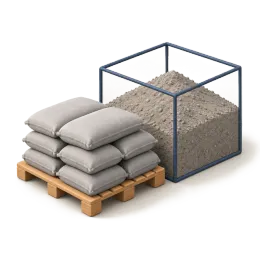
Key numbers
- 1 yd³ = 27 ft³ = 45 × 80 lb bags
- 80 lb bag = 0.60 ft³ = 0.022 yd³ (17 L)
- 1 m³ = 59 × 80 lb or 79 × 60 lb bags
- 3,600 lb of dry mix per yard, whatever the bag size
On this page
- How to use the Bags of Concrete per Yard
- How many bags of concrete make a cubic yard?
- Bags of concrete for 1 to 5 yards
- How many yards do my bags make?
- How many yards is one bag of concrete?
- How much extra should you add per yard?
- How much area does one yard of concrete cover?
- How many bags in a cubic meter?
- Why do bag-per-yard numbers differ between sources?
- How much does a yard of concrete weigh?
- Bags or yards: the same slab both ways
- Common mistakes when converting yards to bags
- Bags per yard vs related calculators: which one to use
- When do bags stop making sense?
- Frequently asked questions
How to use the Bags of Concrete per Yard
- 1Enter your numbersFill in concrete needed (yd³).
- 2Check the assumptionsYields (QUIKRETE Concrete Mix data sheet): 90 lb = 0.675 ft³, 80 lb = 0.60 ft³, 60 lb = 0.45 ft³, 50 lb = 0.375 ft³, 40 lb = 0.30 ft³. Bags are rounded up.
- 3Read the resultsThe calculator shows 80 lb bags, 90 lb bags, 60 lb bags, 50 lb bags or 40 lb bags, updated as you type.
- 4Use the resultRound up to what your supplier sells, and keep a little extra for waste.
Results update as you type. Back to the calculator ↑
How many bags of concrete make a cubic yard?
A cubic yard takes 45 bags of 80 lb concrete. A yard is 3 × 3 × 3 ft, or 27 ft³, and each 80 lb bag of standard premix yields about 0.60 ft³ once mixed with water.
Bags per yard = 27 ÷ yield per bag (ft³)
Smaller bags yield less, so you need more of them. The total dry weight stays the same: 3,600 lb per cubic yard for every bag size.
| Bag size | Yield per bag | Yards per bag | Bags per cubic yard | Bags per cubic meter |
|---|---|---|---|---|
| 80 lb (36.3 kg) | 0.60 ft³ (17 L) | 0.022 | 45 | 59 |
| 60 lb (27.2 kg) | 0.45 ft³ (12.7 L) | 0.017 | 60 | 79 |
| 50 lb (22.7 kg) | 0.375 ft³ (10.6 L) | 0.014 | 72 | 95 |
| 40 lb (18.1 kg) | 0.30 ft³ (8.5 L) | 0.011 | 90 | 118 |
Yields are from the QUIKRETE Concrete Mix data sheet. Sakrete High-Strength Concrete Mix lists the same 0.30, 0.45 and 0.60 ft³ for its 40, 60 and 80 lb bags, but it has no 50 lb size and its 90 lb bag yields 0.66 ft³. Sizes and yields vary by brand, so always check the yield printed on your bag.
Bags of concrete for 1 to 5 yards
Use this chart when you already know the volume, for example from the concrete yards calculator. These are exact counts; add 10% for waste.
| Volume | Cubic feet | 80 lb bags | 60 lb bags | 50 lb bags | 40 lb bags | Dry mix (80 lb bags) |
|---|---|---|---|---|---|---|
| ¼ yd³ | 6.75 | 12 | 15 | 18 | 23 | 960 lb |
| ½ yd³ | 13.5 | 23 | 30 | 36 | 45 | 1,840 lb |
| ¾ yd³ | 20.25 | 34 | 45 | 54 | 68 | 2,720 lb |
| 1 yd³ | 27 | 45 | 60 | 72 | 90 | 3,600 lb |
| 1½ yd³ | 40.5 | 68 | 90 | 108 | 135 | 5,440 lb |
| 2 yd³ | 54 | 90 | 120 | 144 | 180 | 7,200 lb |
| 3 yd³ | 81 | 135 | 180 | 216 | 270 | 10,800 lb |
| 4 yd³ | 108 | 180 | 240 | 288 | 360 | 14,400 lb |
| 5 yd³ | 135 | 225 | 300 | 360 | 450 | 18,000 lb |
Bags per yard with waste included
The chart above gives exact counts. Most pours need about 10% extra for spillage, an uneven base and form bulge, so the numbers to buy are higher. Work out the exact figure, add 10%, then round once:
- ½ yd³: 25 × 80 lb, 33 × 60 lb or 50 × 40 lb bags.
- 1 yd³: 50 × 80 lb, 66 × 60 lb, 80 × 50 lb or 99 × 40 lb bags.
- 2 yd³: 99 × 80 lb or 132 × 60 lb bags.
- 3 yd³: 149 × 80 lb or 198 × 60 lb bags.
- 5 yd³: 248 × 80 lb or 330 × 60 lb bags.
Water adds up quickly too. The QUIKRETE Concrete Mix data sheet says to start with about 6 pints (2.8 L) of water per 80 lb bag and allows up to 9 pints (4.3 L), so the 45 bags in one cubic yard need about 33.75 to 50.6 gallons (128 to 192 L) of clean water. Have a hose or several full containers on site before you open the first bag.
Bags for 6 to 10 yards
Larger volumes come up when people price a driveway or a garage slab in bags before calling a plant. Exact counts, then counts with 10% extra:
| Volume | Cubic feet | 80 lb bags / +10% | 60 lb bags / +10% | 40 lb bags / +10% | Dry mix |
|---|---|---|---|---|---|
| 6 yd³ | 162 | 270 / 297 | 360 / 396 | 540 / 594 | 21,600 lb |
| 7 yd³ | 189 | 315 / 347 | 420 / 462 | 630 / 693 | 25,200 lb |
| 8 yd³ | 216 | 360 / 396 | 480 / 528 | 720 / 792 | 28,800 lb |
| 10 yd³ | 270 | 450 / 495 | 600 / 660 | 900 / 990 | 36,000 lb |
Ten yards in bags is 18 tons of dry mix, mixed one or two bags at a time. At these volumes the bag count is useful mainly as a cost comparison against a ready-mix quote, not as a plan.
Worked example: 10 × 20 ft slab, 4 in thick
- 10 × 20 × 4 ÷ 324 = 2.47 yd³ (66.7 ft³)
- 66.7 ÷ 0.60 = 111.1 → 112 × 80 lb bags
- Add 10%: 123 bags, nearly 10,000 lb of dry mix. Get a ready-mix quote before you buy.
How many yards do my bags make?
Work backwards when you already have bags on hand or a pallet in mind (bags per pallet: 42 of 80 lb, about 0.93 yd³): multiply the number of bags by the yield and divide by 27. For 80 lb bags at 0.60 ft³ each:
| 80 lb bags | Cubic feet | Cubic yards | Cubic metres | Area at 4 in thick |
|---|---|---|---|---|
| 10 | 6 | 0.22 | 0.17 | 18 ft² |
| 20 | 12 | 0.44 | 0.34 | 36 ft² |
| 30 | 18 | 0.67 | 0.51 | 54 ft² |
| 40 | 24 | 0.89 | 0.68 | 72 ft² |
| 50 | 30 | 1.11 | 0.85 | 90 ft² |
| 60 | 36 | 1.33 | 1.02 | 108 ft² |
| 80 | 48 | 1.78 | 1.36 | 144 ft² |
| 100 | 60 | 2.22 | 1.70 | 180 ft² |
For 60 lb bags, multiply the count by 0.45 instead: 30 bags make 13.5 ft³ (half a yard) and 60 bags make exactly one yard. The area column already uses the exact volume, so take your 10% waste off it: 50 × 80 lb bags reliably cover about 81 ft² at 4 in, not 90.
How many yards is one bag of concrete?
One 80 lb bag is about 0.022 cubic yards, a little over 1/45 of a yard (see how many cubic feet are in an 80 lb bag of concrete for every bag size in ft³ and litres). That is why bag counts climb fast: a 12 × 12 ft patio at 4 in is 1.78 yd³ and takes 80 bags.
Coverage per bag at common thicknesses:
| Bag size | At 2 in | At 3 in | At 4 in | At 10 cm (metric) |
|---|---|---|---|---|
| 80 lb | 3.6 ft² | 2.4 ft² | 1.8 ft² | 0.17 m² |
| 60 lb | 2.7 ft² | 1.8 ft² | 1.35 ft² | 0.127 m² |
| 50 lb | 2.25 ft² | 1.5 ft² | 1.13 ft² | 0.106 m² |
| 40 lb | 1.8 ft² | 1.2 ft² | 0.9 ft² | 0.085 m² |
So 25 bags of 80 lb concrete make 15 ft³ (0.56 yd³), enough for about 45 ft² at 4 in thick.
How much extra should you add per yard?
10% is the default on this site, but the right allowance depends on your forms and base. Here is one cubic yard at four waste levels, rounded up after adding the extra:
| Waste allowance | 90 lb bags | 80 lb bags | 60 lb bags | 50 lb bags | 40 lb bags |
|---|---|---|---|---|---|
| 0% (exact) | 40 | 45 | 60 | 72 | 90 |
| 5% | 42 | 48 | 63 | 76 | 95 |
| 10% | 44 | 50 | 66 | 80 | 99 |
| 15% | 46 | 52 | 69 | 83 | 104 |
- 5% suits rigid forms on a compacted, level base that you have checked with a string line.
- 10% covers the usual mix of spillage, small low spots and forms that bow slightly.
- 15% makes sense for an uneven or soft base, a pour into an irregular excavation, or holes dug by hand where the sides are not straight.
Apply the allowance to the total volume, not to each yard separately. For 3 yd³ at 10%, 81 ft³ × 1.1 = 89.1 ft³, which is 149 × 80 lb bags. Taking the rounded 50 bags per yard and multiplying by 3 gives 150, one bag more; on a 5 yd³ pour the gap grows to 2 bags (248 against 250). Small, but it is money spent on bags that go back to the store or harden in the garage.
The 90 lb column uses the 0.675 ft³ yield from the QUIKRETE Concrete Mix data sheet; that size is sold only in some regions.
How much area does one yard of concrete cover?
Divide 324 by the thickness in inches to get square feet per cubic yard. Thicker slabs eat yards quickly:
| Thickness | Area per cubic yard | Area per cubic yard (metric) | 80 lb bags per yard |
|---|---|---|---|
| 2 in | 162 ft² | 15.05 m² | 45 |
| 3 in | 108 ft² | 10.03 m² | 45 |
| 4 in | 81 ft² | 7.53 m² | 45 |
| 5 in | 64.8 ft² | 6.02 m² | 45 |
| 6 in | 54 ft² | 5.02 m² | 45 |
| 8 in | 40.5 ft² | 3.76 m² | 45 |
The bag count per yard never changes; the area does. So if you know your area and thickness, the quickest route is area ÷ (324 ÷ thickness) = yards, then yards × 45 = 80 lb bags. A 9 × 9 ft pad at 4 in is 81 ft², exactly one yard and 45 bags.
How many bags in a cubic meter?
A cubic meter (35.31 ft³) takes 59 × 80 lb bags, 79 × 60 lb, 95 × 50 lb or 118 × 40 lb. A 1 × 1 m pad 10 cm thick is 0.1 m³ and needs 6 × 80 lb bags; a 5 × 5 m slab at 10 cm (2.5 m³) needs 148. Bags sold in kilograms carry their own yield on the label, so divide your volume by that figure.
Per square metre, the count depends on thickness: 3 × 80 lb bags at 5 cm, 5 at 7.5 cm, 6 at 10 cm and 9 at 15 cm. With 60 lb bags the same square metre takes 4, 6, 8 and 12. Multiply by your area and add 10% before rounding.
For metric plans, this chart converts cubic metres straight to bags. A cubic metre is 1.308 cubic yards, so each row needs about 31% more bags than the same number of yards.
| Volume | Cubic feet | Cubic yards | 80 lb bags | 80 lb bags +10% | 60 lb bags | 40 lb bags |
|---|---|---|---|---|---|---|
| 0.25 m³ | 8.83 | 0.33 | 15 | 17 | 20 | 30 |
| 0.5 m³ | 17.66 | 0.65 | 30 | 33 | 40 | 59 |
| 1 m³ | 35.31 | 1.31 | 59 | 65 | 79 | 118 |
| 2 m³ | 70.63 | 2.62 | 118 | 130 | 157 | 236 |
| 3 m³ | 105.94 | 3.92 | 177 | 195 | 236 | 354 |
Why do bag-per-yard numbers differ between sources?
Because they assume different yields, not because the math changes. Every chart divides 27 ft³ by a yield per bag; change the yield and the answer moves. For an 80 lb bag:
| Yield assumed per 80 lb bag | Bags per cubic yard (exact) | Bags to buy |
|---|---|---|
| 0.55 ft³ | 49.1 | 50 |
| 0.58 ft³ | 46.6 | 47 |
| 0.60 ft³ | 45 | 45 |
| 0.62 ft³ | 43.5 | 44 |
| 0.65 ft³ | 41.5 | 42 |
This page uses 0.60 ft³ because that is the figure on the QUIKRETE Concrete Mix data sheet. If a chart tells you 40 bags per yard, check whether it is quoting 90 lb bags (40 × 0.675 ft³ = 27 ft³) rather than 80 lb. The reliable source for your pour is the yield printed on the bag you buy: divide 27 by it and round up.
How much does a yard of concrete weigh?
The dry mix for one cubic yard weighs 3,600 lb, whether you buy 45 × 80 lb or 90 × 40 lb bags. Mixed concrete is heavier because of the water. This site assumes 150 lb/ft³ for normal-weight concrete, about 4,050 lb per yard; QUIKRETE gives about 140 lb/ft³ for its bagged mix.
That weight matters twice on a home project: once lifting bags off the truck, and again with the wheelbarrow. A 3 yd³ pour in bags means moving over five tons of dry mix by hand.
Worked example: 12 × 12 ft slab, 6 in thick
- 12 × 12 × 6 ÷ 324 = 2.67 yd³ (72 ft³)
- 2.67 × 45 = 120 × 80 lb bags, or 160 × 60 lb bags
- Add 10%: 132 × 80 lb bags, 10,560 lb of dry mix. As ready-mix, 72 ft³ plus 10% is 2.93 yd³, so order 3 yd³.
Bags or yards: the same slab both ways
The bag chart and a ready-mix order answer the same question in different units. Ready-mix is usually ordered in steps such as a quarter yard (ask your plant what it accepts), so the order rounds up differently from the bag count. These rows use 4 in thickness and 10% extra:
| Slab (4 in thick) | Exact volume | With 10% extra | Ready-mix order (¼ yd steps) | 80 lb bags / +10% |
|---|---|---|---|---|
| 10 × 10 ft | 1.23 yd³ | 1.36 yd³ | 1.5 yd³ | 56 / 62 |
| 12 × 12 ft | 1.78 yd³ | 1.96 yd³ | 2 yd³ | 80 / 88 |
| 16 × 16 ft | 3.16 yd³ | 3.48 yd³ | 3.5 yd³ | 143 / 157 |
| 20 × 20 ft | 4.94 yd³ | 5.43 yd³ | 5.5 yd³ | 223 / 245 |
| 24 × 24 ft | 7.11 yd³ | 7.82 yd³ | 8 yd³ | 320 / 352 |
Two rules make the comparison fair. First, compare like with like: the bag column with extra against the truck order, which already includes your allowance. Second, price the whole job on the bag side, including mixer rental, delivery of the bags and the extra help, because a ready-mix quote includes the mixing. Some plants charge extra for small loads, so ask your local supplier what applies below a few yards.
Mixing a full yard from bags
A yard in 80 lb bags is 45 bags and about 33.75 gallons (128 L) of water at the 6 pints per bag QUIKRETE Concrete Mix starts with, or up to 50.6 gallons (192 L) at its 9 pint maximum. A mixer that takes two bags per batch needs 23 batches for that yard. Line up enough hands to mix, wheel and finish at the same time, and set the mixer as close to the forms as the site allows; every extra wheelbarrow trip across the yard slows the pour and gives earlier batches more time to stiffen before the next one meets them.
Common mistakes when converting yards to bags
-
Dividing by bag weight instead of yield. 80 lb is a weight; the number that matters is 0.60 ft³. Dividing 27 by 80 gives nonsense, while 27 ÷ 0.60 gives the correct 45.
-
Forgetting that a cubic yard is 27 ft³, not 9 or 3. A square yard is 9 ft². If you divide cubic feet by 9, your yard count is three times too high.
-
Rounding the bag count before adding waste. Work out the exact count, add 10%, then round once: 3 yd³ is 135 bags exactly and 149 with 10% extra.
-
Assuming 60 lb counts match 80 lb counts. One yard is 45 × 80 lb but 60 × 60 lb bags. Buying 45 bags of 60 lb gives only 20.25 ft³, three quarters of a yard.
-
Treating a cubic metre like a cubic yard. A cubic metre is 35.31 ft³, about 31% bigger than a yard. It takes 59 × 80 lb bags, not 45, so using the yard figure for a metric plan leaves you 14 bags short.
-
Skipping the ready-mix check. Past 1 yd³ you are lifting more than 3,600 lb of dry mix. Ask a local plant for a delivered quote before you commit to bags.
-
Counting bags from the rounded ready-mix order. A 10 × 10 ft slab at 4 in rounds to a 1.5 yd³ truck order, but 1.5 × 45 is 68 bags; the slab with 10% extra needs 62. Count bags from the exact volume, not from the order size.
Bags per yard vs related calculators: which one to use
This chart answers one question: how many bags fill a given number of cubic yards. Use another tool if you start somewhere else:
- Concrete bag calculator when you know the length, width and depth of your pour rather than the volume.
- Concrete yards calculator to turn dimensions into cubic yards for a ready-mix order.
- Cubic feet to cubic yards when a plan or another tool gives the volume in cubic feet.
- Quikrete calculator for bag counts with the data-sheet water and strength figures for QUIKRETE Concrete Mix.
When do bags stop making sense?
Bags work well up to about ½ yd³ (23 × 80 lb bags). Between ½ and 1 yd³ you need 23 to 45 bags, which means a mixer rental and a long day. Above 1 yd³, a ready-mix truck is usually less work and gives one continuous pour without cold joints.
Some plants add a charge for small loads, so ask your local supplier for a delivered quote and compare it with your bag count times your store’s bag price. The concrete price per yard guide explains what drives a quote.
FAQ
Frequently asked questions
How many 80 lb bags of concrete make a yard?
45 bags. Each 80 lb bag yields about 0.60 ft³ and a cubic yard is 27 ft³, so 27 ÷ 0.60 = 45. Add 10% for waste and buy 50 bags per yard.
How many bags of concrete for 1.5 yards?
68 bags of 80 lb concrete (67.5 exactly), or 75 with 10% extra. In 60 lb bags 1.5 yd³ (40.5 ft³) takes 90, or 99 with extra, and in 40 lb bags it takes 135.
How many 50 lb bags of concrete are in a yard?
72 bags. A 50 lb bag yields about 0.375 ft³, and 27 ÷ 0.375 = 72. With 10% extra for waste, buy 80 bags of 50 lb per cubic yard.
How many 40 lb bags of concrete are in a yard?
90 bags. A 40 lb bag yields about 0.30 ft³, so 27 ÷ 0.30 = 90, or 99 with 10% extra. Two 40 lb bags make the same volume as one 80 lb bag.
How many 80 lb bags of concrete do I need for 3 yards?
135 bags of 80 lb concrete, which is 10,800 lb of dry mix. With 10% extra that is 149 bags. At 3 yd³ a ready-mix delivery is usually far less work than mixing by hand.
How many bags of concrete for 2 yards?
90 bags of 80 lb concrete, or 99 with 10% extra. In 60 lb bags 2 yd³ takes 120 (132 with extra). That is 7,200 lb of dry mix whichever bag size you buy.
How many bags of concrete in half a yard?
23 bags of 80 lb concrete (22.5 exactly), or 25 with 10% extra. Half a yard is 13.5 ft³ and takes 30 × 60 lb bags or 45 × 40 lb bags.
How many yards of concrete for a 24×24×4 slab?
7.11 cubic yards (192 ft³). With 10% extra that is 7.82 yd³, so order 8 yd³ of ready-mix. In bags it would take 320 × 80 lb bags, or 352 with extra.
How much does 1 yard of concrete cover at 4 inches thick?
81 square feet. Divide 324 by the thickness in inches: 1 yd³ covers 108 ft² at 3 in, 81 ft² at 4 in and 54 ft² at 6 in. That is 45 × 80 lb bags at about 1.8 ft² each.
How many yards is an 80 lb bag of concrete?
About 0.022 yd³, or 0.60 ft³. It takes 45 of them to fill one cubic yard. A 60 lb bag is 0.017 yd³ and a 40 lb bag is 0.011 yd³.
How many cubic feet is an 80 lb bag of concrete?
About 0.60 ft³ (17 L), according to the QUIKRETE Concrete Mix data sheet. A 60 lb bag is 0.45 ft³, a 50 lb bag 0.375 ft³ and a 40 lb bag 0.30 ft³.
How many 90 lb bags of concrete are in a yard?
40 bags of QUIKRETE Concrete Mix, whose data sheet lists about 0.675 ft³ per 90 lb bag (27 ÷ 0.675 = 40). Sakrete High-Strength Concrete Mix lists 0.66 ft³ per 90 lb bag, so it takes 41 (27 ÷ 0.66 = 40.9). The 90 lb size is sold only in some regions.
How many bags of concrete are in a cubic meter?
About 59 × 80 lb bags (58.9 exactly), 79 × 60 lb or 118 × 40 lb. One cubic meter is 35.31 ft³, divided by 0.60 ft³ per 80 lb bag.
How much does a yard of concrete weigh?
The dry mix for one yard weighs 3,600 lb in any bag size. Mixed concrete at 150 lb/ft³ weighs about 4,050 lb per yard; at the 140 lb/ft³ QUIKRETE gives for its bagged mix, about 3,780 lb.
How much water does a yard of bagged concrete need?
About 33.75 to 50.6 gallons (128 to 192 L) for the 45 × 80 lb bags in one cubic yard. The QUIKRETE Concrete Mix data sheet says to start with 6 pints (2.8 L) per bag and allows up to 9 pints (4.3 L). With 10% extra, 50 bags take about 37.5 to 56.25 gallons (142 to 213 L).
4 Sources
- QUIKRETE Concrete Mix (No. 1101) data sheet: bag yields
- Sakrete High-Strength Concrete Mix technical data sheet: bag sizes and yields
- WSDOT Bridge Design Memo 05-2010: unit weight of normal-weight concrete (150 lb/ft³ plain, 155 lb/ft³ reinforced)
- FHWA-HRT-05-057 Appendix C: concrete unit weights about 140 to 155 lb/ft³
Last reviewed October 9, 2026 by M Bilal. Found an error? Tell us.