


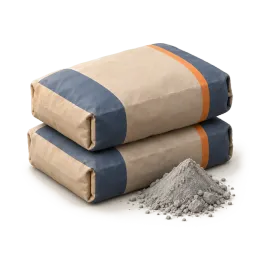
Key numbers
- Formula: bags = volume (ft³) ÷ yield per bag, rounded up
- 80 lb bag = 0.60 ft³ (17 L) and covers 1.8 ft² at 4 in thick
- 1 yd³ = 45 × 80 lb, 60 × 60 lb, 72 × 50 lb or 90 × 40 lb bags
- 1 m³ = 59 × 80 lb bags; add 10% for waste
On this page
- How to use the Concrete Bag Calculator
- How do you calculate how many bags of concrete you need?
- How many cubic feet are in a bag of concrete?
- How many bags of concrete for common slab sizes?
- How does thickness change the bag count?
- How many bags per square foot or square metre?
- How do you count bags for an L-shaped or irregular pour?
- How many bags for fence posts and Sonotubes?
- Bags for round pads, walls and curbs
- Should you use bags or ready-mix?
- How much do the bags weigh to haul?
- Common mistakes when counting bags of concrete
- Concrete bag calculator vs related calculators: which one to use
- Frequently asked questions
How to use the Concrete Bag Calculator
- 1Choose the shapePick slab / pad, monolithic slab, round slab, footing, column / sonotube, post holes, steps, wall, curb & gutter, square / rect. column, beam or hollow cylinder. Each shape uses its own volume formula.
- 2Pick your unitsEvery dimension has its own unit menu (in, ft, yd, cm or m); changing one converts that number so the size stays the same. The US / Metric switch sets all fields to feet and inches or meters and centimeters and resets them to typical values.
- 3Enter the dimensionsType the length (default feet), width (default feet) or thickness (default inches). Measure the inside of the forms and the depth in several places.
- 4Set waste and quantityUse the waste slider (0 to 20%, default 10%) and allow more on uneven ground. If you have several identical pours, enter how many.
- 5Read the resultsSee the volume in cubic yards, cubic feet and cubic meters, the ready-mix order rounded up to ¼ yard, the number of 90, 80, 60, 50 and 40 lb bags rounded up, and the weight at the density you choose (150, 145 or 140 lb/ft³).
- 6Price it and save itPick a pricing basis (per cubic yard, per cubic meter or per bag of the highlighted size) and enter your local price for a material cost. Use Add to project to total several pours, and Copy link to share the exact result.
Results update as you type. Back to the calculator ↑
How do you calculate how many bags of concrete you need?
Work out the volume in cubic feet, divide by the yield of one bag, and round up to a whole bag. The calculator above does both steps for slabs, round pads, holes, steps and walls.
Bags = volume (ft³) ÷ yield per bag (ft³), rounded up
Bag yields for standard premixed concrete, from the QUIKRETE Concrete Mix data sheet:
| Bag size | Yield per bag | Litres per bag | Bags per cubic yard | Bags per cubic meter |
|---|---|---|---|---|
| 80 lb (36.3 kg) | 0.60 ft³ | 17 L | 45 | 59 |
| 60 lb (27.2 kg) | 0.45 ft³ | 12.7 L | 60 | 79 |
| 50 lb (22.7 kg) | 0.375 ft³ | 10.6 L | 72 | 95 |
| 40 lb (18.1 kg) | 0.30 ft³ | 8.5 L | 90 | 118 |
- Measure length and width in feet and thickness or depth in inches.
- Get cubic feet: length × width × (thickness ÷ 12).
- Divide by the yield of the bag size you plan to buy.
- Add 10% for spillage, an uneven base and form bulge, then round up.
Worked example: 6 × 8 ft patio pad, 4 in thick
- 6 × 8 × (4 ÷ 12) = 16 ft³ (0.59 yd³)
- 16 ÷ 0.60 = 26.7 → 27 × 80 lb bags, or 36 × 60 lb bags
- Add 10%: 17.6 ft³ ÷ 0.60 → buy 30 × 80 lb bags
How many cubic feet are in a bag of concrete?
An 80 lb bag of standard premix makes about 0.60 ft³ of placed concrete, which is 0.022 yd³ or 17 L. For QUIKRETE Concrete Mix, every bag size works out to the same ratio, about 133 lb of dry mix per cubic foot of yield, so the yield scales directly with the bag weight. Other brands can differ (Sakrete lists 0.66 ft³ for its 90 lb bag, not 0.675), so use the yield printed on your bag.
| Bag size | Cubic feet per bag | Cubic yards per bag | Litres per bag | Bags per cubic foot |
|---|---|---|---|---|
| 90 lb (40.8 kg) | 0.675 | 0.025 | 19.1 | 1.48 |
| 80 lb (36.3 kg) | 0.60 | 0.022 | 17 | 1.67 |
| 60 lb (27.2 kg) | 0.45 | 0.017 | 12.7 | 2.22 |
| 50 lb (22.7 kg) | 0.375 | 0.014 | 10.6 | 2.67 |
| 40 lb (18.1 kg) | 0.30 | 0.011 | 8.5 | 3.33 |
The “bags per cubic foot” column is the quickest way to estimate in your head. Multiply your cubic feet by 1.67 for 80 lb bags or by 2.22 for 60 lb bags, then round up. The 90 lb size is listed on the QUIKRETE Concrete Mix data sheet as a regional product, so most stores stock only the 40, 50, 60 and 80 lb sizes.
A bag’s yield is its volume after mixing with water and placing, not the loose powder in the sack. That is why you divide by the yield, never by the weight. “Ready mix” or “premix” on a bag means the cement, sand and gravel are already blended; it is still bagged concrete, and the same yields apply. If you want to blend your own from Portland cement, sand and stone, the concrete mix ratio calculator handles that.
How many bags of concrete for common slab sizes?
Most people search for their exact pad, so here are the common sizes at 4 in thick. The first number in each bag column is the exact count; the second adds 10% for waste.
| Slab size (4 in thick) | Cubic feet | Cubic yards | 80 lb bags | 60 lb bags | 40 lb bags |
|---|---|---|---|---|---|
| 4 × 4 ft | 5.33 | 0.20 | 9 / 10 | 12 / 14 | 18 / 20 |
| 4 × 6 ft | 8.00 | 0.30 | 14 / 15 | 18 / 20 | 27 / 30 |
| 4 × 8 ft | 10.67 | 0.40 | 18 / 20 | 24 / 27 | 36 / 40 |
| 6 × 8 ft | 16.00 | 0.59 | 27 / 30 | 36 / 40 | 54 / 59 |
| 8 × 8 ft | 21.33 | 0.79 | 36 / 40 | 48 / 53 | 72 / 79 |
| 10 × 10 ft | 33.33 | 1.23 | 56 / 62 | 75 / 82 | 112 / 123 |
| 10 × 12 ft | 40.00 | 1.48 | 67 / 74 | 89 / 98 | 134 / 147 |
| 12 × 12 ft | 48.00 | 1.78 | 80 / 88 | 107 / 118 | 160 / 176 |
| 16 × 16 ft | 85.33 | 3.16 | 143 / 157 | 190 / 209 | 285 / 313 |
| 20 × 20 ft | 133.33 | 4.94 | 223 / 245 | 297 / 326 | 445 / 489 |
| 24 × 24 ft | 192.00 | 7.11 | 320 / 352 | 427 / 470 | 640 / 704 |
At 6 in thick, the volume is 1.5 times larger. A 10 × 10 ft slab at 6 in needs 84 × 80 lb bags (92 with extra), and a 20 × 20 ft slab needs 334 (367 with extra).
How does thickness change the bag count?
Bags scale in a straight line with thickness: every extra inch on a 10 × 10 ft slab adds 8.33 ft³, or 14 × 80 lb bags. Here is the same 100 ft² pad at the thicknesses people pour most often.
| 10 × 10 ft slab thickness | Cubic feet | Cubic yards | 80 lb bags | 80 lb bags +10% | 60 lb bags | 40 lb bags |
|---|---|---|---|---|---|---|
| 2 in | 16.67 | 0.62 | 28 | 31 | 38 | 56 |
| 3 in | 25.00 | 0.93 | 42 | 46 | 56 | 84 |
| 4 in | 33.33 | 1.23 | 56 | 62 | 75 | 112 |
| 5 in | 41.67 | 1.54 | 70 | 77 | 93 | 139 |
| 6 in | 50.00 | 1.85 | 84 | 92 | 112 | 167 |
| 8 in | 66.67 | 2.47 | 112 | 123 | 149 | 223 |
Use this table to check a different area. A 50 ft² pad needs half the 100 ft² figure before rounding, and a 200 ft² pad needs double. The thickness itself is a design choice that depends on what the slab carries and on your local code, so settle it first and then count bags. Remember that 2 in is the minimum the QUIKRETE Concrete Mix data sheet lists; thinner toppings need a product made for that.
How many bags per square foot or square metre?
If you know the area instead of the dimensions, one 80 lb bag covers about 1.8 ft² at 4 in thick. Divide the area by that coverage and round up.
| Area at 4 in thick | Cubic yards | 80 lb bags (+10%) | 60 lb bags (+10%) |
|---|---|---|---|
| 50 ft² | 0.62 | 28 (31) | 38 (41) |
| 100 ft² | 1.23 | 56 (62) | 75 (82) |
| 200 ft² | 2.47 | 112 (123) | 149 (163) |
| 500 ft² | 6.17 | 278 (306) | 371 (408) |
| 1,000 ft² | 12.35 | 556 (612) | 741 (815) |
In metric, 1 m² at 10 cm thick is 0.1 m³, which takes 6 × 80 lb bags. A 3 × 3 m slab at 10 cm (0.9 m³) needs 53 × 80 lb bags, and a 4 × 4 m slab (1.6 m³) needs 95. Outside the US, bags are often sold in kilogram sizes, so check the yield printed on your bag and divide your volume by it.
How do you count bags for an L-shaped or irregular pour?
Split the outline into rectangles and circles, work out each volume in cubic feet, add them, and only then divide by the bag yield. Rounding each piece separately adds a partial bag for every piece.
Worked example: L-shaped patio, 4 in thick
- Main area 10 × 10 ft: 10 × 10 × (4 ÷ 12) = 33.33 ft³
- Side leg 4 × 6 ft: 4 × 6 × (4 ÷ 12) = 8 ft³
- Total 41.33 ft³ ÷ 0.60 = 68.9 → 69 × 80 lb bags, or 92 × 60 lb bags
- Add 10%: 45.47 ft³ ÷ 0.60 → buy 76 × 80 lb bags
For a curved edge, measure the longest length and the widest width, calculate it as a rectangle, and treat the difference as part of your waste allowance. For a sloped base where the depth changes from one end to the other, average the depths you measured at several points and use that as the thickness. If the depth varies by more than an inch, take readings on a grid every few feet; a slab you think is 4 in thick but averages 4½ in needs 12.5% more bags.
How many bags for fence posts and Sonotubes?
Round holes use the cylinder volume, minus the part of the post below ground. Exact bag counts for a single hole:
| Hole | Concrete | 80 lb bags | 60 lb bags | 50 lb bags |
|---|---|---|---|---|
| 8 in × 2 ft, 4×4 post | 0.53 ft³ | 1 | 2 | 2 |
| 10 in × 2 ft, 4×4 post | 0.92 ft³ | 2 | 3 | 3 |
| 10 in × 3 ft, 4×4 post | 1.38 ft³ | 3 | 4 | 4 |
| 12 in × 3 ft, 6×6 post | 1.73 ft³ | 3 | 4 | 5 |
| 8 in Sonotube, 4 ft deep | 1.40 ft³ | 3 | 4 | 4 |
| 10 in Sonotube, 4 ft deep | 2.18 ft³ | 4 | 5 | 6 |
| 12 in Sonotube, 4 ft deep | 3.14 ft³ | 6 | 7 | 9 |
A 4×4 post measures 3.5 in square and a 6×6 measures 5.5 in. For a run of posts, multiply the exact volume by the number of holes before rounding, which wastes less than rounding each hole. The fence post concrete calculator and Sonotube calculator handle counts and depths.
Bags for round pads, walls and curbs
The calculator above has shapes for these; the counts below give you a feel for the numbers before you measure.
Round pads use π × radius² × thickness. At 4 in thick:
| Round pad, 4 in thick | Cubic feet | 80 lb bags / +10% | 60 lb bags / +10% |
|---|---|---|---|
| 3 ft diameter | 2.36 | 4 / 5 | 6 / 6 |
| 4 ft diameter | 4.19 | 7 / 8 | 10 / 11 |
| 6 ft diameter | 9.42 | 16 / 18 | 21 / 24 |
| 8 ft diameter | 16.76 | 28 / 31 | 38 / 41 |
A circle needs about 21% fewer bags than the square that encloses it: a 4 × 4 ft square pad takes 9 × 80 lb bags, while a 4 ft round pad takes 7.
Small walls and curbs are length × height × thickness. A 10 ft wall 2 ft high and 6 in thick is 10 ft³, so 17 × 80 lb bags (19 with extra). A 20 ft curb 12 in high and 6 in wide is also 10 ft³ and takes the same 17 bags. An 8 ft wall 3 ft high and 8 in thick is 16 ft³: 27 bags, or 30 with extra. For anything that retains soil, the wall design, footing and reinforcement come from your plans or local code, not from a bag count; the concrete footing calculator sizes the footing underneath. For block walls, the concrete block calculator counts blocks instead of bags.
Should you use bags or ready-mix?
Bags make sense for small pours; ready-mix makes sense once you pass about a cubic yard. One cubic yard is 45 × 80 lb bags, or 3,600 lb of dry mix to lift, mix and place.
- Under ½ yd³ (23 × 80 lb bags or fewer): bags are easy to handle and there is no delivery to schedule.
- ½ to 1 yd³ (23 to 45 bags): rent a mixer and recruit help, or ask a local plant whether it delivers small loads and what it charges.
- Over 1 yd³: ready-mix is usually less work and gives a more even pour. Mixing 100+ bags by hand risks cold joints where one batch sets before the next arrives.
To compare cost, multiply the bag count by your store’s bag price and set it against a delivered quote from your supplier. The concrete price per yard page explains what goes into a quote.
Worked example: 10 × 10 ft slab, 4 in thick
- 10 × 10 × (4 ÷ 12) = 33.33 ft³ (1.23 yd³)
- 33.33 ÷ 0.60 = 55.6 → 56 × 80 lb bags, or 75 × 60 lb bags
- Add 10%: 36.7 ft³ ÷ 0.60 → buy 62 × 80 lb bags, about 4,960 lb of dry mix
- Water at about 6 pints per 80 lb bag (QUIKRETE Concrete Mix): 62 × 6 = 372 pints, roughly 46.5 gallons
That is past the 1 yd³ mark, so price a ready-mix delivery before you load a trailer with 62 bags.
How much do the bags weigh to haul?
Every 80 lb bag is 80 lb of dry mix, so the load adds up fast. Before you drive to the store, compare the total with the payload rating of your vehicle or trailer, which is printed on the door jamb or in the manual.
| 80 lb bags | Dry weight (lb) | US tons | Kilograms | Typical job |
|---|---|---|---|---|
| 10 | 800 | 0.40 | 363 | 4 to 6 fence posts |
| 20 | 1,600 | 0.80 | 726 | 4 × 8 ft pad with extra |
| 30 | 2,400 | 1.20 | 1,089 | 6 × 8 ft pad with extra |
| 45 | 3,600 | 1.80 | 1,633 | one cubic yard |
| 62 | 4,960 | 2.48 | 2,250 | 10 × 10 ft slab with extra |
| 88 | 7,040 | 3.52 | 3,193 | 12 × 12 ft slab with extra |
Many stores offer delivery of a full pallet, which saves the double handling; ask your store how many bags it puts on a pallet and what it charges. A factory pallet holds 42 bags of 80 lb or 56 of 60 lb, about 3,360 lb of mix; see how many bags of concrete are on a pallet. Split large loads into several trips rather than overloading one, and stack bags flat over the axle.
Order of work also matters with bags. Stage them near the forms on a tarp, keep them off wet ground, and open only what you can mix and place in the next few minutes. A bag that has absorbed moisture and gone lumpy will not reach its rated strength, so buy close to pour day.
Common mistakes when counting bags of concrete
Most bag-count errors come from units and rounding, not from the formula. These are the ones that change the total the most:
- Entering the depth in feet instead of inches. A 10 × 10 ft slab at 4 in needs 56 × 80 lb bags. Type 4 into a feet field and you get 400 ft³, or 667 bags, twelve times too many.
- Using an 80 lb count when buying 60 lb bags. The bag count is not interchangeable. If you buy 56 bags of 60 lb for a 10 × 10 ft slab, you get 25.2 ft³ instead of 33.3 ft³, which is 24% short, or about 14 more 80 lb bags.
- Rounding each post hole separately. Ten 4×4 posts in 10 in holes 2 ft deep need 9.21 ft³ in total. Rounding each hole up to 2 bags means buying 20 × 80 lb bags; totalling first and rounding once gives 16.
- Ignoring low spots in the base. A base that sits ½ in low across 100 ft² adds 4.17 ft³, which is about 7 more 80 lb bags. Check the depth in several places and keep the 10% waste allowance.
- Measuring the nominal form height. A 2×4 form board is 3.5 in tall, not 4 in. A 10 × 10 ft slab at 3.5 in needs 49 × 80 lb bags, not 56, so measure the actual depth you will fill.
- Pouring too thin or adding too much water. QUIKRETE Concrete Mix is rated for pours 2 in thick or more and takes about 6 pints (2.8 L) of water per 80 lb bag. Extra water makes it easier to place but weaker.
Concrete bag calculator vs related calculators: which one to use
This calculator is the right tool when you already know you will buy bags and want a count for one pour. Switch to a more specific tool when the job or the question changes:
- Bags of concrete per yard when you start from a volume, such as a contractor’s estimate of 2 yd³, and want the bag count (90 × 80 lb bags) without entering dimensions.
- Concrete slab calculator for larger slabs where you will likely order ready-mix in cubic yards. It rounds the order up to the next ¼ yard.
- Fence post concrete calculator for a whole fence line. It totals every hole before rounding, which avoided 4 extra bags in the ten-post example above.
- Quikrete calculator or Sakrete calculator when you have a specific brand in mind and want the data-sheet figures, such as water per bag and strength, next to the count.
FAQ
Frequently asked questions
How many bags of concrete do I need for a 10×10 slab?
At 4 in thick a 10 × 10 ft slab is 33.3 ft³: 56 bags of 80 lb or 75 bags of 60 lb concrete. With 10% extra buy 62 × 80 lb bags. At 6 in thick it takes 84 × 80 lb bags, 92 with extra.
How many bags of concrete do I need for a 4×4 slab?
A 4 × 4 ft pad 4 in thick holds 5.33 ft³, which is 9 bags of 80 lb or 12 bags of 60 lb. With 10% extra buy 10 × 80 lb bags. At 6 in thick it needs 14 × 80 lb bags.
How many bags of concrete do I need for a 4×8 slab?
A 4 × 8 ft slab 4 in thick is 10.67 ft³: 18 bags of 80 lb or 24 bags of 60 lb. Add 10% for waste and buy 20 × 80 lb bags or 27 × 60 lb bags.
How many bags of concrete for a 12×12 slab?
A 12 × 12 ft slab 4 in thick needs 80 bags of 80 lb concrete (88 with 10% extra), or 107 bags of 60 lb. It is 1.78 yd³, which is 6,400 lb of dry mix in 80 lb bags.
How many bags of concrete for a 10×20 slab?
A 10 × 20 ft slab 4 in thick is 66.7 ft³ (2.47 yd³): 112 × 80 lb bags, or 123 with 10% extra. In 60 lb bags it takes 149. At that size, compare the bag count with a ready-mix quote.
How many bags of concrete for a 4×4 post?
For a 4×4 post in a 10 in hole 2 ft deep, about 0.92 ft³ of concrete: 2 bags of 80 lb (1.53 bags exactly) or 3 bags of 60 lb. A 3 ft deep hole of the same width takes 3 × 80 lb bags.
How many 50 lb bags of concrete do I need for a fence post?
Three 50 lb bags for a 4×4 post in a 10 in hole 2 ft deep (2.46 bags exactly). An 8 in hole 2 ft deep needs 2 bags, and a 10 in hole 3 ft deep needs 4 bags of 50 lb concrete.
How many bags of concrete do I need for 100 square feet?
At 4 in thick, 100 ft² needs 33.3 ft³ of concrete: 56 bags of 80 lb, or 62 with 10% extra. That is 1.23 yd³, a size where many people compare bags with a ready-mix delivery.
How many 80 lb bags of concrete are in a yard?
45 bags. Each 80 lb bag yields about 0.60 ft³ and a cubic yard is 27 ft³. The same yard takes 60 bags of 60 lb, 72 bags of 50 lb or 90 bags of 40 lb.
How many 60 lb bags of concrete are in a yard?
60 bags. A 60 lb bag yields about 0.45 ft³, and 27 ÷ 0.45 = 60, which is the same 3,600 lb of dry mix as 45 × 80 lb bags. With 10% extra for waste, buy 66 bags of 60 lb (3,960 lb) per cubic yard.
How many bags of concrete for a 16×16 slab?
A 16 × 16 ft slab 4 in thick is 85.3 ft³ (3.16 yd³): 143 × 80 lb bags, or 157 with 10% extra. In 60 lb bags it takes 190. At that size a ready-mix delivery is usually far less work than bags.
How many cubic feet are in a bag of concrete?
An 80 lb bag of standard concrete mix yields about 0.60 ft³ (17 L), a 60 lb bag 0.45 ft³, a 50 lb bag 0.375 ft³ and a 40 lb bag 0.30 ft³, according to the QUIKRETE Concrete Mix data sheet.
How many square feet does an 80 lb bag of concrete cover?
About 1.8 ft² at 4 in thick, 2.4 ft² at 3 in and 3.6 ft² at 2 in. A 60 lb bag covers 1.35 ft² at 4 in. In metric, an 80 lb bag covers about 0.17 m² at 10 cm.
How many bags of concrete per square metre?
At 10 cm thick, one square metre is 0.1 m³ and takes 6 × 80 lb bags (5.89 exactly) or 8 × 60 lb bags. At 15 cm it takes 9 × 80 lb bags, and at 7.5 cm it takes 5.
Is it cheaper to mix concrete or buy bags?
It depends on local prices. One cubic yard is 45 × 80 lb bags, so multiply 45 by your store's bag price and compare it with a delivered ready-mix quote per yard. Bags are the usual choice for small pours under about ½ yd³ (23 bags).
2 Sources
Last reviewed October 9, 2026 by M Bilal. Found an error? Tell us.