


Key numbers
- ft³ → yd³: divide by 27
- yd³ → ft³: multiply by 27
- 1 ft³ = 0.037 yd³ = 0.0283 m³
- 1 yd³ = 27 ft³ = 46,656 in³ = 0.7646 m³
On this page
- How to use the Cubic Feet to Cubic Yards
- How do you convert cubic feet to cubic yards?
- Cubic feet to cubic yards chart
- Cubic yards to cubic feet chart
- How many cubic feet are in a yard of concrete?
- Cubic feet in bags of mulch, soil and gravel
- Cubic feet, cubic yards and cubic meters
- How much does a cubic foot of concrete weigh?
- Cubic feet formula for concrete shapes
- How many bags of concrete make 1 cubic foot?
- From cubic feet to a ready-mix order
- What does 1 cubic foot of concrete fill?
- When to use cubic feet and when to use cubic yards
- Comparing a bag price with a bulk price
- Cubic inches to cubic feet
- Common mistakes when converting cubic feet to cubic yards
- Cubic feet to cubic yards vs related converters: which one to use
- Frequently asked questions
How to use the Cubic Feet to Cubic Yards
- 1Enter your numbersFill in volume or convert.
- 2Check the assumptions1 cubic yard = 3 ft × 3 ft × 3 ft = 27 cubic feet.
- 3Read the resultsThe calculator shows cubic yards or cubic meters, updated as you type.
- 4Use the resultRound up to what your supplier sells, and keep a little extra for waste.
Results update as you type. Back to the calculator ↑
How do you convert cubic feet to cubic yards?
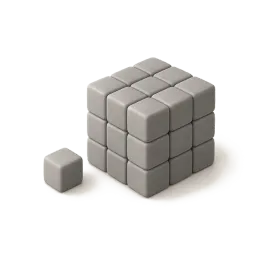
Divide the number of cubic feet by 27. One cubic yard is a cube 3 ft on each side, and 3 × 3 × 3 = 27 cubic feet.
Cubic yards = cubic feet ÷ 27
To convert back, multiply:
Cubic feet = cubic yards × 27
The converter above handles both directions and also gives cubic meters. A common mistake is dividing by 9 or by 3. Nine converts square feet to square yards (area), and 3 converts feet to yards (length). For volume it is always 27.
Worked example: 80 ft³ of soil for raised beds
- 80 ÷ 27 = 2.96 yd³
- In metric: 80 × 0.0283 = 2.27 m³
- Ordering bulk in ½ yard steps, buy 3 yd³
Worked example: 60 bags of 80 lb concrete
- Volume: 60 × 0.60 ft³ = 36 ft³
- In cubic yards: 36 ÷ 27 = 1.33 yd³
- So 60 bags of 80 lb mix make one and a third yards. A 1½ yd³ ready-mix order would hold 40.5 ft³
Cubic feet to cubic yards chart
Every value below is cubic feet ÷ 27, rounded to three decimals.
| Cubic feet (ft³) | Cubic yards (yd³) | Cubic meters (m³) |
|---|---|---|
| 1 | 0.037 | 0.028 |
| 2 | 0.074 | 0.057 |
| 3 | 0.111 | 0.085 |
| 5 | 0.185 | 0.142 |
| 10 | 0.370 | 0.283 |
| 15 | 0.556 | 0.425 |
| 20 | 0.741 | 0.566 |
| 27 | 1.000 | 0.765 |
| 30 | 1.111 | 0.850 |
| 40 | 1.481 | 1.133 |
| 50 | 1.852 | 1.416 |
| 60 | 2.222 | 1.699 |
| 75 | 2.778 | 2.124 |
| 100 | 3.704 | 2.832 |
| 150 | 5.556 | 4.248 |
| 200 | 7.407 | 5.663 |
| 250 | 9.259 | 7.079 |
| 300 | 11.111 | 8.495 |
| 400 | 14.815 | 11.327 |
| 500 | 18.519 | 14.158 |
| 1,000 | 37.037 | 28.317 |
Cubic yards to cubic feet chart
Suppliers quote in yards, but bags and some tools use cubic feet. Multiply by 27.
| Cubic yards (yd³) | Cubic feet (ft³) | Cubic meters (m³) |
|---|---|---|
| ¼ | 6.75 | 0.191 |
| ½ | 13.5 | 0.382 |
| 1 | 27 | 0.765 |
| 1½ | 40.5 | 1.147 |
| 2 | 54 | 1.529 |
| 3 | 81 | 2.294 |
| 4 | 108 | 3.058 |
| 5 | 135 | 3.823 |
| 10 | 270 | 7.646 |
How many cubic feet are in a yard of concrete?
A yard of concrete is 27 ft³, like any cubic yard. Bagged concrete is labeled by weight, so the yield per bag tells you how many bags make a yard. Using QUIKRETE’s published yields (the 90 lb bag is sold only in some regions):
| Bag size | Yield per bag (ft³) | Bags per cubic yard |
|---|---|---|
| 40 lb | 0.30 | 90 |
| 50 lb | 0.375 | 72 |
| 60 lb | 0.45 | 60 |
| 80 lb | 0.60 | 45 |
| 90 lb | 0.675 | 40 |
The bags of concrete per yard page covers partial yards and waste.
Cubic feet in bags of mulch, soil and gravel
Landscape bags are usually labeled in cubic feet. Divide 27 by the bag size to see how many bags equal a bulk yard: 18 bags of 1.5 ft³, 13.5 bags of 2 ft³ or 9 bags of 3 ft³.
A 4 × 8 ft raised bed filled 12 in deep holds 32 ft³, which is 1.19 yd³. That is 16 bags of 2 ft³ or 22 bags of 1.5 ft³. The raised bed soil calculator does this for any bed.
To see what one bag covers, multiply its cubic feet by 12 and divide by the depth in inches. A 2 ft³ bag covers 12 ft² at 2 in or 8 ft² at 3 in; a 1.5 ft³ bag covers 9 ft² at 2 in or 6 ft² at 3 in. A 200 ft² bed at 3 in therefore needs 50 ft³: 25 bags of 2 ft³, or 1.85 yd³ in bulk.
Bagged mulch and soil are often compressed in the bag and fluff up when you open them, while bulk material settles after spreading. Either way, check coverage after the first few bags and adjust before you buy the rest, rather than relying only on the label.
Cubic feet, cubic yards and cubic meters
Outside the US, bulk materials are sold by the cubic meter or the tonne. Use these factors (rounded):
- 1 ft³ = 0.0283 m³, and 1 m³ = 35.31 ft³
- 1 yd³ = 0.7646 m³, and 1 m³ = 1.308 yd³
- 1 yd³ = 27 ft³ = 46,656 in³ (12 × 12 × 12 × 27)
If your quote is in tons rather than volume, use the tons to cubic yards converter, which needs the material’s density.
How much does a cubic foot of concrete weigh?
About 150 lb, the normal-weight value WSDOT uses for design (150 lb/ft³ plain, 155 lb/ft³ reinforced) and the one this site uses for wet-weight results. QUIKRETE states about 140 lb/ft³ for its bagged Concrete Mix, and FHWA gives about 140–155 lb/ft³ for normal-weight concrete.
| Volume | Weight at 150 lb/ft³ | Weight at 140 lb/ft³ | kg at 150 lb/ft³ |
|---|---|---|---|
| 1 ft³ | 150 lb | 140 lb | 68 kg |
| 2 ft³ | 300 lb | 280 lb | 136.1 kg |
| 5 ft³ | 750 lb | 700 lb | 340.2 kg |
| 10 ft³ | 1,500 lb | 1,400 lb | 680.4 kg |
| 27 ft³ (1 yd³) | 4,050 lb | 3,780 lb | 1,837 kg |
In metric, 150 lb/ft³ is about 2,403 kg/m³ and 140 lb/ft³ is about 2,243 kg/m³. Weight is what limits you when moving cured pieces or hauling bags: a 10 ft³ pour is about three quarters of a ton of finished concrete. Even a 4 × 4 ft pad 4 in thick (5.33 ft³) weighs about 800 lb at 150 lb/ft³, so even a small pad is easier to pour where it will sit than to cast elsewhere and move into place later.
Why an 80 lb bag is not 80 lb of finished concrete per cubic foot
An 80 lb bag yields about 0.60 ft³ once mixed, so 1 ft³ takes 1.67 bags, or 2 whole bags. The dry mix plus water ends up near the 140 lb/ft³ density QUIKRETE quotes. Do not divide bag weight by density to estimate yield; use the yield printed on the bag.
Cubic feet formula for concrete shapes
Work out the volume in cubic feet, then divide by 27 if you need yards. All dimensions must be in feet first, so divide inches by 12.
- Slab, footing or wall: length × width × thickness. A wall 10 ft long, 3 ft high and 8 in thick is 10 × 3 × 0.667 = 20 ft³ (0.74 yd³).
- Round hole or tube: 3.1416 × radius² × depth. A 12 in tube 4 ft deep is 3.14 ft³; an 8 in tube 4 ft deep is 1.40 ft³; a 6 in tube 3 ft deep is 0.59 ft³.
- Post hole with a post in it: hole volume minus the post. A 10 in hole 3 ft deep is 1.64 ft³ empty and 1.38 ft³ with a 4×4 post (3.5 × 3.5 in actual) in it.
- Steps: add up each step as a block of width × run × its height above grade, plus the landing.
The Sonotube calculator, fence post concrete calculator and concrete steps calculator apply these formulas with the right inputs for each shape.
Worked example: 4 × 4 ft pad, 4 in thick, in bags
- Volume: 4 × 4 × 0.333 = 5.33 ft³ (0.20 yd³)
- 80 lb bags at 0.60 ft³: 5.33 ÷ 0.60 = 8.9, so 9 bags
- With 10% extra: 5.87 ft³, so 10 bags
How many bags of concrete make 1 cubic foot?
Divide 1 by the bag yield, then round up. Using the QUIKRETE Concrete Mix yields:
| Bag size | Yield (ft³) | Bags per ft³ | Whole bags for 1 ft³ |
|---|---|---|---|
| 40 lb | 0.30 | 3.33 | 4 |
| 50 lb | 0.375 | 2.67 | 3 |
| 60 lb | 0.45 | 2.22 | 3 |
| 80 lb | 0.60 | 1.67 | 2 |
| 90 lb | 0.675 | 1.48 | 2 |
For a single cubic foot you need at least two bags. Two 80 lb bags give 1.2 ft³ (0.2 ft³ to spare), and two 90 lb bags give 1.35 ft³ (0.35 ft³ to spare). A 3 × 3 ft pad 4 in thick is exactly 3 ft³, which is 5 bags of 80 lb or 7 bags of 60 lb. For bag counts on bigger jobs, the concrete bag calculator handles waste and mixed bag sizes.
Mixing bag sizes
If you already have a mix of bags, add their yields in cubic feet first. Twenty 80 lb bags plus ten 60 lb bags is 20 × 0.60 + 10 × 0.45 = 16.5 ft³, which is 0.61 yd³.
From cubic feet to a ready-mix order
Ready-mix is ordered in cubic yards, often in ¼ or ½ yard steps (ask your supplier). Convert your cubic feet, add the waste allowance, then round up once.
| Your volume (ft³) | yd³ | With 10% | Example: order in ¼ yd³ steps |
|---|---|---|---|
| 20 | 0.74 | 0.81 | 1 |
| 45 | 1.67 | 1.83 | 2 |
| 60 | 2.22 | 2.44 | 2½ |
| 100 | 3.70 | 4.07 | 4¼ |
| 150 | 5.56 | 6.11 | 6¼ |
Going the other way, multiply the order by 27 to see the cubic feet you are paying for: ¾ yd³ is 20.25 ft³, 1¼ yd³ is 33.75 ft³ and 2½ yd³ is 67.5 ft³. Compare that with your measured volume to see how much margin the rounding left. The concrete yards calculator does the whole calculation from dimensions.
What does 1 cubic foot of concrete fill?
One cubic foot is a 12 × 12 × 12 in cube, or 0.037 yd³ (0.0283 m³). Spread flat, it covers 12 ft² at 1 in thick, so divide 12 by your thickness in inches:
- 2 in thick: 6 ft²
- 4 in thick: 3 ft²
- 6 in thick: 2 ft²
It fills a square hole 12 in on a side and 12 in deep, or about 1.8 ft of a 10 in round post hole (1.64 ft³ fills 3 ft). That makes 1 ft³ a useful mental unit: a 4 in slab takes one cubic foot for every 3 ft², so a 6 × 8 ft pad (48 ft²) needs 16 ft³, about 27 bags of 80 lb before waste.
When to use cubic feet and when to use cubic yards
Cubic feet suit small jobs and anything sold in bags: concrete mix, potting soil, bagged mulch and sand. Cubic yards suit bulk deliveries, where a supplier loads a truck. The break-even point is about where bag counts become impractical. One cubic yard is 45 bags of 80 lb concrete or 13.5 bags of 2 ft³ mulch.
A practical rule: do the measuring in feet and the volume in cubic feet, because the multiplication is easier to check. Convert to cubic yards only at the end, when you are ready to compare with a bulk quote or a ready-mix order. That keeps one division by 27 in the whole calculation and leaves fewer places for an error. Write the cubic feet down next to the yards on your order sheet, so anyone checking the delivery can follow the arithmetic.
Comparing a bag price with a bulk price
Turn both prices into the same unit before you compare. Divide the bag price by the bag’s cubic feet to get a price per cubic foot, then multiply by 27 for a price per cubic yard. That figure sits directly next to a bulk quote.
The bulk quote usually has extras the bag price does not: a delivery charge, and sometimes a small-load fee. Add those to the bulk total, then divide by the yards you are ordering. Bags have hidden costs too: trips to the store and, for concrete, lifting and mixing every bag. Over a yard of 80 lb concrete that is 45 bags, about 1.8 tons of dry mix.
Prices vary by region and season, so use your own quotes. The concrete price per yard page explains what goes into a ready-mix quote.
Cubic inches to cubic feet
Divide cubic inches by 1,728 (12 × 12 × 12) for cubic feet, or by 46,656 for cubic yards. 1,000 in³ is 0.579 ft³. A form 8 × 16 × 24 in holds 3,072 in³, which is 1.78 ft³, close to three 80 lb bags. A 6 × 6 × 6 in cube is 216 in³, exactly 0.125 ft³ or one eighth of a cubic foot, so eight of them fill one cubic foot.

Common mistakes when converting cubic feet to cubic yards
Most wrong orders come from mixing up length, area and volume units. Check these before you call a supplier.
- Dividing by 9 or 3 instead of 27. Nine square feet make a square yard, which is area, and 3 feet make a linear yard. 100 ft³ ÷ 9 gives 11.1 and ÷ 3 gives 33.3. The right answer is 3.70 yd³.
- Forgetting to convert inches. A bed 10 × 10 ft and 6 in deep is 10 × 10 × 0.5 = 50 ft³, not 600. Divide inches by 12 before multiplying, or use the cubic yard calculator, which takes depth in inches.
- Rounding too early. Keep two or three decimals until the end, then round up once. 4 bags of 0.6 ft³ is 2.4 ft³, or 0.089 yd³, not 0.1.
- Ignoring settling and waste. Mulch and soil compact after spreading, and concrete orders usually include a margin for spillage and an uneven base (this site’s concrete calculators default to 10%; ask your supplier what they recommend). Add the allowance to the cubic yards, then round up to the supplier’s step, often ½ or ¼ yard.
- Treating bag weight as volume. An 80 lb bag of concrete is about 0.60 ft³, not 0.8 ft³. Always use the yield printed on the bag.
- Rounding bag counts down. 90 ft³ of mulch is 45 bags of 2 ft³ but 60 bags of 1.5 ft³. Always round the bag count up to a whole bag.
Cubic feet to cubic yards vs related converters: which one to use
- This converter when you already have a volume in cubic feet, such as from bag labels or a plan.
- Cubic yard calculator when you have length, width and depth instead of a volume.
- Square feet to cubic yards when you know the area and the depth in inches.
- Bags of concrete per yard when you need bag counts for a concrete order, with waste included.
- Tons to cubic yards when the supplier quotes by weight.
FAQ
Frequently asked questions
How many cubic feet are in a cubic yard?
27 cubic feet. A cubic yard measures 3 ft on each side, and 3 × 3 × 3 = 27. That is why you divide cubic feet by 27 to get cubic yards.
How many cubic feet is an 80 lb bag of concrete?
About 0.60 ft³, according to the QUIKRETE Concrete Mix data sheet. That is 0.022 yd³ per bag, so 45 bags make one cubic yard. Use the yield printed on your bag if it differs.
How many cubic feet is a 60 lb bag of concrete?
About 0.45 ft³, per the QUIKRETE Concrete Mix data sheet. Sixty of them make one cubic yard (27 ÷ 0.45 = 60), and 10 bags fill 4.5 ft³, enough for three 10 in post holes 3 ft deep around 4×4 posts.
How many cubic yards is 100 cubic feet?
3.70 cubic yards. 100 ÷ 27 = 3.704 yd³, which is 2.83 m³. Similarly, 50 ft³ is 1.85 yd³ and 200 ft³ is 7.41 yd³.
How many cubic feet is 1 yard of concrete?
27 cubic feet, the same as any cubic yard. In 80 lb bags that yield 0.60 ft³ each, one yard of concrete is 45 bags.
How many cubic feet are in 2 cubic yards?
54 cubic feet. Multiply cubic yards by 27: 2 × 27 = 54 ft³. Half a yard is 13.5 ft³, and 5 yards is 135 ft³.
How many cubic yards is 10 cubic feet?
0.37 cubic yards. 10 ÷ 27 = 0.370 yd³, or 0.283 m³. Five cubic feet is 0.185 yd³ and 20 cubic feet is 0.741 yd³, so small amounts are often easier to buy in bags.
How many cubic yards is 1,000 cubic feet?
37.04 cubic yards. 1,000 ÷ 27 = 37.037 yd³, which is 28.32 m³. For comparison, 500 ft³ is 18.52 yd³ and 300 ft³ is 11.11 yd³.
How many cubic feet in a 50 lb bag of concrete?
About 0.375 ft³, from the QUIKRETE Concrete Mix data sheet. That works out to 72 bags per cubic yard. The 40 lb bag yields about 0.30 ft³, or 90 bags per yard.
How many cubic feet in a yard of mulch?
27 cubic feet. A 2 ft³ bag of mulch is 0.074 yd³, so a cubic yard equals 13.5 bags. Buy 14 bags to replace one yard of bulk mulch.
How many cubic feet of soil do I need for a 4x8 raised bed?
32 ft³ for a bed filled 12 in deep: 4 × 8 × 1 = 32. That is 1.19 yd³, or 16 bags of 2 ft³ or 22 bags of 1.5 ft³.
How many cubic inches are in a cubic yard?
46,656 cubic inches. A cubic foot is 12 × 12 × 12 = 1,728 in³, and a cubic yard is 27 ft³, so 1,728 × 27 = 46,656. Divide cubic inches by 46,656 to get cubic yards.
How many cubic feet are in a ton of gravel?
It depends on the gravel's loose density, so ask your supplier for their tons-per-yard figure. As an illustration only, at an assumed 1.4 tons per yd³, one ton is 1 ÷ 1.4 ≈ 0.71 yd³, or about 19.3 ft³. Enter your supplier's figure in the tons to cubic yards converter.
Is a cubic foot the same as a square foot?
No. A square foot (ft²) is an area of 1 × 1 ft. A cubic foot (ft³) is a volume of 1 × 1 × 1 ft. You need a depth to turn square feet into cubic feet.
How do I convert cubic feet to cubic meters?
Multiply cubic feet by 0.0283. 100 ft³ is 2.83 m³. One cubic yard is 0.7646 m³, and one cubic meter is 35.31 ft³ or 1.308 yd³.
3 Sources
Last reviewed October 9, 2026 by M Bilal. Found an error? Tell us.