


Key numbers
- Traction: floated, rough aggregate or evenly grooved finishes give the best footing (QUIKRETE)
- Broom direction: sidewalks and driveways are broomed at right angles to traffic
- Stamping: pressed into slightly stiff concrete to a depth of about 1 in (25 mm)
- Stain: concrete should be at least 60 days old before staining (QUIKRETE)
- Troweling wait: after the surface water sheen is gone, often 30 minutes to an hour
On this page
- How to use the Types of Concrete Finishes
- What are the main types of concrete finishes?
- How do I choose a concrete finish?
- What is a broom finish and how is it done?
- What is a smooth troweled finish?
- How are stamped and grooved finishes made?
- How is exposed aggregate concrete made?
- What are colored and other decorative finishes?
- Does the finish change how much concrete I need?
- Frequently asked questions
How to use the Types of Concrete Finishes
- 1Pick your unitsEvery dimension has its own unit menu (in, ft, yd, cm or m); changing one converts that number so the size stays the same. The US / Metric switch sets all fields to feet and inches or meters and centimeters and resets them to typical values.
- 2Enter the dimensionsType the length (default feet), width (default feet) or thickness (default inches). Measure the inside of the forms and the depth in several places.
- 3Set waste and quantityUse the waste slider (0 to 20%, default 10%) and allow more on uneven ground. If you have several identical pours, enter how many.
- 4Read the resultsSee the volume in cubic yards, cubic feet and cubic meters, the ready-mix order rounded up to ¼ yard, the number of 90, 80, 60, 50 and 40 lb bags rounded up, and the weight at the density you choose (150, 145 or 140 lb/ft³).
- 5Price it and save itPick a pricing basis (per cubic yard, per cubic meter or per bag of the highlighted size) and enter your local price for a material cost. Use Add to project to total several pours, and Copy link to share the exact result.
Results update as you type. Back to the calculator ↑
What are the main types of concrete finishes?
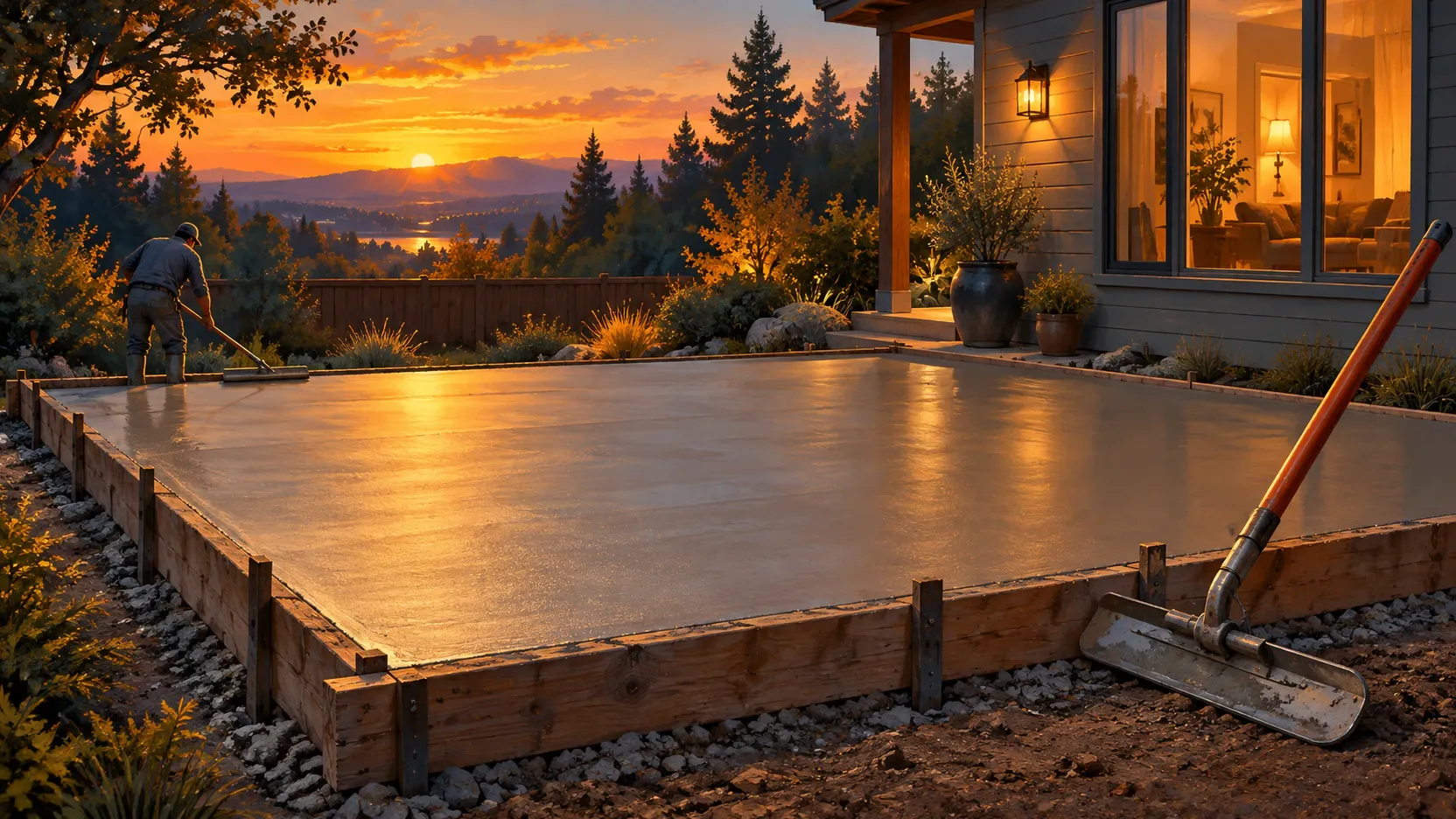
There are six families: rough-floated, steel-troweled, broomed, grooved or stamped, exposed aggregate, and colored. Most are made in the same pour, while the concrete is still workable, so the choice has to be made before the truck arrives. The finish changes how the slab looks, how it grips underfoot and how easy it is to clean, but not how much concrete you order.
Professional floor work follows ACI 302.1R, the American Concrete Institute’s guide to concrete floor and slab construction, which covers finishing alongside site preparation, joints and curing. For homeowner flatwork, the clearest primary source we found is QUIKRETE’s Special Concrete Finishes project sheet, which this page follows. Brand names are used descriptively only; this site is independent of every manufacturer.
| Finish | How it is made | When in the pour | Traction | Cleaning | Typical uses |
|---|---|---|---|---|---|
| Rough-floated | Wood hand float, darby or bull float worked in patterns | After screeding, before the surface stiffens | High | Harder | Pool decks, wet areas |
| Smooth (steel-troweled) | Steel trowel in overlapping arcs, 1–3 passes | After the water sheen is gone | Low when wet | Easiest | Garages, basements, interiors |
| Broomed | Broom pulled across soft concrete | After floating or a light trowel | Medium to high | Moderate | Walks, driveways, steps, slopes |
| Grooved / stamped | Stamp pads or tools pressed in about 1 in (25 mm) | Slightly stiff, after floating and troweling | Medium | Moderate | Patios, walks, decorative areas |
| Exposed aggregate | Stones seeded or retarder used, then mortar washed off | Seeded after first floating; retarder right after floating | High | Harder | Walks, drives, pool decks |
| Colored | Integral color in the mix, or stain/paint on cured concrete | Color: at mixing; stain: after 60 days | Same as the texture used | Depends on sealer | Any of the above |
Sources: QUIKRETE Special Concrete Finishes (methods, timing, 1 in stamp depth, 60-day stain wait); Brown University standard 32 13 14 (exposed aggregate methods).
How do I choose a concrete finish?
Decide on cleaning, weather and traction first, then looks. QUIKRETE’s guide asks three questions in that order:
- Will it need frequent, thorough cleaning? Choose a smooth troweled finish; grooved or heavily broomed surfaces hold dirt.
- Will it see freeze-thaw, abrasion or heavy traffic? Avoid splattered finishes, which the guide says are more likely to peel and spall.
- Does it need grip? Use a floated, rough aggregate or evenly grooved finish, which give the best footing.
You can combine finishes on one project; a common pattern is a broomed field with smooth troweled borders, or stamped panels framed by broom finish.
What is a broom finish and how is it done?
A broom finish is a texture of fine ridges made by pulling a broom across concrete that is still soft. It is the standard finish for outdoor walks and drives because the ridges give grip when wet. QUIKRETE’s directions:
- A damp, stiff-bristled broom gives a coarse texture for slopes and heavy traffic; a dry, soft-bristled broom gives a medium to fine texture.
- Pull the broom toward you in parallel, slightly overlapping strokes; never push it back and forth.
- Broom sidewalks and driveways at right angles to the direction of traffic. On a 4 × 50 ft (1.22 × 15.24 m) walk, that means strokes across the 4 ft width.
- Rinse the bristles often to keep the tips clean.
QUIKRETE notes the effect depends on how soon you broom, how stiff the bristles are and whether the broom is wet or dry. Try a test strip at the end of the slab that will be least visible.
What is a smooth troweled finish?
A smooth finish is made by steel-troweling the surface after floating, and it is the easiest concrete to clean. Troweling waits until the surface water has evaporated and the concrete has lost its sheen; QUIKRETE gives 30 minutes to several hours depending on weather and the mix, with 30 minutes to an hour typical.
The first pass sweeps the trowel in overlapping arcs. For a denser surface, a second pass holds the leading edge up slightly and presses harder, and a third pass, with the edge higher and more pressure, gives an almost glossy finish. That gloss is also why smooth concrete is slippery when wet; keep it for garages, shops and interiors, or add a broom texture outdoors.
Do not finish over bleed water
QUIKRETE’s guide starts troweling only after the surface moisture has evaporated and the concrete has lost its sheen. Finishing earlier works that water back into the top layer. Wait for the sheen to go.
How are stamped and grooved finishes made?
Stamped concrete imprints a brick, stone or tile pattern into concrete that has stiffened slightly. QUIKRETE’s method: after the surface has been floated and troweled, step on the stamping pad to press the design to a depth of about 1 in (25 mm). On a 4 in (100 mm) slab that is a quarter of the thickness, so the timing window is short and large areas need a crew with enough stamp sets. Stamping tools can be rented at many rental centers.
Grooves can be cut with a jointer, made to look like flagstone, or pressed with a piece of bent pipe for deep, clean lines; scoring is done when the concrete has partly set. Stamped slabs are almost always colored, either with integral color or a color applied to the surface, and sealed.
How is exposed aggregate concrete made?
Exposed aggregate removes the top film of cement paste so the stones show. Brown University’s paving standard (Section 32 13 14) specifies two methods:
| Method | Steps | Key number |
|---|---|---|
| Monolithic (retarder) | Spray a surface retarder right after float finishing; cover with plastic; brush off excess mortar with a stiff nylon broom; fine-spray with water and brush until the cement film is removed to the required depth | Aggregate already in the mix |
| Seeded | Spread a single layer of aggregate right after initial floating; tamp it in and float so it is covered by mortar; brush and wash to expose | Mortar cover 1/16 in (1.6 mm); the standard’s mix uses 3/8 in (9.5 mm) crushed bluestone as coarse aggregate |
QUIKRETE describes the DIY version: use clean, damp stones, press them in with a heavy screed, remove excess mortar with a stiff broom, then wash with a fine spray until no cement film is left on the stones. Hand-set stones should be pressed in so more than half of each one is embedded. Exposed aggregate gives strong traction, but it is harder to clean than troweled concrete.
What are colored and other decorative finishes?
Color goes in two ways. Integral color is mixed with the water before it is added to the dry mix, which keeps one batch uniform; with several batches, the proportions must be controlled closely. Surface color (paint, colored coating or stain) goes on after curing; QUIKRETE says the concrete or mortar must be at least 60 days old before staining, and recommends a long-nap roller of 3/4 to 1 in (20 to 25 mm) for paint.
Smaller textures include a sandy finish (fine sand shaken over partly set concrete and rubbed in with burlap) and hammered aggregate (pebbles or shell set with a screed to spread each blow). On existing concrete, a resurfacer can add color and texture without a new pour; see concrete resurfacing cost. Whatever the finish, cure the slab properly; see concrete curing time.
Does the finish change how much concrete I need?
No. Order by length × width × thickness plus waste, whatever the finish. The calculator above is set to a 12 × 12 ft slab at 4 in. Figures with 10% extra, from scripts/types-of-concrete-finishes.ts:
| Slab (ft, thickness) | Area (ft²) | Area (m²) | Volume +10% (yd³) | Volume +10% (m³) | Ready-mix order (yd³) | 80 lb bags | 60 lb bags |
|---|---|---|---|---|---|---|---|
| 10 × 10, 4 in | 100 | 9.29 | 1.36 | 1.04 | 1.5 | 62 | 82 |
| 12 × 12, 4 in | 144 | 13.38 | 1.96 | 1.50 | 2.0 | 88 | 118 |
| 12 × 16, 4 in | 192 | 17.84 | 2.61 | 1.99 | 2.75 | 118 | 157 |
| Walk 4 × 50, 4 in | 200 | 18.58 | 2.72 | 2.08 | 2.75 | 123 | 163 |
| Drive 12 × 40, 5 in | 480 | 44.59 | 8.15 | 6.23 | 8.25 | 367 | 489 |
Bag counts use QUIKRETE’s yields of 0.60 ft³ per 80 lb bag and 0.45 ft³ per 60 lb bag. What the finish does change is the schedule: stamped and exposed aggregate work needs the whole slab placed quickly so every part reaches the same stiffness together, which favors ready-mix over bag mixing on anything larger than a small pad. Price the pour with cost to pour a concrete slab or the concrete patio cost calculator, and size it on the concrete calculator home page.
FAQ
Frequently asked questions
What is the best concrete finish for a driveway?
A broom finish is the usual choice, pulled at right angles to the direction of traffic. QUIKRETE notes that a damp, stiff-bristled broom gives a coarse texture suited to slopes and heavy traffic. A 12 × 40 ft drive at 5 in needs 8.15 yd³ with 10% extra.
What concrete finish is least slippery?
Rough-floated, rough exposed aggregate and evenly grooved finishes, according to QUIKRETE's finishing guide, which says they provide the best footing. A coarse broom finish also adds traction. Smooth steel-troweled concrete is the most slippery when wet, so keep it indoors or in dry areas.
What is the difference between a broom finish and a smooth finish?
A smooth finish is steel-troweled one to three times until dense and almost glossy; it is easy to clean. A broom finish drags bristles across soft concrete to leave fine ridges for grip. Smooth suits garages and interiors; broom suits walks, drives and steps.
How is exposed aggregate concrete made?
Either a surface retarder is sprayed on right after floating and the cement film is brushed and washed off later, or a single layer of stones is seeded, tamped in and floated under about 1/16 in (1.6 mm) of mortar, then exposed by brushing and a fine water spray.
How deep is stamped concrete?
QUIKRETE's guide stamps the pattern to a depth of about 1 in (25 mm) after the surface has been floated and troweled, using stamping pads pressed into slightly stiff concrete. On a 4 in (100 mm) slab, that is a quarter of the thickness, so timing matters.
When can you stain new concrete?
QUIKRETE says concrete or mortar must be at least 60 days old before staining. Stains go on with a brush, roller or airless sprayer; paint is easiest with a long-nap roller of 3/4 to 1 in (20 to 25 mm). Integral color is mixed in before placing instead.
When do you trowel concrete after pouring?
After the surface water has evaporated and the concrete has lost its sheen. QUIKRETE puts this anywhere from 30 minutes to several hours depending on weather and mix moisture, with 30 minutes to an hour typical. Troweling over bleed water weakens the surface.
How much concrete do I need for a 10 × 10 stamped patio?
The finish does not change the volume. A 10 × 10 ft patio at 4 in is 1.23 yd³, or 1.36 yd³ (1.04 m³) with 10% extra; order 1.5 yd³ of ready-mix or use 62 bags of 80 lb mix. Stamping usually favors ready-mix for one continuous pour.
4 Sources
- QUIKRETE project sheet, Special Concrete Finishes: rough-floated, smooth troweled, broomed, grooved and stamped (about 1 in deep), rubbed and hammered aggregate, exposed stone, colored finishes; trowel timing; stain after 60 days
- Brown University Design & Construction Standards, Section 32 13 14 Concrete Paving with Exposed Aggregate (Sept. 1, 2012): monolithic retarder method and seeded method with 1/16 in mortar cover; 3/8 in crushed bluestone coarse aggregate
- QUIKRETE Concrete Mix (No. 1101) data sheet: bag yields used for the bag counts
- NIST SP 811, Appendix B.9: conversion factors for volume
Last reviewed October 10, 2026 by M Bilal. Found an error? Tell us.