


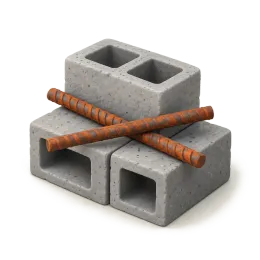
Key numbers
- 8×8×16 standard: about 40 lb (18.1 kg) each
- 8×8×16 lightweight: about 26 lb (11.8 kg) each
- Pallet of 90 standard 8 in blocks ≈ 3,600 lb (1.8 US tons)
- Block wall: 1.125 blocks per ft² ≈ 45 lb/ft² before mortar and grout
On this page
- How to use the Cinder Block Weight Calculator
- How much does a cinder block weigh?
- Concrete block weight chart by size
- How much does a pallet of cinder blocks weigh?
- How much do 100, 500 or 1,000 blocks weigh?
- How much does a block wall weigh per square foot?
- Lightweight vs standard blocks: which should you buy?
- Common mistakes with block weight
- Block weight vs the other masonry tools
- Frequently asked questions
How to use the Cinder Block Weight Calculator
- 1Enter your numbersFill in number of blocks, block, your block weight (overrides) (lb) or blocks per pallet.
- 2Check the assumptionsUnit weights from the Basalite building-block cut sheet (lightweight: Partanna CMU data sheet). Weights vary by plant, aggregate and moisture; use your supplier’s figure.
- 3Read the resultsThe calculator shows total weight, us tons, kilograms, pallets or weight per block, updated as you type.
- 4Use the resultRound up to what your supplier sells, and keep a little extra for waste.
Results update as you type. Back to the calculator ↑
How much does a cinder block weigh?
A standard hollow 8×8×16 in concrete block weighs about 40 lb (18.1 kg). That figure comes from manufacturer Basalite’s building-block cut sheet. Lightweight blocks, made with lighter aggregate, can weigh as little as 26 lb (11.8 kg); Partanna’s data sheet lists 38 lb for its standard block and 26 lb for its lightweight one.
Block weight is not one fixed number. It depends on the concrete density each plant uses, the core shape and the moisture in the block. The figures here are published manufacturer weights; for a truck payload or a structural load, use the cut sheet from your own supplier.
“Cinder block” is the everyday name. The trade term is concrete masonry unit (CMU).
Concrete block weight chart by size
This chart lists the weights printed on manufacturer data sheets, converted to kilograms. Nominal sizes include a ⅜ in mortar joint, so an “8×8×16” block actually measures 7⅝ × 7⅝ × 15⅝ in.
| Block (nominal W × H × L, in) | Actual size (in) | Weight (lb) | Weight (kg) | Per pallet (Basalite) | Pallet weight (lb) | Source |
|---|---|---|---|---|---|---|
| 8×8×16 standard (hollow) | 7⅝ × 7⅝ × 15⅝ | 40 | 18.1 | 90 | 3,600 | Basalite |
| 8×8×16 lightweight | 7⅝ × 7⅝ × 15⅝ | 26 | 11.8 | — | — | Partanna |
| 6×8×16 standard (hollow) | 5⅝ × 7⅝ × 15⅝ | 27 | 12.2 | 120 | 3,240 | Basalite |
| 8×8×8 half block | 7⅝ × 7⅝ × 7⅝ | 22 | 10.0 | 150 | 3,300 | Basalite |
| 6×8×8 half block | 5⅝ × 7⅝ × 7⅝ | 12 | 5.4 | 200 | 2,400 | Basalite |
| 8×4×16 solid | 7⅝ × 3⅝ × 15⅝ | 28 | 12.7 | 120 | 3,360 | Basalite |
| 16×4×16 solid base pad | 15⅝ × 3⅝ × 15⅝ | 58 | 26.3 | 54 | 3,132 | Basalite |
Basalite also lists its 8×8×16 bond beam at 40 lb, the same as the standard block. We do not list 4, 10 or 12 in blocks here because we could not open a manufacturer sheet confirming their weights; they are heavier or lighter roughly in step with their width, so ask your supplier.
Why the same block can weigh 38 or 40 lb
Partanna’s standard block is made from 136.8 lb/ft³ material and weighs 38 lb; its lightweight block is 96.5 lb/ft³ and weighs 26 lb. Same size, different concrete. A wet block from an outdoor yard also weighs more than a dry one.
How much does a pallet of cinder blocks weigh?
A pallet of 90 standard 8×8×16 blocks weighs about 3,600 lb (1.8 US tons, 1,633 kg) at 40 lb each. That is close to the pallet weight for every block size in the chart, roughly 2,400 to 3,600 lb, because plants size pallets to similar loads.
Pallet counts vary by manufacturer. Use the calculator above: enter the number of blocks, pick the block or type your supplier’s weight, and set the pallet count to get total weight and pallets.
How much do 100, 500 or 1,000 blocks weigh?
Most people ask this to plan a pickup or trailer trip. Multiply the count by the unit weight:
Total weight = number of blocks × weight per block
| Blocks | Standard 40 lb (lb) | US tons | kg | Lightweight 26 lb (lb) | US tons |
|---|---|---|---|---|---|
| 10 | 400 | 0.20 | 181 | 260 | 0.13 |
| 50 | 2,000 | 1.00 | 907 | 1,300 | 0.65 |
| 90 | 3,600 | 1.80 | 1,633 | 2,340 | 1.17 |
| 100 | 4,000 | 2.00 | 1,814 | 2,600 | 1.30 |
| 200 | 8,000 | 4.00 | 3,629 | 5,200 | 2.60 |
| 500 | 20,000 | 10.00 | 9,072 | 13,000 | 6.50 |
| 1,000 | 40,000 | 20.00 | 18,144 | 26,000 | 13.00 |
Compare the total with your vehicle’s payload rating on the door-jamb sticker, not the “ton” name of the truck. For more than a pallet or two, delivery is usually the safer choice.
Worked example: block walls for a 10 × 10 ft shed, 8 ft high
- Wall area: 40 ft of perimeter × 8 ft = 320 ft²
- Blocks: 320 × 1.125 = 360 blocks (before openings and breakage; corners overlap slightly)
- Weight: 360 × 40 lb = 14,400 lb (7.2 tons) standard, or 9,360 lb lightweight
- That is four pallets of 90, delivered
How much does a block wall weigh per square foot?
An ungrouted wall of 40 lb 8×8×16 blocks weighs about 45 lb per square foot of wall face, before mortar. Each block covers 8 × 16 = 128 in² of wall including the joint, so a square foot (144 in²) holds 1.125 blocks.
Wall weight (lb/ft²) ≈ 1.125 × block weight (lb)
With lightweight 26 lb blocks that drops to about 29 lb/ft². Mortar adds a little; filling cores with grout adds a lot. For a foundation, retaining wall or anything carrying a roof, the dead load comes from the engineer’s design, not this estimate.
Lightweight vs standard blocks: which should you buy?
Lightweight blocks are easier to lift and ship; standard blocks are the default most yards stock. Both are made in the same sizes; the difference is the density of the concrete.
- Lighter to handle: a third less weight per block means less strain over hundreds of lifts.
- Smaller loads: a pallet of 90 lightweight blocks is about 2,340 lb instead of 3,600 lb.
- Availability and price: not every yard stocks lightweight units. Compare prices on the concrete block price page.
- Design requirements: if your plans specify a block type, strength or fire rating, buy that block; the class affects more than weight.
Common mistakes with block weight
- Using one internet number for every block. Weights vary by plant; use your supplier’s cut sheet.
- Forgetting pallets in the payload. Count the wooden pallet and straps when loading a trailer.
- Overloading a pickup. 100 standard blocks are 4,000 lb, well above many half-ton payload ratings.
- Ignoring grout. A grouted wall can weigh far more than the blocks alone.
- Confusing nominal and actual size. An 8×8×16 block is 7⅝ × 7⅝ × 15⅝ in.
Block weight vs the other masonry tools
This page answers how much blocks weigh. To count blocks for a wall, use the concrete block calculator; for mortar, the mortar calculator; for cost, concrete block price. For poured concrete weight, use the concrete weight calculator.
Brand names are used descriptively; this site is independent and not affiliated with Basalite, Partanna or Angelus Block.
FAQ
Frequently asked questions
How much does an 8x8x16 cinder block weigh?
About 40 lb (18.1 kg) for a standard hollow 8×8×16 in block, per Basalite's building-block cut sheet. Lightweight versions weigh less: Partanna lists 26 lb (11.8 kg). Weight varies by plant, aggregate and moisture, so check your supplier's figure.
How much does a lightweight cinder block weigh?
A lightweight 8×8×16 in block weighs about 26 lb (11.8 kg) in one manufacturer's data sheet (Partanna, 96.5 lb/ft³ concrete), against 38 lb for its standard block. That is roughly a third lighter, which adds up over a pallet: 2,340 lb instead of 3,600 lb.
How much does a pallet of cinder blocks weigh?
About 3,600 lb (1.8 US tons, 1,633 kg) for a Basalite pallet of 90 standard 8×8×16 blocks at 40 lb each. A pallet of 120 six-inch blocks at 27 lb is about 3,240 lb. Pallet counts vary by plant, so ask your supplier.
How much does a 6 inch concrete block weigh?
About 27 lb (12.2 kg) for a 6×8×16 in standard block (actual 5⅝ × 7⅝ × 15⅝ in), per Basalite's cut sheet. A 6×8×8 half block weighs about 12 lb.
How much does a solid concrete block weigh?
Basalite lists its 8×4×16 in solid block at 28 lb (12.7 kg) and its 16×4×16 in solid base pad at 58 lb (26.3 kg). Solid units have no cores, so they weigh more per inch of height than hollow blocks.
How much do 100 cinder blocks weigh?
About 4,000 lb (2 US tons, 1,814 kg) at 40 lb per standard 8×8×16 block, or 2,600 lb at 26 lb per lightweight block. That is more than most pickup trucks can carry in one trip, so check your vehicle's payload.
How much does a block wall weigh per square foot?
About 45 lb per square foot for an ungrouted wall of 40 lb 8×8×16 blocks: 1.125 blocks per ft² × 40 lb. Mortar adds a little and grouted cores add much more, so get the engineer's dead load for anything structural.
What is the difference between a cinder block and a concrete block?
In everyday use the names mean the same thing: a hollow concrete masonry unit (CMU), usually 8×8×16 in nominal. Lightweight units use lighter aggregate, so the same size block weighs less.
4 Sources
- Basalite (manufacturer) Building Blocks cut sheet: 8x8x16 standard 40 lb, 90/pallet; 6x8x16 27 lb, 120/pallet; 8x8x8 half 22 lb; 6x8x8 half 12 lb; 8x4x16 solid 28 lb; 16x4x16 base pad 58 lb; actual dimensions
- Partanna (manufacturer) Standard & Lightweight CMU technical data (Sept 2023): 8x8x16 standard 38 lb (17.2 kg), 136.8 pcf; lightweight 26 lb (11.8 kg), 96.5 pcf
- Angelus Block, CMU dimensions and sizes: nominal 8×8×16 = actual 7⅝ × 7⅝ × 15⅝ in with a ⅜ in mortar joint
- NIST SP 811 Appendix B.9: 1 lb = 0.4535924 kg; short ton = 907.1847 kg
Last reviewed October 11, 2026 by M Bilal. Found an error? Tell us.