


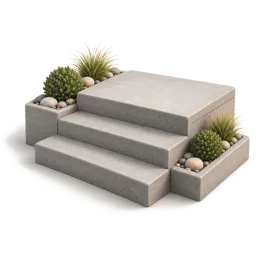
Key numbers
- Each step = width × run × (rise × step number)
- 3 steps, 4 ft wide, 7 × 11 in: 0.48 yd³ = 22 × 80 lb bags
- With a 36 in landing: 1.25 yd³ (0.96 m³), 57 × 80 lb bags
- The landing is often more than half of the concrete
On this page
- How to use the Concrete Steps Calculator
- How do you calculate concrete for steps?
- How much concrete for 1 to 5 steps?
- How big is the landing, and how much does it add?
- How many steps for your total rise?
- What size should concrete steps be?
- Metric concrete steps
- How much do concrete steps weigh?
- Forming steps so the estimate holds
- Steps onto an existing slab or walkway
- Bags or ready-mix for steps?
- How to estimate the cost of concrete steps
- Do concrete steps need footings or rebar?
- Ways to use less concrete on big steps
- Cinder block steps: blocks, fill and cap
- Common mistakes when estimating concrete steps
- Steps calculator vs other calculators: which one to use
- Frequently asked questions
How to use the Concrete Steps Calculator
- 1Pick your unitsEvery dimension has its own unit menu (in, ft, yd, cm or m); changing one converts that number so the size stays the same. The US / Metric switch sets all fields to feet and inches or meters and centimeters and resets them to typical values.
- 2Enter the dimensionsType the number of steps, rise (height) per step (default inches), run (depth) per step (default inches), width (default feet) or top landing depth (default inches). Measure the inside of the forms and the depth in several places.
- 3Set waste and quantityUse the waste slider (0 to 20%, default 10%) and allow more on uneven ground. If you have several identical pours, enter how many.
- 4Read the resultsSee the volume in cubic yards, cubic feet and cubic meters, the ready-mix order rounded up to ¼ yard, the number of 90, 80, 60, 50 and 40 lb bags rounded up, and the weight at the density you choose (150, 145 or 140 lb/ft³).
- 5Price it and save itPick a pricing basis (per cubic yard, per cubic meter or per bag of the highlighted size) and enter your local price for a material cost. Use Add to project to total several pours, and Copy link to share the exact result.
Results update as you type. Back to the calculator ↑

How do you calculate concrete for steps?
Solid steps on the ground are a stack of blocks. The bottom step is one rise tall, the second is two rises tall, and so on, because each step sits on solid concrete all the way down. Add them up, then add the top landing.
Volume (ft³) = width × run × rise × (1 + 2 + … + number of steps) + width × landing depth × total rise
In the calculator each field has its own unit menu (in, ft, yd, cm or m). Rise, run and landing start in inches and width in feet, and it converts for you. To do it by hand, convert inches to feet by dividing by 12, then divide the cubic feet by 27 for cubic yards.
- Count the steps that are separate from the landing. The landing is the top platform at door level.
- Measure rise (height) and run (tread depth) of one step. Keep every step the same.
- Measure the width of the stairs and the depth of the landing from the door.
- Add the calculator’s default 10% planning allowance for form bulges and spillage (ask your supplier what they recommend).
Worked example: 3 steps, 4 ft wide, 7 in rise, 11 in run, 36 in landing
- Step 1: 4 × 0.917 × 0.583 = 2.14 ft³
- Step 2: twice as tall = 4.28 ft³; step 3: three times = 6.42 ft³
- Steps only: 12.83 ft³ (0.48 yd³)
- Landing: 4 × 3 × 1.75 ft (21 in total rise) = 21 ft³
- Total: 33.83 ft³ = 1.25 yd³ (0.96 m³) → 57 × 80 lb bags, 63 with 10% extra
The shortcut 1 + 2 + … + n equals n × (n + 1) ÷ 2, so 3 steps count as 6 step-blocks, 4 steps as 10 and 5 steps as 15. That is why volume climbs much faster than the number of steps: 5 steps hold 2.5 times the concrete of 3 steps.
How much concrete for 1 to 5 steps?
The table assumes a 7 in rise and an 11 in run, the defaults in the calculator. It shows each flight with no landing and with a 36 in deep landing.
| Steps | Width | No landing (ft³) | No landing (yd³) | 80 lb bags | With 36 in landing (yd³) | 80 lb bags |
|---|---|---|---|---|---|---|
| 1 | 4 ft | 2.14 | 0.08 | 4 | 0.34 | 16 |
| 2 | 3 ft | 4.81 | 0.18 | 9 | 0.57 | 26 |
| 2 | 4 ft | 6.42 | 0.24 | 11 | 0.76 | 35 |
| 3 | 3 ft | 9.63 | 0.36 | 17 | 0.94 | 43 |
| 3 | 4 ft | 12.83 | 0.48 | 22 | 1.25 | 57 |
| 3 | 5 ft | 16.04 | 0.59 | 27 | 1.57 | 71 |
| 4 | 4 ft | 21.39 | 0.79 | 36 | 1.83 | 83 |
| 4 | 5 ft | 26.74 | 0.99 | 45 | 2.29 | 103 |
| 5 | 4 ft | 32.08 | 1.19 | 54 | 2.48 | 112 |
| 5 | 5 ft | 40.10 | 1.49 | 67 | 3.11 | 140 |
| 6 | 4 ft | 44.92 | 1.66 | 75 | 3.22 | 145 |
Bag counts have no waste allowance; add 10%. Notice how fast the landing adds up: on a 3-step, 4 ft flight it is 21 of the 33.83 ft³.
Other rise and run combinations
Rise and run change the volume less than the landing does, but they still matter on longer flights. All rows are 4 ft wide.
| Rise × run | 3 steps, no landing (ft³) | 3 steps + 36 in landing (yd³) | 4 steps, no landing (ft³) | 4 steps + 36 in landing (yd³) | 80 lb bags, 4 steps + landing |
|---|---|---|---|---|---|
| 6 × 12 in | 12.00 | 1.11 | 20.00 | 1.63 | 74 |
| 7 × 11 in | 12.83 | 1.25 | 21.39 | 1.83 | 83 |
| 7 × 12 in | 14.00 | 1.30 | 23.33 | 1.90 | 86 |
| 7½ × 10 in | 12.50 | 1.30 | 20.83 | 1.88 | 85 |
How big is the landing, and how much does it add?
The landing is a solid block as tall as the whole flight, so it is often the largest part of the pour. For 3 steps 4 ft wide at 7 × 11 in (21 in total rise):
| Landing depth | Total (ft³) | Total (yd³) | Order with 10% extra | 80 lb bags (+10%) |
|---|---|---|---|---|
| No landing | 12.83 | 0.48 | ¾ yd³ | 24 |
| 3 ft | 33.83 | 1.25 | 1½ yd³ | 63 |
| 4 ft | 40.83 | 1.51 | 1¾ yd³ | 75 |
| 5 ft | 47.83 | 1.77 | 2 yd³ | 88 |
Each extra foot of landing depth adds 7 ft³ here (4 ft wide × 1.75 ft high). Size the landing from your plans and local code; the door swing and any handrail often decide it.
A front stoop with no separate steps is just the landing on its own: width × depth × height. A 5 × 4 ft stoop 21 in high is 35 ft³, or 1.30 yd³ (59 × 80 lb bags, 65 with extra).
How many steps for your total rise?
Total rise is the height from the finished ground (or walkway) to the top of the landing, usually just below the door threshold. Divide it by your target rise and round up to a whole number of steps; then divide the total rise by that number to get the actual rise for each step.
| Total rise | Steps at about 7 in | Actual rise per step | Steps at about 7½ in | Actual rise per step |
|---|---|---|---|---|
| 14 in | 2 | 7 in | 2 | 7 in |
| 21 in | 3 | 7 in | 3 | 7 in |
| 24 in | 4 | 6 in | 4 | 6 in |
| 28 in | 4 | 7 in | 4 | 7 in |
| 30 in | 5 | 6 in | 4 | 7½ in |
| 36 in | 6 | 6 in | 5 | 7.2 in |
| 42 in | 6 | 7 in | 6 | 7 in |
When the division does not come out even, the rise per step changes, and so does the concrete. A 30 in rise as 5 steps of 6 in uses more concrete than 4 steps of 7½ in, because the extra step adds another full tread. Run both options in the calculator before you build forms.
What size should concrete steps be?
The most important rule is consistency: every rise and every run in a flight should match, because uneven steps are a trip hazard. Your local building code sets the maximum rise and minimum run, so take the numbers from your code or plans. The calculator defaults of 7 in × 11 in are only a starting point.
- Total rise decides the step count, as shown above.
- Landing. Many entry doors need a landing in front of them. Size it to your plans.
- Width. Match the door and walkway; 4 ft is the calculator default. Volume rises in direct proportion: 3 steps with a 36 in landing need 0.94 yd³ at 3 ft wide, 1.25 yd³ at 4 ft, 1.57 yd³ at 5 ft, 1.88 yd³ at 6 ft and 2.51 yd³ at 8 ft.
- Codes vary. Rise, run, landing size and handrails for entry steps are set by your local building code, so check before you build forms.
Metric concrete steps
In metric units the method is the same. Three steps 1.2 m wide with an 18 cm rise and 28 cm tread need 0.36 m³ on their own. Add a 0.9 m deep landing and the total is 0.95 m³, which weighs about 2,270 kg wet and equals about 56 bags of 80 lb concrete. Switch the calculator to Metric to enter centimetres and metres, and round the order up to your supplier’s increment.
How much do concrete steps weigh?
At about 150 lb/ft³, solid steps are far heavier than they look. Three steps 4 ft wide at 7 × 11 in weigh about 1,925 lb on their own and about 5,075 lb with a 36 in landing. Five steps with the same landing weigh about 10,060 lb. Two practical consequences follow:
- Get the position right before the pour. Once cured, a flight this heavy cannot be nudged into line with the door; removing it means breaking it out.
- The ground has to carry it. A heavy block of steps on soft, uncompacted fill will settle away from the house. Compact the base, and use footings where your plans call for them.
Forming steps so the estimate holds
Step forms bulge more than slab forms because the concrete is deeper and pushes harder on the boards. A side board that bows out ½ in along a 21 in high landing adds concrete you did not count.
- Brace the side forms every couple of feet with stakes and kickers so they cannot spread.
- Bevel the bottom edge of each riser board so the finisher can reach the tread surface beneath it.
- Fix the riser boards to cleats at each end rather than relying on nails into the side forms alone.
- Check every rise with a level and tape before the pour. A riser set ½ in high changes the landing height and the door clearance.
- Fill from the bottom step up, and tap the forms to release trapped air.
The calculator’s volume assumes perfectly straight forms, and its 10% waste setting is a planning allowance for small form bulges and spillage, not a measured figure. On very tall or wide flights, brace the forms more rather than relying on extra concrete, and ask your supplier how much extra to order.
Steps onto an existing slab or walkway
When steps sit on an existing concrete walkway or patio, the bottom step starts at the slab surface, so measure total rise from the slab, not from the soil. If the walkway is being poured at the same time, calculate it with the concrete slab calculator and add the two with Add to project. A 4 ft wide, 10 ft long walkway at 4 in adds 0.49 yd³.
Steps that drop from a raised patio into a yard have no landing of their own; the patio is the landing. Enter a landing depth of 0 and the calculator gives the steps only.
Bags or ready-mix for steps?
Small flights are a bag job; anything with a big landing usually is not. Under about ½ yd³ (around 23 × 80 lb bags), bags and a rented mixer are practical. A 3-step flight with a landing is 1.25 yd³, or 57 bags and about 4,600 lb of dry mix, so compare that with a small ready-mix delivery. Ask your plant about minimum loads and short-load charges.
Bagged concrete such as QUIKRETE Concrete Mix lists steps among its uses and is rated for pours 2 in thick or more. Use the yield on the bag you buy; an 80 lb bag makes about 0.60 ft³ and a 60 lb bag about 0.45 ft³, so the same 3-step flight with a landing takes 76 × 60 lb bags.
Steps are also slow to place. Each tread is finished separately and the forms need time to be filled from the bottom up, so a crew mixing bags by hand must keep up with the finisher. If you go with bags, have the mixer, water and all the bags on site before you start.
How to estimate the cost of concrete steps
There is no reliable national price for steps, because concrete, forms and labor vary by area. Build your own estimate from the volume:
Material cost = cubic yards ordered × your price per yard, or bags × your price per bag
For the 3-step flight with a 36 in landing that means 1½ yd³ of ready-mix, or 63 × 80 lb bags with 10% extra. Add form lumber, stakes, rebar or mesh, any delivery or short-load charge, and labor quotes. Enter your local price per yard in the calculator for the material cost, and see concrete price per yard for what drives that price. For a full estimate with labor, demolition and repair options, use the concrete steps cost calculator.
Do concrete steps need footings or rebar?
Often, yes, but it depends on where you live and how the steps attach to the house. Steps tied to a house foundation in a cold climate usually need footings below the frost line so they do not heave apart from the house. Reinforcement and anchoring to the foundation are also common. Follow your plans and local code.
- Calculate footings separately with the footing calculator and use Add to project to total them with the steps. Two round piers 12 in across and 36 in deep, for example, add 4.71 ft³ (8 × 80 lb bags).
- Size reinforcement with the rebar calculator.
- Steps that span between supports, rather than resting on solid ground, are structural and should be designed by a professional.
Ways to use less concrete on big steps
The calculator gives the solid volume, which is the safe number for small steps. On tall flights and large landings, many builders fill the core with compacted gravel or clean broken concrete and pour a shell several inches thick over it. Estimate the fill as a block and subtract it from the total, but keep the shell thickness your plans specify.
Worked example: 4 steps, 5 ft wide, 4 ft landing, with a filled core
- Solid volume: 4 steps at 7 × 11 in plus a 4 ft landing, 5 ft wide = 73.40 ft³ (2.72 yd³)
- Core under the landing, leaving a 6 in shell at the sides, front and top: 4 ft wide × 3.5 ft deep × 22 in high = 25.67 ft³
- Shell: 73.40 ft³ solid minus the 25.67 ft³ core = 47.74 ft³ (1.77 yd³)
- Order with 10% extra: 2 yd³ instead of 3 yd³, about 0.95 yd³ of concrete saved
- The core needs about 25.7 ft³ of compacted fill; use the shell thickness and fill your plans call for
Cinder block steps: blocks, fill and cap
Cinder block steps are built as stacked rings of concrete block, one course per step, filled with compacted gravel and topped with a poured concrete cap. You buy blocks for the walls, fill for the core and concrete only for the cap, so the concrete order is far smaller than for solid steps.
To count blocks, each course is a U of block: the front wall across the full width plus two side walls back to the house. With 8 × 8 × 16 in blocks (actual 7⅝ × 7⅝ × 15⅝ in, laid at 16 in per block with the mortar joint), the side walls are the course depth minus the 8 in front block. Course 1 runs under every tread; each course above is one tread shorter.
Worked example: 3 cinder block steps, 4 ft wide, 12 in treads
- Course 1: 48 in front + 2 × (36 − 8) in sides = 104 in → 6.5 blocks
- Course 2: 48 + 2 × (24 − 8) = 80 in → 5 blocks; course 3: 48 + 2 × (12 − 8) = 56 in → 3.5 blocks
- Total: 15 blocks; buy 16 with about 5% for cuts and breakage
- Cap: 4 ft × 3 ft of treads at 4 in = 4 ft³ (0.11 m³) → 7 × 80 lb bags, 8 with 10% extra
- Fill: the core is roughly the solid step volume, about 16 ft³ (0.45 m³) of compacted gravel before you subtract the block walls
At 5 ft wide the same three steps take 17.25 blocks (buy 19) and a 5 ft³ cap (9 × 80 lb bags, 10 with extra); two steps 4 ft wide take 8.5 blocks (buy 9). Each riser is one block course plus the cap, so check that height against the step rules in your local code before you build; the concrete block calculator handles taller block walls and mortar.
Common mistakes when estimating concrete steps
- Leaving out the landing. On 3 steps 4 ft wide the 36 in landing is 21 ft³, more than the steps themselves (12.83 ft³).
- Counting only the treads. Treating each step as a 4 in slab gives 3.67 ft³ for a 3-step flight; the solid steps need 12.83 ft³, three and a half times more.
- Rounding the rise up by an inch. Building 3 steps with an 8 in rise instead of 7 in, with the same landing, takes 38.67 ft³ instead of 33.83 ft³, and makes the top step miss the door threshold.
- Using the total rise as the step count. Count steps from total rise ÷ target rise, rounded up. A 30 in rise is 4 or 5 steps, not 4.3.
- Forgetting footings and piers. Two 12 in piers 36 in deep add 4.71 ft³, 8 more bags.
- Ordering without waste. Forms can bulge and concrete spills. With the calculator’s default 10% planning allowance, 57 bags becomes 63; ask your supplier what they recommend.
Steps calculator vs other calculators: which one to use
- This steps calculator: poured stairs and landings, where each step is a different height.
- Concrete slab calculator: a flat walkway or patio at the bottom of the steps.
- Concrete footing calculator: footings and frost walls under the steps.
- Concrete bag calculator: bag counts for any volume in 40, 50, 60, 80 or 90 lb bags.
FAQ
Frequently asked questions
How much concrete do I need for 3 steps?
Three steps 4 ft wide with a 7 in rise and 11 in run need 12.83 ft³ (0.48 yd³) without a landing: 22 bags of 80 lb concrete, or 24 with 10% extra. With a 36 in deep landing the total is 1.25 yd³, or 57 bags.
How much concrete to pour 4 concrete steps?
Four steps 4 ft wide, 7 in rise and 11 in run, need 21.39 ft³ (0.79 yd³) or 36 × 80 lb bags. Add a 36 in landing and it rises to 1.83 yd³ (83 bags). Price depends on your local concrete and labor quotes.
How do I calculate the amount of concrete needed for stairs?
Multiply width × run × rise for the first step, then add twice that for step 2, three times for step 3 and so on. Add the landing (width × depth × total height). Divide cubic feet by 27 for yards, or use the calculator.
How many bags of concrete for 2 steps?
Two steps 4 ft wide with a 7 in rise and 11 in run need 6.42 ft³: 11 bags of 80 lb or 15 bags of 60 lb concrete. With a 36 in landing the total is 20.42 ft³, or 35 × 80 lb bags.
How many bags of concrete for 5 steps?
Five steps 4 ft wide, 7 in rise and 11 in run, need 32.08 ft³ (1.19 yd³), which is 54 bags of 80 lb concrete. With a 36 in landing it needs 2.48 yd³, so ready-mix is the practical choice.
What rise and run should concrete steps have?
Your local building code sets the maximum rise and minimum run for steps, and the limits vary by location, so check yours before forming. Every rise in a flight should be the same height. The calculator starts at a 7 in rise and 11 in run, which you can change.
Can I fill concrete steps with gravel or rubble to save concrete?
Yes, on many steps. Builders often fill the core with compacted gravel or broken concrete and pour a shell several inches thick. The calculator gives the solid volume, so your real need will be lower; follow your plans.
How many cinder blocks do I need for 3 steps?
About 15 standard 8 × 8 × 16 in blocks for 3 steps 4 ft wide with 12 in treads: 6.5, 5 and 3.5 blocks per course. Buy 16 for cuts. The 4 in concrete cap takes about 4 ft³, or 7 × 80 lb bags (8 with 10% extra).
How much concrete for 6 steps?
Six steps 4 ft wide with a 7 in rise and 11 in run need 44.92 ft³ (1.66 yd³), or 75 bags of 80 lb concrete, without a landing. With a 36 in landing the total is 3.22 yd³, so order ready-mix.
How many steps do I need for a 28 inch rise?
Four steps of exactly 7 in. Divide the total rise by your target rise and round up: 28 ÷ 7 = 4. For a 30 in rise, 4 steps gives 7½ in each and 5 steps gives 6 in each. Keep every rise identical.
How much does the landing size change the concrete?
A lot. For 3 steps 4 ft wide at 7 × 11 in, a 3 ft deep landing brings the total to 1.25 yd³, a 4 ft landing to 1.51 yd³ and a 5 ft landing to 1.77 yd³. Each extra foot adds 7 ft³ at a 21 in height.
How much concrete for a front stoop?
A stoop is a block: width × depth × height. A 5 × 4 ft stoop 21 in high needs 35 ft³ (1.30 yd³), or 59 bags of 80 lb concrete. With 10% extra, order 1½ yd³ of ready-mix or buy 65 bags.
How much do concrete steps weigh?
About 150 lb per cubic foot of solid concrete. Three 4 ft wide steps with a 36 in landing (33.83 ft³) weigh about 5,075 lb. Without the landing the steps alone weigh about 1,925 lb, too heavy to move once cured.
How much concrete for steps in cubic metres?
Three steps 1.2 m wide with an 18 cm rise and 28 cm tread need 0.36 m³. Add a 0.9 m deep landing and the total is 0.95 m³, about 2,270 kg of concrete. Switch the calculator to Metric to enter centimetres.
How do I estimate the cost of concrete steps?
Multiply the volume by your local price: yards × price per yard for ready-mix, or bags × bag price. A 3-step flight with a landing is 1.5 yd³ ordered or 63 × 80 lb bags; add forms, rebar and any labor quotes.
How much concrete for wider steps?
Volume grows in step with width. Three steps at 7 × 11 in with a 36 in landing need 0.94 yd³ at 3 ft wide, 1.25 yd³ at 4 ft, 1.57 yd³ at 5 ft, 1.88 yd³ at 6 ft and 2.51 yd³ at 8 ft.
4 Sources
- Angelus Block CMU dimensions: nominal 8 × 8 × 16 in = actual 7-5/8 × 7-5/8 × 15-5/8 in with 3/8 in joint
- QUIKRETE Concrete Mix (No. 1101) data sheet: bag yields, steps listed as a use
- WSDOT Bridge Design Memo 05-2010: normal concrete 150 lb/ft³ (155 lb/ft³ used for reinforced dead load)
- FHWA-HRT-05-057 Appendix C: concrete unit weights range from about 140 to 155 lb/ft³
Last reviewed October 9, 2026 by M Bilal. Found an error? Tell us.