


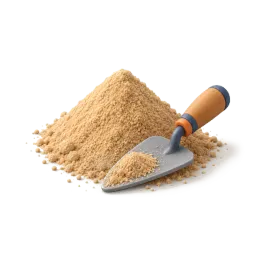
Key numbers
- Formula: area (ft²) × depth (in) ÷ 324 = cubic yards
- About 1.35 tons per cubic yard (planning figure from QUIKRETE Mason Sand, ≈1.6 t/m³; ask your supplier)
- 1 ton covers about 240 ft² at 1 in, 120 ft² at 2 in
- 54 bags of 0.5 ft³ (about 50 lb each) make one cubic yard
On this page
- How to use the Sand Calculator
- How to calculate how much sand you need
- Sand for common areas
- How many tons of sand in a yard?
- How much sand for a sandbox?
- How much sand do I need under an above-ground pool?
- Sand for a paver patio: bedding layer and base
- How far does a ton of sand go?
- Sand for leveling a lawn
- Ordering bulk sand: what to ask the supplier
- Which type of sand is this calculator for?
- Sand depth for common jobs
- How much sand per square metre?
- Common mistakes when ordering sand
- Sand calculator vs other calculators: which one to use
- Frequently asked questions
How to use the Sand Calculator
- 1Describe the areaChoose Rectangle (length × width), Circle (diameter) or Known area if you already have the square footage.
- 2Pick your unitsUse US (feet and inches) or Metric (meters and centimeters). Switching converts the numbers you typed, so the area stays the same.
- 3Enter the depthType how deep the sand (dry) should be, 1 in is a common starting point for this job.
- 4Choose the materialThe calculator uses 1.35 tons per cubic yard for sand (dry). Use your supplier's figure if it differs.
- 5Allow for settlingChoose the extra: none, 5%, 10% (the default) or 20% for a base you will compact.
- 6Read and price the resultsSee cubic yards, cubic feet, cubic meters, US tons and metric tonnes and the number of 0.5 ft³ bags. Enter your supplier's price per ton for the total cost.
Results update as you type. Back to the calculator ↑
How to calculate how much sand you need
Measure the area, choose the depth, and convert to cubic yards. Then convert to tons if your supplier sells by weight:
Cubic yards = area (ft²) × depth (in) ÷ 324 · Tons ≈ cubic yards × 1.35
The 324 is 12 inches per foot × 27 cubic feet per cubic yard. The 1.35 is the figure implied by QUIKRETE Mason Sand’s 50 lb ≈ 0.5 ft³ bag yield; use your supplier’s number if they give one.
- Measure the area in feet. For circles, such as a round pool base, choose the circle shape and enter the diameter.
- Set the depth for the job: the bedding depth in the paver maker’s guide (examples here use 1 in), the depth in the pool maker’s instructions under a pool (examples here use 2 in), or your chosen fill depth for a sandbox (examples here use 6–12 in).
- Run the calculator. It gives cubic yards, cubic feet, cubic meters, tons and bags.
- Add about 10% for screeding, compaction and uneven ground.
Worked example: 12 × 12 ft paver patio, 1 in sand bed
- Area: 12 × 12 = 144 ft²
- 144 × 1 ÷ 324 = 0.44 yd³ (12 ft³, 0.34 m³)
- Weight: 0.44 × 1.35 = about 0.6 tons (0.66 tons with 10% extra)
- In bags: 12 ft³ ÷ 0.5 = 24 bags of 0.5 ft³ (27 with 10% extra)
Sand for common areas
Most searches are for a specific size. This table gives volume and weight at 1 in and 2 in example depths. Tons use 1.35 tons per cubic yard.
| Area | Depth | Cubic feet | Cubic yards | Tons (approx.) | Cubic meters | 0.5 ft³ bags |
|---|---|---|---|---|---|---|
| 4 × 8 ft (32 ft²) | 1 in | 2.7 | 0.10 | 0.13 | 0.08 | 6 |
| 10 × 10 ft (100 ft²) | 1 in | 8.3 | 0.31 | 0.42 | 0.24 | 17 |
| 10 × 10 ft (100 ft²) | 2 in | 16.7 | 0.62 | 0.83 | 0.47 | 34 |
| 12 × 12 ft (144 ft²) | 1 in | 12.0 | 0.44 | 0.60 | 0.34 | 24 |
| 10 × 20 ft (200 ft²) | 1 in | 16.7 | 0.62 | 0.83 | 0.47 | 34 |
| 20 × 20 ft (400 ft²) | 1 in | 33.3 | 1.23 | 1.67 | 0.94 | 67 |
| 20 × 20 ft (400 ft²) | 2 in | 66.7 | 2.47 | 3.33 | 1.89 | 134 |
| 24 × 24 ft (576 ft²) | 1 in | 48.0 | 1.78 | 2.40 | 1.36 | 96 |
| 500 ft² | 1 in | 41.7 | 1.54 | 2.08 | 1.18 | 84 |
| 1,000 ft² | 1 in | 83.3 | 3.09 | 4.17 | 2.36 | 167 |
| 1,000 ft² | 2 in | 166.7 | 6.17 | 8.33 | 4.72 | 334 |
Bag counts are exact, before extra. Above roughly a ton, bulk delivery is usually far less lifting than 40 or more bags.
For a size not listed, scale from the nearest row: area doubles, sand doubles. A 10 × 12 ft area (120 ft²) at 1 in is 0.37 yd³, about 0.5 tons, and a 20 × 30 ft area (600 ft²) at 1 in is 1.85 yd³, about 2.5 tons. Depth scales the same way, so 2 in is always twice the 1 in figure and 3 in three times it.
How many tons of sand in a yard?
About 1.35 US tons, or 2,700 lb, per cubic yard, the figure implied by QUIKRETE Mason Sand (about 0.5 ft³ per 50 lb bag, or about 100 lb/ft³). Other sands differ, so ask your supplier. In metric that is about 1.6 tonnes per cubic metre, and about 100 lb per cubic foot.
That density gives a few handy rules:
- 1 ton of sand is about 0.74 yd³ and covers about 240 ft² at 1 in deep, or 120 ft² at 2 in.
- A 50 lb bag holds roughly 0.5 ft³, so about 54 bags make a cubic yard and 40 bags make a ton.
- Moisture changes the weight. Damp sand straight from an open pile weighs more than dry sand, so a ton of wet sand covers less. Ask the supplier for their tons per yard.
In metric units, 2,700 lb per cubic yard is about 1,225 kg per cubic yard, or about 1,602 kg per cubic metre, which this page rounds to 1.6 tonnes. A 50 lb bag is about 22.7 kg. If a supplier gives you a different density, divide their tons by your cubic yards to check it: 2.7 tons for 2 yd³ is the same 1.35 tons per yard, while 3 tons for 2 yd³ is 1.5 tons per yard and means wetter or heavier sand.
Convert in this order: work out the volume from the area and depth first, then turn it into weight. Going the other way, from a ton quote back to area, is where most mistakes happen, because the density you assume decides the answer.
How much sand for a sandbox?
Multiply length × width × fill depth. The examples below use fill depths of 6–12 in; pick the depth that suits your box and check the sandbox maker’s instructions if it has them.
| Sandbox | Fill depth | Cubic feet | Cubic yards | Tons (approx.) | 0.5 ft³ bags |
|---|---|---|---|---|---|
| 4 × 4 ft | 6 in | 8 | 0.30 | 0.40 | 16 |
| 4 × 4 ft | 12 in | 16 | 0.59 | 0.80 | 32 |
| 5 × 5 ft | 12 in | 25 | 0.93 | 1.25 | 50 |
| 6 × 6 ft | 12 in | 36 | 1.33 | 1.80 | 72 |
| 8 × 8 ft | 12 in | 64 | 2.37 | 3.20 | 128 |
Buy sand sold as play sand for children’s sandboxes and follow the product label. Our calculator handles the volume; it does not judge whether a product is suitable for play.
For a round sandbox, use the circle shape: a 6 ft round box filled 9 in deep holds 21.21 ft³ (0.79 yd³), about 1.06 tons or 43 bags of 0.5 ft³. Smaller boxes add up quickly in bags too: a 4 × 6 ft box at 9 in is 18 ft³, or 36 bags weighing about 1,800 lb in total.
How much sand do I need under an above-ground pool?
Multiply the pool’s footprint by the sand depth. Pools are round, so the footprint is 3.1416 × (diameter ÷ 2)². Pool makers set their own base requirements, and some call for a wider pad than the pool itself, so read the installation guide before you order; the table gives the volume for the pool footprint at common depths.
| Pool diameter | Footprint (ft²) | 1 in (yd³ / tons) | 2 in (yd³ / tons) | 2 in tons +10% | 2 in, 0.5 ft³ bags | 3 in (yd³ / tons) |
|---|---|---|---|---|---|---|
| 12 ft | 113.1 | 0.35 / 0.47 | 0.70 / 0.94 | 1.04 | 38 | 1.05 / 1.41 |
| 15 ft | 176.7 | 0.55 / 0.74 | 1.09 / 1.47 | 1.62 | 59 | 1.64 / 2.21 |
| 16 ft | 201.1 | 0.62 / 0.84 | 1.24 / 1.68 | 1.84 | 68 | 1.86 / 2.51 |
| 18 ft | 254.5 | 0.79 / 1.06 | 1.57 / 2.12 | 2.33 | 85 | 2.36 / 3.18 |
| 21 ft | 346.4 | 1.07 / 1.44 | 2.14 / 2.89 | 3.17 | 116 | 3.21 / 4.33 |
| 24 ft | 452.4 | 1.40 / 1.88 | 2.79 / 3.77 | 4.15 | 151 | 4.19 / 5.65 |
| 27 ft | 572.6 | 1.77 / 2.39 | 3.53 / 4.77 | 5.25 | 191 | 5.30 / 7.16 |
| 30 ft | 706.9 | 2.18 / 2.95 | 4.36 / 5.89 | 6.48 | 236 | 6.54 / 8.84 |
Oval pools are close to an ellipse: area = 3.1416 × half the length × half the width. A 15 × 30 ft oval is 353.4 ft², so a 2 in base is 2.18 yd³, about 2.95 tons (3.24 tons with 10% extra).
Worked example: 18 ft round pool on a 20 ft pad, 2 in sand
- Pad area: 3.1416 × 10² = 314.2 ft² (a 20 ft circle gives 1 ft of sand beyond the wall all round)
- 314.2 × 2 ÷ 324 = 1.94 yd³
- Weight: 1.94 × 1.35 = about 2.62 tons, or 2.88 tons with 10% extra
- In bags it would be 105 bags of 0.5 ft³, so this is a bulk delivery job
Level the ground as the pool maker’s installation guide directs before adding sand.
Sand for a paver patio: bedding layer and base
A paver patio has two loose layers: a compacted gravel base and a thin sand bedding layer on top. This page sizes the sand; the gravel calculator sizes the base. The base depth depends on your soil, climate and the paver maker’s guide, so the table shows the base volume at 4 in and 6 in for comparison only.
| Patio | Area (ft²) | 1 in sand (yd³) | Sand tons (+10%) | 0.5 ft³ bags (+10%) | Base at 4 in (yd³) | Base at 6 in (yd³) |
|---|---|---|---|---|---|---|
| 10 × 10 ft | 100 | 0.31 | 0.46 | 19 | 1.23 | 1.85 |
| 10 × 12 ft | 120 | 0.37 | 0.55 | 22 | 1.48 | 2.22 |
| 12 × 12 ft | 144 | 0.44 | 0.66 | 27 | 1.78 | 2.67 |
| 12 × 16 ft | 192 | 0.59 | 0.88 | 36 | 2.37 | 3.56 |
| 10 × 20 ft | 200 | 0.62 | 0.92 | 37 | 2.47 | 3.70 |
| 16 × 20 ft | 320 | 0.99 | 1.47 | 59 | 3.95 | 5.93 |
| 20 × 20 ft | 400 | 1.23 | 1.83 | 74 | 4.94 | 7.41 |
| 20 × 30 ft | 600 | 1.85 | 2.75 | 110 | 7.41 | 11.11 |
The bedding layer is thin. Screed it to an even depth, as the paver maker’s guide specifies, with a straight board run along two pipes or rails, and do not use extra sand to make up for a base that is out of level. Joint sand swept in after laying is a separate, small purchase; use the coverage printed on that bag.
How far does a ton of sand go?
Coverage depends only on depth. At the 1.35 tons per cubic yard our calculator uses, one ton is about 0.74 yd³.
| Depth | 1 ton covers | 1 yd³ covers | One 50 lb bag (0.5 ft³) covers |
|---|---|---|---|
| ½ in | 480 ft² | 648 ft² | 12 ft² |
| 1 in | 240 ft² | 324 ft² | 6 ft² |
| 1½ in | 160 ft² | 216 ft² | 4 ft² |
| 2 in | 120 ft² | 162 ft² | 3 ft² |
| 3 in | 80 ft² | 108 ft² | 2 ft² |
| 4 in | 60 ft² | 81 ft² | 1.5 ft² |
| 6 in | 40 ft² | 54 ft² | 1 ft² |
If the supplier’s sand is damp and runs nearer 1.5 tons per yard, one ton covers about 216 ft² at 1 in instead of 240 ft². That is why it pays to ask how they measure before ordering by weight.
Sand for leveling a lawn
Some homeowners spread a thin layer of sand, or a sand and soil blend, to fill small bumps and hollows in a lawn. Depths are fractions of an inch, so the order is smaller than people expect:
- 1,000 ft² at ¼ in: 0.77 yd³, about 1.04 tons or 42 bags of 0.5 ft³.
- 1,000 ft² at ½ in: 1.54 yd³, about 2.08 tons or 84 bags.
- 2,000 ft² at ½ in: 3.09 yd³, about 4.17 tons.
Whether to use sand, topsoil or a blend depends on your soil and grass type; heavy clay and pure sand behave very differently. Ask your local extension office before covering a whole lawn, and see the topsoil calculator if you decide on soil instead. Work the layer into the low spots with the back of a rake so the grass tips still show.
Ordering bulk sand: what to ask the supplier
Bulk sand is sold by the cubic yard at some yards and by the ton at others, and the same word can mean different products in different regions. Five questions avoid most surprises:
- Is the price per cubic yard, per ton or per tonne? The calculator gives all three, so you can compare quotes on the same basis.
- What does your sand weigh per yard? If it differs from 1.35 tons, enter it so the tons figure matches their scale.
- Is it washed, screened, or straight from the pit? That changes both the product and the weight.
- Where can the truck tip? One ton of sand is about 0.74 yd³, or 20 ft³, in a pile that needs a firm, clear spot.
- Is there a minimum load or a small-order charge? Practices vary, so ask rather than assume.
For comparison, one ton bought in bags is 40 bags of 50 lb, each lifted twice: once into the car and once into the barrow.
Which type of sand is this calculator for?
The volume maths is the same for every sand; only the weight per yard changes, and the right product depends on the job. Common names you will see at a supplier:
- Concrete sand: a coarser sand used in concrete mixes; ask your supplier or the paver maker whether it suits paver bedding.
- Mason sand: a finer sand used in mortar.
- Play sand: sand sold for children’s sandboxes; follow the product label.
- Joint or polymeric sand: sold in bags for paver joints, with its own coverage and installation instructions on the bag.
Product names and grades vary by region, so describe the job to your supplier and ask which sand they recommend. Enter their tons-per-yard figure if they sell by weight.
Sand depth for common jobs
- Paver and flagstone bedding: a thin sand layer screeded flat over a compacted gravel base, at the depth in your paver maker’s installation guide (this page uses 1 in as an example).
- Leveling under an above-ground pool: use the depth in the pool maker’s installation instructions; this page shows 1, 2 and 3 in for comparison.
- Sandbox: your chosen fill depth (examples here use 6–12 in).
- Filling joints between pavers: a small amount, usually sold by the bag. Follow the coverage on the bag for joint or polymeric sand.
For mortar and concrete you need sand as part of a mix ratio rather than a layer; the concrete mix ratio calculator gives cement, sand and stone separately.
How much sand per square metre?
In metric, each centimetre of depth needs 10 litres, or 0.01 m³, per square metre. At about 1.6 tonnes per m³ (the metric equivalent of 1.35 US tons per cubic yard), a 3 cm bed is about 48 kg per m² and a 5 cm layer about 80 kg per m².
| Area | Depth | Cubic metres | Kilograms (approx.) | Tonnes | 25 kg bags |
|---|---|---|---|---|---|
| 5 m² | 3 cm | 0.15 | 240 | 0.24 | 10 |
| 10 m² | 3 cm | 0.30 | 481 | 0.48 | 20 |
| 10 m² | 5 cm | 0.50 | 801 | 0.80 | 33 |
| 20 m² | 3 cm | 0.60 | 961 | 0.96 | 39 |
| 20 m² | 5 cm | 1.00 | 1,602 | 1.60 | 65 |
| 50 m² | 3 cm | 1.50 | 2,403 | 2.40 | 97 |
| 4 m² sandpit | 30 cm | 1.20 | 1,922 | 1.92 | 77 |
A metric tonne is 1,000 kg, about 1.102 US short tons, so a quote per tonne buys about 10% more sand than one per short ton. Switch the calculator to metric to enter metres and centimetres directly; it returns m³ and tonnes.
Common mistakes when ordering sand
- Making the bedding layer thicker than specified. A 12 × 12 ft patio needs about 0.6 tons at 1 in; at 2 in it needs 1.2 tons. Keep the bed to the thickness the paver manufacturer specifies.
- Ordering by the ton without asking about moisture. Damp sand at 1.5 tons per yard covers about 216 ft² per ton at 1 in, not 240 ft². Ask the supplier for their figure.
- Forgetting the screeding allowance. Screeding pushes sand off the edges and into low spots. On a 400 ft² patio at 1 in, the measured 1.23 yd³ becomes 1.36 yd³ with 10% extra and 1.48 yd³ (about 2 tons) with 20%.
- Sizing a pool base for the pool and not the pad. An 18 ft pool footprint at 2 in is 1.57 yd³; a 20 ft pad is 1.94 yd³, about half a ton more.
- Mixing up tons and tonnes. A metric tonne is about 1.102 short tons. On a 2-tonne order that difference is about 0.2 tons.
- Counting 50 lb bags for big jobs. A 20 × 20 ft patio bed at 1 in is 67 bags before extra. At that size, price bulk delivery.
Sand calculator vs other calculators: which one to use
Use this page when sand is a layer you spread: paver bedding, pool bases, sandboxes and leveling. For related jobs:
- The gravel base under pavers: the gravel calculator returns yards and tons of base stone.
- Sand in concrete or mortar: the concrete mix ratio calculator splits a mix into cement, sand and stone.
- A soil layer instead of sand: the topsoil calculator uses topsoil’s lighter weight per yard.
- A ton quote you need in yards: the tons to cubic yards converter converts in both directions.
FAQ
Frequently asked questions
How much sand do I need for a 10×10 area?
A 10 × 10 ft area is 100 ft². At 1 in deep it needs 0.31 yd³ (about 0.42 tons, 17 bags of 0.5 ft³). At 2 in it needs 0.62 yd³, about 0.83 tons or 34 bags.
How many tons of sand are in a cubic yard?
About 1.35 US tons (2,700 lb), the figure implied by QUIKRETE Mason Sand (50 lb ≈ 0.5 ft³), which is about 1.6 tonnes per cubic metre. Other sands and damp sand differ, so ask your supplier for their tons-per-yard figure and enter it.
How much area does a ton of sand cover?
About 240 ft² at 1 in deep and 120 ft² at 2 in, using 1.35 tons per cubic yard. One ton is about 0.74 yd³. Wetter or heavier sand covers a little less.
How much play sand do I need for a sandbox?
Multiply length × width × depth. A 4 × 4 ft sandbox filled 6 in deep needs 8 ft³: 16 bags of 0.5 ft³. At 12 in deep it needs 16 ft³, or 32 bags. A 5 × 5 ft box 12 in deep needs 50 bags.
How many 50 lb bags of sand are in a ton?
40 bags, because a US ton is 2,000 lb. At about 100 lb per cubic foot of dry sand, a 50 lb bag holds roughly 0.5 ft³, so about 54 bags make one cubic yard.
How much sand do I need for a 20×20 area?
A 20 × 20 ft area is 400 ft². A 1 in paver bed needs 1.23 yd³, about 1.67 tons (1.83 tons with 10% extra). At 2 in deep it needs 2.47 yd³ or about 3.33 tons.
How much sand do I need per square metre?
Each centimetre of depth needs 10 litres (0.01 m³) per square metre. A 3 cm paver bed is 0.03 m³ per m², about 48 kg at 1.6 tonnes per m³. For 20 m² that is 0.6 m³, close to 1 tonne.
How much sand do I need for 1,000 square feet?
At 1 in deep, 1,000 ft² needs 3.09 yd³ of sand, about 4.17 tons. At 2 in it needs 6.17 yd³, about 8.33 tons. Add 10% for screeding and uneven ground.
How much sand do I need for a 6 × 6 ft sandbox?
Filled 12 in deep, a 6 × 6 ft sandbox holds 36 ft³ of sand: 1.33 yd³, about 1.8 tons, or 72 bags of 0.5 ft³. Filled 9 in deep it holds 27 ft³, exactly 1 yd³, or 54 bags.
How much sand do I need for an above-ground pool?
Multiply the pool footprint by the depth. At an example depth of 2 in, an 18 ft round pool needs 1.57 yd³, about 2.12 tons; a 24 ft pool needs 2.79 yd³, about 3.77 tons. Follow the pool maker's base instructions, which may call for a wider pad.
How much sand for a 15 ft pool?
A 15 ft round pool covers 176.7 ft². At an example 2 in depth (use your pool maker's figure), the sand base needs 1.09 yd³, about 1.47 tons or 1.62 tons with 10% extra. In bags that is 59 bags of 0.5 ft³.
How many 50 lb bags of sand are in a yard?
About 54. A cubic yard of dry sand weighs about 2,700 lb, and a 50 lb bag holds roughly 0.5 ft³, so 27 ft³ ÷ 0.5 = 54 bags. Use the cubic feet printed on your bag if it differs.
How much area does a yard of sand cover?
One cubic yard covers 324 ft² at 1 in, 162 ft² at 2 in and 108 ft² at 3 in. At ½ in, for lawn leveling, it covers 648 ft². Divide 324 by the depth in inches.
How much does a cubic yard of sand weigh in kg?
About 1,225 kg, using the 2,700 lb per cubic yard our calculator assumes (QUIKRETE Mason Sand basis). That is about 1,602 kg per cubic metre. Damp sand weighs more, so ask your supplier for their figure.
How much sand do I need to level a lawn?
Thin layers are the norm. At ¼ in, 1,000 ft² takes 0.77 yd³, about 1.04 tons; at ½ in it takes 1.54 yd³, about 2.08 tons. Check with your local extension office whether sand suits your soil.
2 Sources
Last reviewed October 9, 2026 by M Bilal. Found an error? Tell us.