


Key numbers
- Formula: L (ft) × W (ft) × base depth (in) ÷ 324 = cubic yards
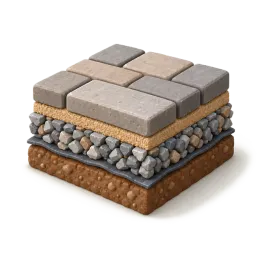
- Iowa State Extension guidance: 5 in of compacted 3/4 in-and-smaller gravel, then 1 1/2 in of sand
- At a typical 1.6 t/yd³ (use your supplier's figure), 1 ton of crusher run covers about 51 ft² at 4 in, 41 ft² at 5 in, 34 ft² at 6 in
- Add about 10% as an ordering allowance for spillage, settlement and an uneven subgrade (a rule of thumb, not a published standard; ask your supplier)
On this page
- How to use the Paver Base Calculator
- How to calculate how much paver base you need
- How deep should paver base be?
- How much paver base do I need for common patio sizes?
- How much does a ton of paver base cover?
- Paver base per square metre
- How deep do I dig for a paver patio?
- Paver base for round, curved and L-shaped patios
- Bulk delivery or bags of paver base?
- Crusher run vs #57 stone for paver base
- Common mistakes when ordering paver base
- Paver base calculator vs gravel, sand and patio calculators: which one to use
- Frequently asked questions
How to use the Paver Base Calculator
- 1Describe the areaChoose Rectangle (length × width), Circle (diameter) or Known area if you already have the square footage.
- 2Pick your unitsUse US (feet and inches) or Metric (meters and centimeters). Switching converts the numbers you typed, so the area stays the same.
- 3Enter the depthType how deep the crusher run / road base should be, 4 in is a common starting point for this job.
- 4Choose the materialPick crusher run / road base or crushed stone (#57). Each uses its own weight per cubic yard to work out tons.
- 5Allow for settlingChoose the extra: none, 5%, 10% (the default) or 20% for a base you will compact.
- 6Read and price the resultsSee cubic yards, cubic feet, cubic meters, US tons and metric tonnes. Enter your supplier's price per ton for the total cost.
Results update as you type. Back to the calculator ↑
How to calculate how much paver base you need
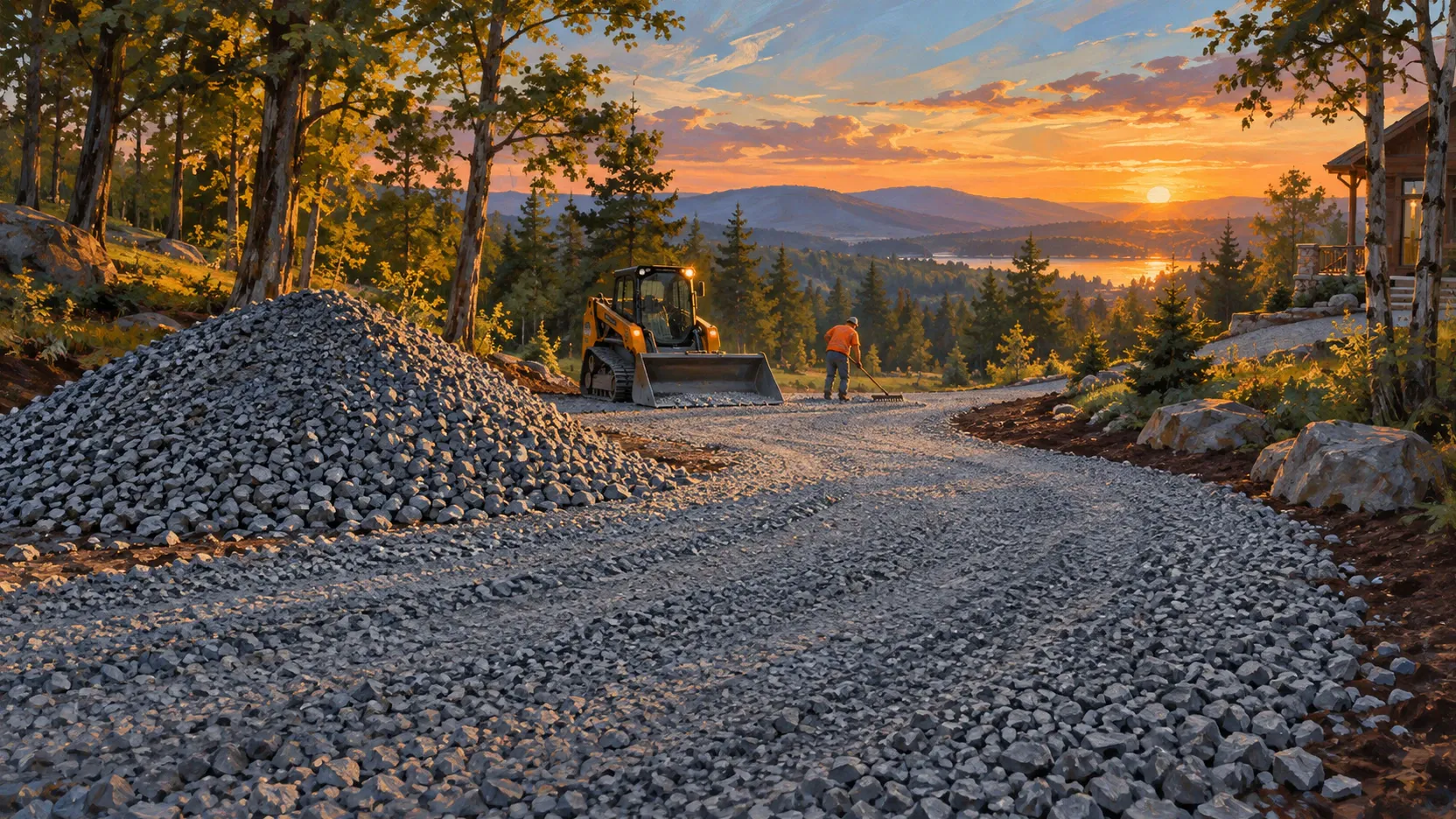
Paver base is a layer of compacted crushed stone that carries the sand and the pavers. You order it by the cubic yard or by the ton, and both come from three measurements: length and width in feet, and the finished base depth in inches.
Cubic yards = length (ft) × width (ft) × base depth (in) ÷ 324
Tons = cubic yards × your supplier’s tons per yd³ (the calculator assumes about 1.6 for crusher run and 1.35 for #57 stone)
The 324 is 12 inches per foot × 27 cubic feet per cubic yard. To count the pavers themselves by size and pattern, use the paver calculator. The calculator above runs the same formula and also returns cubic feet, cubic meters and tonnes, with crusher run and #57 crushed stone presets.
- Measure the paved area. Add a little past the edge if your edging sits on the base; split L-shapes into rectangles.
- Set the compacted depth. Iowa State University Extension’s paver guide uses 5 inches of compacted gravel. Your paver maker may give a different depth for your soil and traffic, and their guide wins for their product.
- Pick the stone. Crusher run (stone with fines) packs hard. Washed #57 stone drains freely. The weight per yard differs, so the tons differ.
- Add about 10% for spillage, settlement and a subgrade that is never perfectly flat (a rule of thumb, not a standard; your supplier can advise).
Worked example: 12 × 12 ft paver patio, 5 in base
- 12 × 12 × 5 ÷ 324 = 2.22 yd³ (60 ft³, 1.7 m³)
- Crusher run: 2.22 × 1.6 = 3.56 tons, or 3.91 tons with 10% extra
- #57 stone instead: 3 tons, or 3.3 tons with 10%
- Bedding sand at 1 1/2 in on top: 0.67 yd³, about 0.9 tons
Compact the base with a vibrating plate, making at least two passes as Iowa State Extension advises, then screed the sand without compacting it.
How deep should paver base be?
The depth that matters is the compacted, finished depth of the base. Iowa State University Extension and Outreach, in its concrete paver installation guide, tells homeowners to dig out “enough soil to allow for 5 inches of base, 1 1/2 inches of sand, plus the thickness of the paver”, to use quarried gravel 3/4 inch and smaller, and to compact it with a vibrating plate. That is the default depth in our worked examples.
The same guide sets two tolerances worth copying. The finished base should not vary more than 1/2 inch either way over a 10 ft length, and the bedding sand should not be deeper than 1 1/2 inches, because thicker sand leaves a wavy surface. It also calls for a fall of 2 inches over 8 feet so water runs away from buildings.
Paver manufacturers publish their own base depths, and they change with soil, frost and whether cars will drive on the surface. Before you order, read the installation guide for the exact paver you are buying and use its number. If you are paving a driveway, a structural engineer or the paver maker’s driveway section should set the base, not a patio rule.
The calculator accepts any depth, so you can price two depths and see the difference before you decide. On a 12 × 12 ft patio, each extra inch of base adds 0.44 yd³, about 0.71 tons of crusher run.
How much paver base do I need for common patio sizes?
This table covers common patio and walkway sizes at 4, 5 and 6 in of compacted base. Tons are crusher run at the calculator’s typical 1.6 tons per yd³ (use your supplier’s figure if they give one), and the order column adds 10%. Every figure comes from the site’s calculation library.
| Area | Yd³ at 4 in | Tons at 4 in | Yd³ at 5 in | Tons at 5 in | Order at 5 in +10% (tons) | Yd³ at 6 in | Tons at 6 in |
|---|---|---|---|---|---|---|---|
| 3 × 20 ft walkway (60 ft²) | 0.74 | 1.19 | 0.93 | 1.48 | 1.63 | 1.11 | 1.78 |
| 4 × 30 ft walkway (120 ft²) | 1.48 | 2.37 | 1.85 | 2.96 | 3.26 | 2.22 | 3.56 |
| 10 × 10 ft (100 ft²) | 1.23 | 1.98 | 1.54 | 2.47 | 2.72 | 1.85 | 2.96 |
| 10 × 12 ft (120 ft²) | 1.48 | 2.37 | 1.85 | 2.96 | 3.26 | 2.22 | 3.56 |
| 12 × 12 ft (144 ft²) | 1.78 | 2.84 | 2.22 | 3.56 | 3.91 | 2.67 | 4.27 |
| 12 × 16 ft (192 ft²) | 2.37 | 3.79 | 2.96 | 4.74 | 5.21 | 3.56 | 5.69 |
| 10 × 20 ft (200 ft²) | 2.47 | 3.95 | 3.09 | 4.94 | 5.43 | 3.70 | 5.93 |
| 12 × 20 ft (240 ft²) | 2.96 | 4.74 | 3.70 | 5.93 | 6.52 | 4.44 | 7.11 |
| 16 × 16 ft (256 ft²) | 3.16 | 5.06 | 3.95 | 6.32 | 6.95 | 4.74 | 7.59 |
| 20 × 20 ft (400 ft²) | 4.94 | 7.90 | 6.17 | 9.88 | 10.86 | 7.41 | 11.85 |
| 24 × 24 ft (576 ft²) | 7.11 | 11.38 | 8.89 | 14.22 | 15.64 | 10.67 | 17.07 |
For #57 stone, multiply any tons figure by 0.84 (the assumed 1.35 ÷ 1.6). A 20 × 20 ft patio at 5 in is 8.33 tons of #57 instead of 9.88 tons of crusher run. The cubic-yard columns do not change with stone type, because they are pure volume.
How much does a ton of paver base cover?
One ton of crusher run covers about 51 ft² at 4 in, 41 ft² at 5 in and 34 ft² at 6 in. Coverage per ton depends on both the depth and the weight of the stone, so the same ton of lighter #57 stone covers more ground.
| Compacted depth | ft² per yd³ (any stone) | ft² per ton, crusher run (1.6) | ft² per ton, #57 (1.35) | lb per ft², crusher run | lb per ft², #57 |
|---|---|---|---|---|---|
| 4 in | 81 | 50.6 | 60 | 39.5 | 33.3 |
| 5 in | 64.8 | 40.5 | 48 | 49.4 | 41.7 |
| 6 in | 54 | 33.8 | 40 | 59.3 | 50 |
To turn coverage into an order, divide your area by the figure for your depth. A 300 ft² patio at 5 in of crusher run needs 300 ÷ 40.5 ≈ 7.4 tons before the 10% allowance.
These weights are the site’s typical loose figures for each stone type. Quarries publish their own weight per yard, and moisture changes it, so if your supplier quotes a figure, multiply the cubic yards by that number instead.
Paver base per square metre
Outside the US, base is ordered by the tonne or the cubic metre and depth is given in millimetres. Using the site’s typical loose figure of 1.6 US tons per yd³, crusher run is about 1.9 tonnes per m³; #57 stone at a typical 1.35 tons per yd³ is about 1.6 tonnes per m³. If your supplier quotes a figure, use theirs instead.
| Compacted depth | m³ per m² | kg per m², crusher run | m² per tonne, crusher run | kg per m², #57 stone |
|---|---|---|---|---|
| 100 mm | 0.100 | 189.8 | 5.27 | 160.2 |
| 125 mm | 0.125 | 237.3 | 4.21 | 200.2 |
| 150 mm | 0.150 | 284.8 | 3.51 | 240.3 |
Metric jobs need no 324: multiply length × width × depth, all in metres. A 4 × 3 m patio at 125 mm is 4 × 3 × 0.125 = 1.5 m³, about 2.85 tonnes of crusher run, or 3.13 tonnes with 10% extra. Iowa State Extension’s 5 in base is 127 mm, so 125 mm is the close metric equivalent.
Worked example: 3 × 20 ft garden walkway, 5 in base
- 3 × 20 × 5 ÷ 324 = 0.93 yd³ (25 ft³, 0.71 m³)
- Crusher run: 1.48 tons, or 1.63 tons with 10% extra
- In 0.5 ft³ bags: 50 bags, or 55 with 10% extra
- Digging depth with 1 1/2 in of sand and a 2 3/8 in paver: about 8 7/8 in
Fifty bags is a lot of lifting for one path. Price a bulk load against bags before you choose.
How deep do I dig for a paver patio?
Dig to the base depth plus the sand plus the paver thickness. Iowa State University Extension spells it out that way: 5 inches of base, 1 1/2 inches of sand and the paver. Paver thickness varies by product, so read it from the pallet label or spec sheet.
- 2 3/8 in paver: 5 + 1.5 + 2.375 = about 8 7/8 in of excavation.
- 3 1/8 in paver: 5 + 1.5 + 3.125 = about 9 5/8 in of excavation.
The dig is deeper than the base, so the soil you remove is more than the stone you bring in. For a 12 × 12 ft patio dug 8 7/8 in deep, you are removing about 3.94 yd³ of soil (144 × 8.875 ÷ 324), loose and bulked up once it is out of the ground. Plan where it goes before the delivery truck arrives.
Measure depth from string lines set at finished height, not from the existing grass, which is rarely level. Build in the slope at the subgrade stage so the base and the pavers follow it rather than trying to create the fall in the sand.
Paver base for round, curved and L-shaped patios
Curved and L-shaped patios use the same depth math; only the area changes. For a circle, the area is 3.1416 × radius², where the radius is half the diameter in feet. Choose the circle shape and enter the diameter, or use the known-area option, and the calculator handles the rest.
| Round patio diameter | Area (ft²) | Yd³ at 5 in | Tons of crusher run | Tons with 10% |
|---|---|---|---|---|
| 10 ft | 78.5 | 1.21 | 1.94 | 2.13 |
| 12 ft | 113.1 | 1.75 | 2.79 | 3.07 |
| 16 ft | 201.1 | 3.10 | 4.96 | 5.46 |
For an L-shape, split it into two rectangles and add them. A 12 × 16 ft patio with an 8 × 10 ft leg is 192 + 80 = 272 ft². At 5 in deep that is 4.2 yd³, about 6.72 tons of crusher run, or 7.39 tons with 10% extra. Drawing one 20 × 16 ft box around the same shape would give 7.9 tons, over a ton too much before the allowance.
Measure to the outside of any edging that sits on the base, not to the paver line, when you work out the area.
Bulk delivery or bags of paver base?
Bags suit small walkways and repairs; most patios need a bulk delivery. A 0.5 ft³ bag holds 1/54 of a cubic yard, so a ton of crusher run at the assumed 1.6 tons per yd³ is about 33.8 of those bags. A 10 × 10 ft patio at 5 in deep takes 84 bags, or 92 with 10% extra.
Bag sizes and contents vary by brand and store. If the bag lists a volume, divide the job’s cubic feet by it. If it lists only a weight, divide the job’s total pounds by the bag weight. Ask local suppliers about minimum loads and delivery charges, which vary by area, and convert their quote to the same unit with the tons to cubic yards converter before you compare.
Spread the gravel and compact it with a vibrating plate. Iowa State Extension’s guide calls for at least two passes to remove air pockets (and two passes at right angles on the soil beneath). Check depth at several points against your string lines before the sand goes down, because fixing a low spot in the base is far easier than fixing it after the sand goes down.
Crusher run vs #57 stone for paver base
Pick the stone your paver system’s guide names. The calculator’s two presets cover the two common choices.
- Crusher run / road base (calculator assumes about 1.6 tons per yd³; ask your supplier): crushed stone mixed with stone dust. It matches Iowa State Extension’s “quarried gravel, 3/4-inch and smaller” and compacts into a dense, firm layer. It drains more slowly than washed stone.
- Crushed stone #57 (calculator assumes about 1.35 tons per yd³; ask your supplier): washed, single-size angular stone with open gaps. Some paver systems specify washed stone; if yours does, follow its guide for the bedding layer and edging too.
Regional names change: crusher run is also sold as road base, dense-graded aggregate or quarry process. Ask your supplier whether the product contains fines and what a yard of it weighs. The first answer picks the preset; the second replaces the preset if they give a figure.
Common mistakes when ordering paver base
Most paver base problems start with a quantity or depth error, not with the pavers.
- Ordering for the loose depth instead of the compacted depth. The plan depth is what remains after compaction. The roughly 10% allowance in the calculator is a rule-of-thumb allowance for settlement and spillage; very soft ground may need more.
- Ordering tons when you worked out yards. A 20 × 20 ft patio at 5 in is 6.17 yd³ but 9.88 tons of crusher run. Ordering “6.17 tons” brings about 3.86 yd³, 37.5% short.
- Using the wrong stone weight. The same 20 × 20 ft base at 5 in is 9.88 tons of crusher run and 8.33 tons of #57. Match the preset to the product, or enter your supplier’s weight.
- Making up depth with sand. Iowa State Extension caps bedding sand at 1 1/2 in because deeper sand gives a washboard surface. Fix low spots in the base, not in the sand.
- Skipping the edges. Edging restraints often sit on the base, so the base should run a little past the pavers. Add that strip to the area you measure.
- Entering depth in feet. The 324 formula expects inches. A 10 × 10 ft patio at 5 in is 1.54 yd³; entering 5 ft by mistake gives 18.52 yd³.
Paver base calculator vs gravel, sand and patio calculators: which one to use
This page sizes the compacted stone base under pavers, patio slabs and walkways. Other layers and materials have their own tools:
- Gravel calculator: loose gravel for paths, shed pads and drains, with presets for pea gravel, river rock and landscape rock.
- Sand calculator: the bedding sand layer that goes on top of the base, and joint sand.
- Driveway gravel calculator: layer-by-layer tonnage for gravel driveways rather than paved patios.
- Tons to cubic yards: when one quarry quotes by the ton and another by the yard.
- Concrete patio cost: if you are weighing a poured patio against pavers.
FAQ
Frequently asked questions
How much paver base do I need for a 10×10 patio?
At 5 in deep a 10 × 10 ft patio needs 1.54 yd³ of base, about 2.47 tons of crusher run, or 2.72 tons with 10% extra. At 4 in it needs 1.23 yd³ (1.98 tons) and at 6 in 1.85 yd³ (2.96 tons).
How much paver base do I need for a 12×12 patio?
A 12 × 12 ft patio with a 5 in compacted base needs 2.22 yd³, about 3.56 tons of crusher run, or 3.91 tons ordered with 10% extra. In #57 stone the same base is 3 tons, or 3.3 tons with 10%.
How much paver base do I need for a 20×20 patio?
At 5 in deep a 20 × 20 ft patio needs 6.17 yd³ of base, about 9.88 tons of crusher run, or 10.86 tons with 10% extra. At 4 in deep it needs 4.94 yd³ (7.9 tons) and at 6 in 7.41 yd³ (11.85 tons).
How much paver base do I need for a 10×20 patio?
A 10 × 20 ft patio at 5 in deep takes 3.09 yd³, about 4.94 tons of crusher run, or 5.43 tons with 10% extra. At 4 in it is 2.47 yd³ (3.95 tons), and at 6 in 3.7 yd³ (5.93 tons).
How much paver base do I need for a walkway?
A 3 ft wide, 20 ft long walkway with a 4 in base needs 0.74 yd³, about 1.19 tons of crusher run, or 1.3 tons with 10% extra. A 4 × 30 ft path at 4 in needs 1.48 yd³, about 2.37 tons.
How deep should paver base be?
Iowa State University Extension's paver guide calls for 5 inches of compacted gravel under 1 1/2 inches of sand. Paver manufacturers publish their own depths by soil and use, so check the installation guide for the paver you buy.
How many tons of paver base per square foot?
At the calculator's typical 1.6 tons per yd³, each square foot at 5 in deep takes about 49 lb of crusher run, or 0.025 tons. At 4 in it is about 40 lb and at 6 in about 59 lb. Multiply by your square footage and divide by 2,000 for tons.
How much area does a ton of paver base cover?
One ton of crusher run covers about 51 ft² at 4 in deep, 41 ft² at 5 in and 34 ft² at 6 in. A ton of #57 stone, at the calculator's assumed 1.35 tons per yd³, covers about 60, 48 and 40 ft². These assume typical weights; your supplier's may differ.
How much does a yard of paver base cover?
One cubic yard covers 81 ft² at 4 in deep, 64.8 ft² at 5 in and 54 ft² at 6 in, whatever the stone. Divide 324 by the depth in inches to get the coverage for any depth.
How many bags of paver base do I need?
Divide the volume by the bag size. A 3 × 20 ft walkway at 5 in deep is 25 ft³, or 50 bags of 0.5 ft³, 55 with 10% extra. Bags only make sense for small jobs; most patios need a bulk delivery.
How deep do I dig for a paver patio?
Add the base, the sand and the paver thickness. With Iowa State Extension's 5 in of gravel and 1 1/2 in of sand, a 2 3/8 in paver needs about 8 7/8 in of digging and a 3 1/8 in paver about 9 5/8 in.
Should I use crusher run or #57 stone for paver base?
Iowa State Extension describes the base as quarried gravel 3/4 in and smaller, and where vehicles will drive keeps fines passing a No. 200 sieve at 5 to 11 percent. A graded crusher run with fines fits that; some paver systems use washed #57 stone instead. The calculator assumes typical figures of about 1.6 tons per yd³ for crusher run and 1.35 for #57; weights vary by quarry, so use your supplier's figure.
How much sand do I need under pavers?
At the 1 1/2 in bedding depth in Iowa State Extension's guide, a 12 × 12 ft patio needs 0.67 yd³ of sand, about 0.9 tons. If your paver maker's guide calls for a thinner bed, such as 1 in, then at 1 in the same patio needs 0.44 yd³, about 0.6 tons. Size it on the paver sand calculator.
How much paver base per square metre?
At 125 mm deep each square metre needs 0.125 m³, about 237 kg of crusher run, assuming about 1.9 tonnes per m³ (check your supplier's figure). At 100 mm it is about 190 kg and at 150 mm about 285 kg. One tonne covers about 4.2 m² at 125 mm.
Do I need paver base under a 16×16 patio?
Yes, a compacted base carries the pavers. A 16 × 16 ft patio at 5 in deep needs 3.95 yd³, about 6.32 tons of crusher run, or 6.95 tons with 10% extra. At 4 in it needs 3.16 yd³ (5.06 tons).
Last reviewed October 9, 2026 by M Bilal. Found an error? Tell us.