


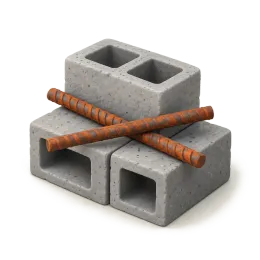
Key numbers
- Cement = powdered binder (Portland cement, ASTM C150)
- Concrete = cement + water + sand + gravel
- Mortar = cement + sand (+ lime), no gravel
- 1 yd³ of 1:2:3 concrete: 7 bags of 94 lb cement (calculator, 1.54 dry-volume factor)
- Clinker is fired at about 2,700 °F, then ground with gypsum (PCA)
On this page
- How to use the Cement vs Concrete
- What is the difference between cement and concrete?
- What is cement made of?
- What is concrete made of?
- Is concrete stronger than cement?
- Cement vs concrete vs mortar: which do I need?
- Should I buy Portland cement or bagged concrete mix?
- Why do people call concrete “cement”?
- Common mix-ups that cost money
- Which calculator do I need?
- Frequently asked questions
How to use the Cement vs Concrete
- 1Enter your numbersFill in concrete needed (yd³) or mix ratio (cement : sand : stone).
- 2Check the assumptionsUses the dry-volume method: dry materials = 1.54 × wet volume, and one 94 lb bag of Portland cement is taken as 1 ft³. Water assumes a 0.5 water-cement ratio. For a required strength, use a tested mix design or a rated premix.
- 3Read the resultsThe calculator shows portland cement (94 lb bags), sand, gravel / stone or water (approx., w/c 0.5), updated as you type.
- 4Use the resultRound up to what your supplier sells, and keep a little extra for waste.
Results update as you type. Back to the calculator ↑
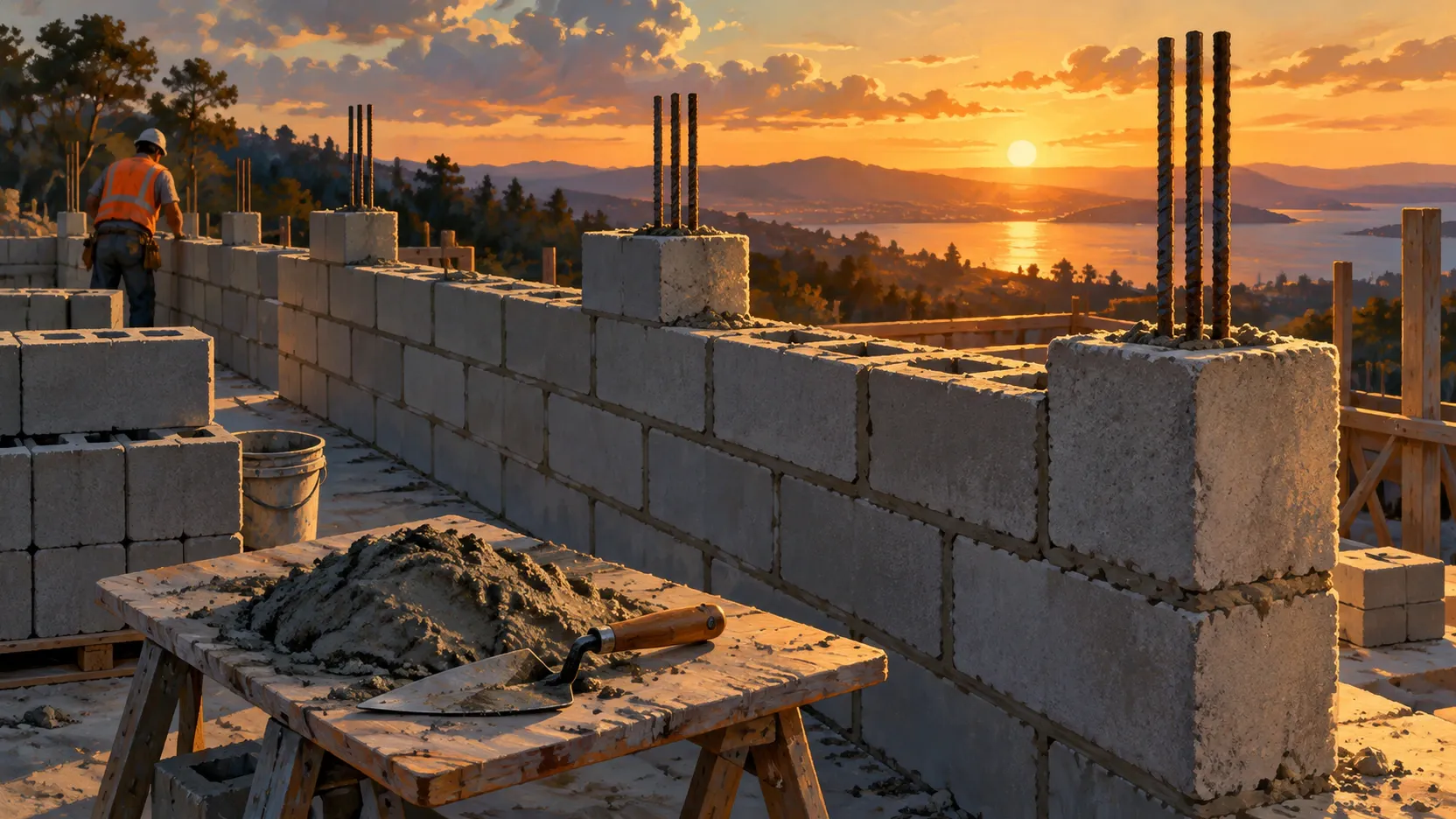
People say “cement truck”, “cement sidewalk” and “cement driveway”, but in each case the material is concrete. The calculator above shows the difference in numbers: enter a volume of concrete and it returns how much cement (and how much sand and gravel) goes into it.
What is the difference between cement and concrete?
Short answer: cement is a powder; concrete is a composite. Cement is the binder that, once wet, glues sand and gravel together. Concrete is the hardened result.
The Portland Cement Association (now the American Cement Association) puts it in one line: concrete forms “when portland cement creates a paste with water that binds with sand and rock to harden.” Portland cement is “the basic ingredient of concrete”, but it is not concrete. A bag of cement left in the rain turns into a lump, not a slab.
| Cement | Concrete | |
|---|---|---|
| What it is | Fine gray powder (binder) | Hardened mix of paste and aggregate |
| Ingredients | Clinker ground with gypsum | Cement, water, sand, gravel or crushed stone |
| US standard | ASTM C150 (Portland cement) | ASTM C94 when bought as ready-mix |
| US package | 94 lb bag (also 47 lb) | Ready-mix by the yd³, or 40/60/80 lb premix bags |
| Metric package | 25 kg or 50 kg bag | Ready-mix by the m³ |
| Used alone? | No, needs aggregate and water | Yes, placed directly in forms |
| Typical use | Ingredient in concrete, mortar, grout | Slabs, footings, driveways, posts, walls |
What is cement made of?
Short answer: limestone, clay and similar raw materials, fired in a kiln and ground fine.
According to PCA, the main elements in Portland cement are calcium, silicon, aluminum and iron, commonly sourced from limestone, marl and clay. The crushed raw mix is fed into a rotating kiln where “a roaring flame heats the material to about 2,700 degrees Fahrenheit” (about 1,480 °C), partly melting it. It leaves as clinker, gray balls about the size of marbles, which a ball mill grinds with gypsum into the powder in the bag.
In the US, Portland cement is specified under ASTM C150 (AASHTO M 85 is the highway equivalent). C150 defines several types; highway specifications commonly reference Types I, II and III, plus air-entraining versions IA, IIA and IIIA (FHWA). For a home project, the bag’s type matters less than the mix you put it in; general-purpose bags are what hardware stores stock. QUIKRETE’s Portland cement, for example, is sold in 94 lb and 47 lb bags.
What is concrete made of?
Short answer: cement, water, sand and gravel (crushed stone), sometimes with admixtures.
Water reacts with cement (hydration) and forms a paste that coats every grain of sand and stone. As the paste hardens, it locks the aggregate together. Sand fills the gaps between the stones, and paste fills the gaps in the sand, which is why the dry ingredients shrink in volume when mixed. Our calculator uses a dry-volume factor of 1.54 for that shrinkage (an estimating assumption, not a standard).
The proportions are set by a mix ratio, such as 1:2:3 (cement : sand : gravel by volume). Choosing a ratio, bucket batching and water-cement ratio are covered in detail on the concrete mix ratio calculator; this page sticks to what separates the ingredient from the product.
How much of concrete is actually cement?
Less than most people expect. Run 1 yd³ (27 ft³) through the calculator at 1:2:3:
Worked example: what goes into 1 cubic yard of 1:2:3 concrete
- Dry volume: 27 ft³ × 1.54 = 41.6 ft³
- Cement: 41.6 ÷ 6 = 6.93 ft³ → 7 bags of 94 lb (658 lb)
- Sand: 13.9 ft³ (0.51 yd³); gravel: 20.8 ft³ (0.77 yd³)
- Water at a 0.5 water-cement ratio: about 39 gallons
- At an assumed 150 lb/ft³, the yard weighs about 4,050 lb, so cement is roughly 16% by weight
In metric terms, 1 m³ of 1:2:3 concrete takes about 386 kg of cement (16 bags of 25 kg or 8 of 50 kg); 1:2:4 takes about 331 kg. Everything else is aggregate and water.
| Concrete volume | Mix | Cement (94 lb bags) | Cement (kg) | Sand (ft³) | Gravel (ft³) |
|---|---|---|---|---|---|
| 1 yd³ (27 ft³) | 1:2:3 | 7 | 295 | 13.9 | 20.8 |
| 1 yd³ (27 ft³) | 1:2:4 | 6 | 253 | 11.9 | 23.8 |
| 1 m³ (35.3 ft³) | 1:2:3 | 10 | 386 | 18.1 | 27.2 |
| 1 m³ (35.3 ft³) | 1:2:4 | 8 | 331 | 15.5 | 31.1 |
| 10 × 10 ft slab, 4 in (33.3 ft³) | 1:2:3 | 9 | 365 | 17.1 | 25.7 |
Cement kilograms are the exact (unrounded) cement volume at the calculator’s 94 lb ≈ 1 ft³ assumption; bag counts are rounded up.
Is concrete stronger than cement?
Short answer: yes. Cement is not a building material on its own; concrete is.
Neat cement paste, hardened without aggregate, uses far more cement for the same volume and shrinks more as it dries, which invites cracking. The stone in concrete carries load and restrains that shrinkage. When you need a known strength, the strength rating belongs to the concrete, not the cement: QUIKRETE Concrete Mix lists 4,000 psi (27.6 MPa) at 28 days on its data sheet, and ready-mix plants sell concrete ordered by psi under ASTM C94. A bag of Portland cement carries no psi rating for your slab, because the result depends on what you mix it with.
Cement vs concrete vs mortar: which do I need?
Short answer: concrete for anything that stands on its own or carries load; mortar for laying bricks and blocks; plain cement only as an ingredient.
| Material | Ingredients | Gravel? | Typical job | Buy as |
|---|---|---|---|---|
| Portland cement | Ground clinker + gypsum | No | Ingredient for site mixing | 94 lb / 47 lb bag; 25 / 50 kg |
| Concrete | Cement, sand, gravel, water | Yes | Slabs, footings, posts, steps | Ready-mix (yd³ / m³) or premix bags |
| Mortar | Cement, sand, often lime, water | No | Bedding brick, block and stone | Mortar mix bags or masonry cement |
| Grout | Cement, sand, sometimes pea gravel | Fine only | Filling block cores, tile joints | Bagged grout |
Mortar is weaker in bulk and lacks the coarse stone, so do not pour a slab or set a post with it. For bagged mortar per block or brick, use the mortar calculator.
Should I buy Portland cement or bagged concrete mix?
Short answer: premix for small jobs, cement plus aggregate (or ready-mix) for bigger ones.
Bagged concrete mix already contains cement, sand and gravel; you add water. Portland cement is only the binder, so you also buy, store and measure sand and gravel. The break-even depends on your local prices, so compare quotes using the inputs below rather than a national average.
Worked example: one fence post, 10 in hole, 3 ft deep
- Volume: π × (5 in ÷ 12)² × 3 ft = 1.64 ft³
- Premix at 0.6 ft³ per 80 lb bag (QUIKRETE): 1.64 ÷ 0.6 = 2.73 → 3 bags
- Site mix at 1:2:3: 0.42 ft³ of cement (under half a 94 lb bag), 0.84 ft³ of sand, 1.26 ft³ of gravel
- Verdict: for one post, premix wins; you would have leftover cement, sand and gravel
Worked example: 10 × 10 ft slab, 4 in thick
- Volume: 10 × 10 × 0.333 = 33.3 ft³ (1.23 yd³)
- Premix: 56 bags of 80 lb (about 4,480 lb to carry)
- Site mix 1:2:3: 9 bags of 94 lb cement, 17.1 ft³ sand, 25.7 ft³ gravel, about 51 gal of water
- Site mix 1:2:4: 8 bags, 14.7 ft³ sand, 29.3 ft³ gravel
What drives the choice on your quotes:
- Bag price of premix × bag count versus cement bags + sand and gravel (often sold by the yd³ or ton with a delivery fee).
- Delivery and minimums. A bulk aggregate delivery may carry a fee that wipes out savings on a small pour.
- Labor and time. Site mixing means measuring each batch; premix is one bag to one batch.
- Strength assurance. Premix and ready-mix come with a rated strength; a site mix depends on your measuring and water.
For pours past about a cubic yard, price ready-mix too. ASTM C94 is the specification ready-mix plants work to, and you order by volume and strength. Bag counts per yard are on bags of concrete per yard.
Why do people call concrete “cement”?
Habit. Cement is the ingredient that makes concrete set, and the word stuck to the finished product, the same way people say “tin foil” for aluminum. The truck with the rotating drum is a ready-mix concrete truck; it delivers mixed concrete, not powder. The distinction matters when shopping: ask for “a bag of cement” at a hardware store and you get Portland cement that needs sand and gravel, not a ready-to-use mix.
Common mix-ups that cost money
- Buying Portland cement for a just-add-water job. It will not make usable concrete alone. Buy concrete mix, or add sand and gravel in the right ratio.
- Using premix bags in a ratio recipe. A yard of 1:2:3 takes 7 bags of 94 lb cement, not 7 bags of premix (premix is about 45 bags of 80 lb per yard).
- Setting posts or pouring pads with mortar mix. It has no gravel and is meant for masonry joints.
- Adding extra cement “for strength” without less water. Strength comes from a low water-cement ratio and good curing, not a heaped shovel.
- Assuming any cement bag gives a psi. Strength is rated on the concrete; check the premix data sheet or order ready-mix by psi.
Which calculator do I need?
- Concrete mix ratio calculator for every ratio, metric bags, water and batching.
- Concrete bag calculator for 40, 60 and 80 lb premix bags.
- Concrete yards calculator for the volume of slabs, footings and holes.
- Mortar calculator for bags of mortar mix by block or brick count.
- Concrete calculator for any shape, start to finish.
FAQ
Frequently asked questions
Is cement the same as concrete?
No. Cement is a powder, usually Portland cement, that acts as the glue. Concrete is the hardened mix of cement, water, sand and gravel. Saying a sidewalk is made of cement is like calling a cake flour: cement is only one ingredient, and a minority one.
Which is stronger, cement or concrete?
Concrete. Cement on its own is only a powder, and neat cement paste hardened without aggregate shrinks and cracks more. The sand and gravel in concrete carry load and limit shrinkage. Bagged QUIKRETE Concrete Mix, for example, lists 4,000 psi at 28 days on its data sheet.
What is the difference between cement, concrete and mortar?
Cement is the powdered binder. Concrete is cement, water, sand and gravel, used for slabs, footings and posts. Mortar is cement, sand and often lime with no gravel, used as the bedding and glue between bricks and blocks. Mortar is not a substitute for structural concrete.
What is concrete made of?
Portland cement, water, sand (fine aggregate) and gravel or crushed stone (coarse aggregate), sometimes with admixtures. The cement and water form a paste that coats the aggregate and hardens. In a 1:2:3 mix, 1 part cement goes with 2 parts sand and 3 parts gravel by volume.
What is cement made of?
Portland cement is made mainly from calcium, silicon, aluminum and iron, commonly sourced from limestone, marl and clay (PCA). The raw mix is heated to about 2,700 °F in a kiln to form clinker, which is ground with gypsum into the fine powder sold in bags.
Can I use cement instead of concrete?
Not on its own. A bag of Portland cement needs sand, gravel and water mixed in the right proportions to become concrete. If you want to just add water, buy a bagged concrete mix (premix), which already contains cement, sand and gravel.
How much cement is in a yard of concrete?
About 7 bags of 94 lb Portland cement (658 lb) for a 1:2:3 site mix and 6 bags (564 lb) for 1:2:4, using the 1.54 dry-volume method. At an assumed 150 lb/ft³, that 658 lb is about 16% of the weight of the yard.
Should I buy cement or concrete mix for fence posts?
Bagged concrete mix is simpler: a 10 in hole 3 ft deep (1.64 ft³) takes 3 bags of 80 lb premix. Mixing it yourself at 1:2:3 needs less than half a 94 lb bag of cement plus 0.84 ft³ of sand and 1.26 ft³ of gravel, which only pays off across many posts.
6 Sources
- Portland Cement Association (American Cement Association): How Cement Is Made
- ASTM C150/C150M: Standard Specification for Portland Cement
- ASTM C94/C94M: Standard Specification for Ready-Mixed Concrete
- FHWA: proposed AASHTO HPC revisions (Portland cement to AASHTO M 85 / ASTM C150; Types I, II, III)
- QUIKRETE Concrete Mix (No. 1101) data sheet: bag yield and 4,000 psi at 28 days
- QUIKRETE Portland Cement (No. 1124): 94 lb and 47 lb bags
Last reviewed October 10, 2026 by M Bilal. Found an error? Tell us.