



Key numbers
- IRC R311.7.5.1: riser height not more than 7¾ in (196 mm)
- IRC R311.7.5.2: tread depth not less than 10 in (254 mm)
- 3 steps + 4 ft landing, 4 ft wide, 7 × 12 in: 1.56 yd³ (1.19 m³), 6,300 lb if solid
- One manufacturer's range: 1 to 6 risers at 7 in rise and 12 in tread (Wilbert Precast)
- Compare quotes on the installed total: unit, delivery, setting, base and railings
On this page
- How to use the Precast vs Poured Concrete Steps
- Precast or poured concrete steps: which costs less?
- How much concrete is in poured steps?
- How much do precast concrete steps weigh?
- What riser height and tread depth does the code require?
- How many risers do I need for my door height?
- What else should you compare besides price?
- Questions to ask for each quote
- Common mistakes when choosing steps
- Precast steps vs the other cost pages
- Frequently asked questions
How to use the Precast vs Poured Concrete Steps
- 1Pick your unitsEvery dimension has its own unit menu (in, ft, yd, cm or m); changing one converts that number so the size stays the same. The US / Metric switch sets all fields to feet and inches or meters and centimeters and resets them to typical values.
- 2Enter the dimensionsType the number of steps, rise (height) per step (default inches), run (depth) per step (default inches), width (default feet) or top landing depth (default inches). Measure the inside of the forms and the depth in several places.
- 3Set waste and quantityUse the waste slider (0 to 20%, default 10%) and allow more on uneven ground. If you have several identical pours, enter how many.
- 4Read the resultsSee the volume in cubic yards, cubic feet and cubic meters, the ready-mix order rounded up to ¼ yard, the number of 90, 80, 60, 50 and 40 lb bags rounded up, and the weight at the density you choose (150, 145 or 140 lb/ft³).
- 5Price it and save itPick a pricing basis (per cubic yard, per cubic meter or per bag of the highlighted size) and enter your local price for a material cost. Use Add to project to total several pours, and Copy link to share the exact result.
Results update as you type. Back to the calculator ↑
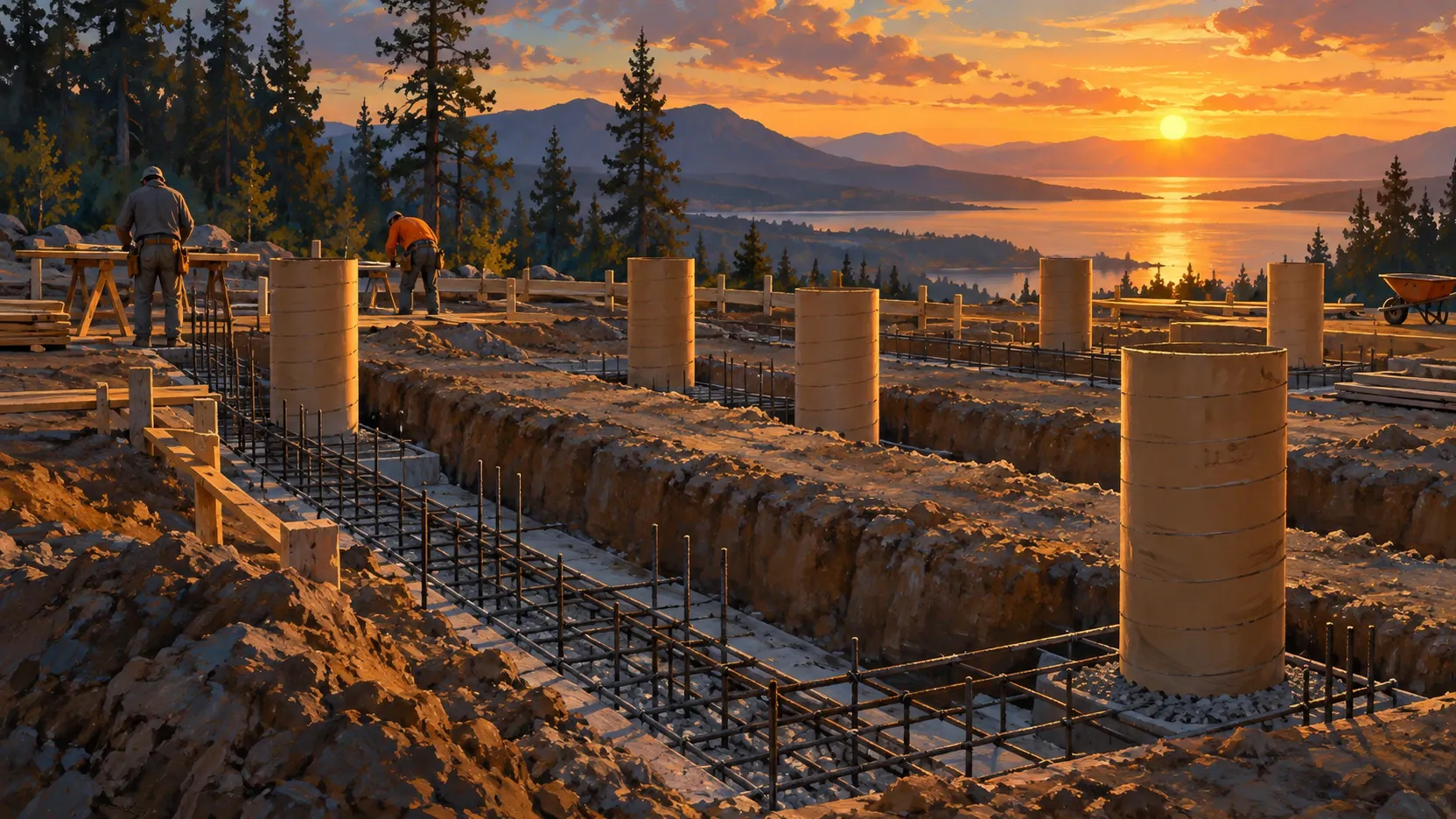
Precast or poured concrete steps: which costs less?
There is no fixed winner; it depends on your two quotes. Precast steps are cast in a plant, cured, delivered and set as a finished unit. Poured steps are formed, filled and finished on your site. The calculator above gives the poured volume, and this page shows how to put both quotes on the same footing.
One precast maker, Wilbert Precast, writes that its steps “are less costly than poured-in-place product and comparable in price to wood steps.” That is a seller’s claim for its own market, not a national figure. We do not print average prices; use the line items below to see where each quote’s money goes.
| Quote line | Precast steps | Poured steps |
|---|---|---|
| Product | Unit price by number of risers, width and landing size | Ready-mix (yd³ × price) or 80 lb bags |
| Delivery | Truck, often with a boom or crane to set | Ready-mix delivery; short-load fee on small orders |
| Base | Compacted gravel or pad per the maker | Gravel base; footings if required locally |
| Forms | None | Lumber, riser forms, stakes, form release |
| Labor | Setting and leveling the unit | Forming, placing, finishing, stripping forms |
| Curing | Done at the plant | Days of protection on site before use |
| Railings | Often offered as a bolt-on option | Separate; anchors set in wet or drilled into cured concrete |
| Demolition | Removing old steps | Same |
The two lines that usually decide it are labor and access. Poured steps need several site visits (form, pour, strip). A precast unit is set in one visit, but only if the truck can reach the door.
How much concrete is in poured steps?
The steps calculator above treats solid steps as stacked blocks: each step is width × tread × its height above the ground, and the landing is width × depth × the full height.
Volume (ft³) = width × tread × rise × (1 + 2 + … + n) + width × landing depth × rise × n
The table uses a 7 in rise and 12 in tread, the sizes on Wilbert’s precast data sheet, so the poured and precast versions are the same shape. Order sizes add 10% and round up to the next ¼ yd³.
| Steps (7 in rise) | Width | Landing depth | Volume (ft³) | Volume (yd³) | Volume (m³) | Ready-mix order (yd³) | 80 lb bags (+10%) |
|---|---|---|---|---|---|---|---|
| 2 | 4 ft | none | 7.00 | 0.26 | 0.20 | ½ | 13 |
| 3 | 4 ft | none | 14.00 | 0.52 | 0.40 | ¾ | 26 |
| 3 | 4 ft | 3 ft | 35.00 | 1.30 | 0.99 | 1½ | 65 |
| 3 | 4 ft | 4 ft | 42.00 | 1.56 | 1.19 | 1¾ | 77 |
| 4 | 4 ft | none | 23.33 | 0.86 | 0.66 | 1 | 43 |
| 4 | 4 ft | 3 ft | 51.33 | 1.90 | 1.45 | 2¼ | 95 |
| 3 | 5 ft | 4 ft | 52.50 | 1.94 | 1.49 | 2¼ | 97 |
| 4 | 5 ft | 4 ft | 75.83 | 2.81 | 2.15 | 3¼ | 140 |
| 3 | 6 ft | 4 ft | 63.00 | 2.33 | 1.78 | 2¾ | 116 |
| 5 | 6 ft | 4 ft | 122.50 | 4.54 | 3.47 | 5 | 225 |
Figures come from scripts/precast-vs-poured-concrete-steps.ts using the site’s calc library; bag counts use the QUIKRETE 0.60 ft³ yield for an 80 lb bag. The landing is the big number: on 3 steps 4 ft wide, a 4 ft landing triples the concrete. The concrete steps calculator has more sizes and 40 to 90 lb bags.
Worked example: poured 3-step stoop with a 4 ft landing
- 3 steps, 4 ft wide, 7 in rise, 12 in tread, 4 ft deep landing: 42 ft³ = 1.56 yd³ (1.19 m³)
- +10% and rounded up to ¼ yd³: 1¾ yd³ of ready-mix, or 77 × 80 lb bags (103 × 60 lb)
- Example quote of $150 per yd³ plus a $150 short-load fee under 5 yd³ (placeholders; ask your plant): 1¾ × $150 + $150 = $412.50 for the concrete
- Add forms, gravel base, labor and railings from your contractor’s quote to get the figure you compare with the precast quote
How much do precast concrete steps weigh?
Ask the manufacturer for the shipping weight of the exact unit; many precast steps are not solid all the way through, so a real unit can weigh less than the same shape poured solid. What you can compute is the solid weight, which is the most the shape could weigh and what a poured version actually puts on your soil.
| Steps (7 × 12 in) | Width | Landing | Solid weight (lb) | Solid weight (kg) |
|---|---|---|---|---|
| 2 | 4 ft | none | 1,050 | 476 |
| 3 | 4 ft | none | 2,100 | 953 |
| 4 | 4 ft | none | 3,500 | 1,588 |
| 3 | 4 ft | 3 ft | 5,250 | 2,381 |
| 3 | 4 ft | 4 ft | 6,300 | 2,858 |
| 4 | 4 ft | 3 ft | 7,700 | 3,493 |
| 3 | 5 ft | 4 ft | 7,875 | 3,572 |
| 4 | 5 ft | 4 ft | 11,375 | 5,160 |
Weights use 150 lb/ft³, the WSDOT design value for normal-weight concrete. Even small stoops weigh more than a crew can carry, so precast units are set by machine. Before ordering, check three things with the supplier: the truck’s reach from the street or drive, whether it can cross your lawn, and what it must not drive over, such as a septic tank or a thin slab. The concrete weight calculator converts any other volume.
What riser height and tread depth does the code require?
Under the International Residential Code (IRC), the maximum riser is 7¾ in and the minimum tread is 10 in, whichever way the steps are made. The text below is IRC section R311.7.5 as printed in the City of Boise’s code handout (February 2022):
R311.7.5.1 Risers: “The riser height shall be not more than 7 ¾ inches (196 mm). … The greatest riser height within any flight of stairs shall not exceed the smallest by more than 3/8 inches (9.5 mm).”
R311.7.5.2 Treads: “The tread depth shall be not less than 10 inches (254 mm). … The greatest tread depth within any flight of stairs shall not exceed the smallest by more than 3/8 inch (9.5 mm).”
Grinnell, Iowa’s 2015 IRC handout adds two numbers people often miss: stairways not less than 36 in wide (R311.7.1), and a handrail required on at least one side of stairs with four or more risers (R311.7.8). States and cities adopt different editions and amend them; South Carolina, for example, allows an 8 in maximum riser for masonry stairs. Confirm with your building department before you buy or form.
For precast this matters at the catalog stage. Wilbert’s line uses a 7 in rise and 12 in tread on every step, inside the IRC limits. For poured steps it matters at the forms: the 3/8 in rule applies to every riser, including the bottom one where the walk or grade may not be level.
How many risers do I need for my door height?
Measure from the finished grade or walk to the bottom of the door threshold, divide by 7¾ in and round up. That gives the fewest risers the IRC allows; then divide the height by that count for the actual riser.
| Height to threshold (in) | Height (mm) | Risers needed (≤ 7¾ in) | Each riser (in) |
|---|---|---|---|
| 14 | 356 | 2 | 7.00 |
| 21 | 533 | 3 | 7.00 |
| 24 | 610 | 4 | 6.00 |
| 28 | 711 | 4 | 7.00 |
| 30 | 762 | 4 | 7.50 |
| 35 | 889 | 5 | 7.00 |
| 42 | 1,067 | 6 | 7.00 |
Precast units come in fixed rises. Wilbert’s measuring guide says to measure overall height from grade to the bottom of the threshold, pick the riser count from its chart, and leave a gap between platform and threshold of 1 in maximum as standard, or ½ in maximum for disabilities. If your height falls between catalog sizes, the fix is usually at the bottom: a little base or a short paver course, cleared with the supplier and inspector. Poured steps can be formed to any height, which is their main advantage on odd openings.
What else should you compare besides price?
Price is one line; these are the others that decide which is better for your door.
- Fit. Precast comes in catalog sizes; Wilbert lists 1 to 6 risers, landing widths of 48, 60 or 72 in and landing depths from 14 to 48 in. Poured steps fit any width, curve or wrap-around.
- Quality control. Precast is cast and cured in a plant. NPCA, the National Precast Concrete Association, runs an Accredited Plant Quality Certification Program that its 2023 fact sheet says is recognized by state DOTs in 41 states, with more than 380 plants certified. Ask whether your supplier’s plant is certified. Poured quality depends on the day’s mix, weather and finisher.
- Reinforcement. Wilbert states its steps are reinforced with wire mesh and rebar. For poured steps, ask what the contractor puts in and whether the steps are tied to the foundation.
- Downtime. A precast unit can be used once it is set. Poured steps need forms stripped and days of curing before heavy use; see concrete curing time.
- Access. A precast unit needs a truck within reach. Poured steps need a ready-mix truck or a mixer and many bags.
- Repair. A settled precast unit can sometimes be lifted and reset; a cracked poured step is usually broken out and re-poured.
Questions to ask for each quote
Ask both bidders the same list, and get the answers in writing:
- What is the installed total, and what does it exclude (demolition, railings, base, haul-away)?
- What riser height and tread depth will the steps have, and do they meet our local code?
- What base or footing goes under them, and how deep?
- How will the steps be held to the house, and what gap is left at the threshold?
- For precast: what does the unit weigh, and can your truck reach the door from where it parks?
- For poured: how many yards are ordered, at what price, and is there a short-load fee?
- When can we walk on them, and when can we put weight on a railing?
Common mistakes when choosing steps
- Comparing a unit price with an installed price. A precast price list may not include delivery, setting or railings. Compare totals.
- Measuring to the floor, not the threshold. The height that sets the riser count is grade to the bottom of the threshold.
- Ignoring the landing. It holds most of the concrete and weight; on 3 steps 4 ft wide, a 4 ft landing adds 28 ft³.
- Uneven bottom riser. A sloping walk makes the first riser taller on one side. Both IRC 3/8 in rules still apply.
- Forgetting the truck. A one-piece unit weighing thousands of pounds needs a clear path and firm ground.
Precast steps vs the other cost pages
Use this page to decide between precast and poured. For the poured volume and bag count for any size, use the concrete steps calculator. For the ready-mix ticket and short-load fees, see concrete delivery cost. If the steps lead down to a new patio, the concrete patio cost page prices the slab, and cost to pour a concrete slab covers labor, base and reinforcement for any flatwork.
FAQ
Frequently asked questions
Are precast concrete steps cheaper than poured?
Sometimes. One manufacturer, Wilbert Precast, states its precast steps are less costly than poured-in-place and comparable in price to wood steps, but that is a seller's claim. Get one installed quote for each and compare totals, including delivery, base, demolition and railings.
How much do precast concrete steps weigh?
Ask the manufacturer for the unit's shipping weight, because many units are not solid. As an upper bound, the same shape poured solid at 150 lb/ft³ weighs 2,100 lb for three 4 ft wide steps with no landing and 6,300 lb with a 4 ft landing.
How much concrete do I need for 3 concrete steps?
Three steps 4 ft wide with a 7 in rise and 12 in tread need 14 ft³ (0.52 yd³), or 26 × 80 lb bags with 10% extra. Adding a 4 ft deep landing at the top raises it to 42 ft³ (1.56 yd³), so order 1¾ yd³ of ready-mix.
What is the code for concrete step height?
IRC R311.7.5.1 says: "The riser height shall be not more than 7 ¾ inches (196 mm)." Risers in one flight may differ by no more than 3/8 in (9.5 mm). Your city adopts and may amend the code, so confirm with the building department.
How deep should a concrete step tread be?
IRC R311.7.5.2 says: "The tread depth shall be not less than 10 inches (254 mm)." Treads in one flight may differ by no more than 3/8 in. Precast lines often use deeper treads; one manufacturer uses 12 in on all steps.
How many steps do I need for a 30 inch rise?
Four risers. Divide the height from grade to the threshold by 7¾ in and round up: 30 ÷ 7.75 = 3.9, so 4 risers of 7½ in each. A 21 in height takes 3 risers of 7 in.
How many bags of concrete for 4 steps?
Four steps 4 ft wide, 7 × 12 in, with no landing need 23.33 ft³: 43 × 80 lb bags with 10% extra. With a 3 ft landing it is 51.33 ft³ (1.90 yd³), which is 95 bags, so ready-mix is usually easier.
Do precast steps need a footing?
Follow the manufacturer's setting instructions and your building department. Ask the supplier what base it requires (compacted gravel, a slab or footings), how far the unit must sit from the wall, and whether frost depth applies in your area. Those answers change the quote.
7 Sources
- City of Boise, IRC Code Handout #437 (02/2022): IRC R311.7.5.1 Risers and R311.7.5.2 Treads text
- City of Grinnell, IA, Residential Stairs/Ramps/Handrails (2015 IRC, March 2017): width R311.7.1, handrails R311.7.8 at four or more risers
- S.C. Code Regs. § 8-1210, IRC R311.7.5.1 Risers as adopted by South Carolina (8 in maximum for masonry stairs), Cornell LII
- Wilbert Precast, Precast Steps brochure: 1 to 6 risers, 7 in rise and 12 in tread, landing widths 48, 60 and 72 in, depths 14 to 48 in, mesh and rebar reinforcement
- National Precast Concrete Association, About NPCA fact sheet (2023): Accredited Plant Quality Certification Program, more than 380 plants certified
- Washington State DOT Bridge Design Memo 05-2010: unit weight of normal-weight concrete 150 lb/ft³
- QUIKRETE Concrete Mix (No. 1101) data sheet: 80 lb bag yield 0.60 ft³, 60 lb 0.45 ft³
Last reviewed October 10, 2026 by M Bilal. Found an error? Tell us.