


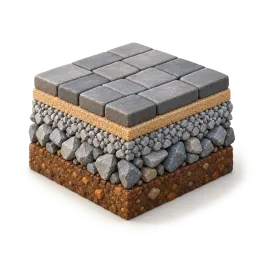
Key numbers
- Per layer: L (ft) × W (ft) × depth (in) ÷ 324 = cubic yards
- Typical planning weights: crusher run about 1.6 tons per yd³, #57 stone about 1.35 (loose, varies by quarry; use your supplier's figure)
- 100 × 12 ft at 4 in = 14.81 yd³ (23.7 tons of crusher run)
- Depth: Wisconsin's PASER manual for gravel roads calls for at least 6 in of gravel, and 10 in or more for heavy loads or poor soil; ask a local supplier or contractor what depth suits your driveway and soil
- Compacted stone is heavier: Ohio DOT pays crushed stone at 3,800 lb (1.9 tons) per yd³ compacted, so ask your supplier for their weight
On this page
- How to use the Driveway Gravel Calculator
- How to calculate gravel for a driveway
- How much gravel for common driveway sizes?
- How deep should a gravel driveway be?
- Which gravel is best for a driveway?
- Driveway gravel in metric
- How much gravel per foot of driveway?
- How many tons for a complete new driveway?
- Turnarounds, parking pads and aprons
- How to measure a driveway for gravel
- Filling potholes before a top coat
- Common mistakes when ordering driveway gravel
- Driveway gravel calculator vs related calculators: which one to use
- Gravel or concrete driveway?
- Frequently asked questions
How to use the Driveway Gravel Calculator
- 1Describe the areaChoose Rectangle (length × width), Circle (diameter) or Known area if you already have the square footage.
- 2Pick your unitsUse US (feet and inches) or Metric (meters and centimeters). Switching converts the numbers you typed, so the area stays the same.
- 3Enter the depthType how deep the crusher run / road base should be, 4 in is a common starting point for this job.
- 4Choose the materialPick crusher run / road base, crushed stone (#57), gravel (mixed) or pea gravel. Each uses its own weight per cubic yard to work out tons.
- 5Allow for settlingChoose the extra: none, 5%, 10% (the default) or 20% for a base you will compact.
- 6Read and price the resultsSee cubic yards, cubic feet, cubic meters, US tons and metric tonnes. Enter your supplier's price per ton for the total cost.
Results update as you type. Back to the calculator ↑
Considering recycled asphalt instead of stone? The asphalt millings calculator uses the FHWA weight range for millings.
How to calculate gravel for a driveway
Calculate each layer separately, because each layer uses a different stone and depth. For every layer:
Cubic yards = length (ft) × width (ft) × depth (in) ÷ 324
Tons = cubic yards × tons per yd³ of that stone
The calculator above defaults to crusher run at 4 in. Switch the material and depth for each layer, note each result, and add them up.
- Measure the driveway length along the centerline and the usable width. Add any turnaround or parking pad as a separate rectangle.
- Decide on the layers and the compacted depth of each.
- Run each layer with its own material. The calculator uses typical planning values of about 1.6 tons per yd³ for crusher run and 1.35 for #57 stone (loose); weights vary by quarry and moisture, so use your supplier’s figure if it differs.
- Add 10–20% for compaction and the stone pressed into soft subgrade. The tables here use 10%.
For a curved driveway, measure the length along the middle of the drive, not along the inside or outside edge. For a flared entrance or apron, calculate the extra area as a triangle (half of length × width) and add it. Tons are what most quarries sell, but some yards sell by the cubic yard, so note both figures before you call for quotes.
Worked example: new 100 × 12 ft driveway, three layers
- Base, 4 in of large crushed stone: 14.81 yd³ → 20 tons, 22 tons with 10%
- Middle, 4 in of #57 stone: 14.81 yd³ → 20 tons, 22 tons with 10%
- Top, 3 in of crusher run: 11.11 yd³ → 17.78 tons, 19.56 tons with 10%
- Total: 11 in deep, about 63.6 tons to order
The base layer uses the calculator’s crushed stone weight (1.35 tons per yd³). Large base stone can weigh a little differently, so confirm with your quarry. If your plans call for a DOT-grade aggregate base sized by compacted depth, the road base calculator uses a compacted density instead.
How much gravel for common driveway sizes?
Driveways are often 10–12 ft wide for one car and 16–20 ft for two. The table shows one 4 in layer, the most common lift, for crusher run and #57 crushed stone at typical planning weights of 1.6 and 1.35 tons per yd³ (use your supplier’s figure if it differs). Figures are computed with the site’s calculation library.
| Driveway | Cubic yards (4 in) | Crusher run, tons | Crusher run +10% | #57 stone, tons | #57 stone +10% |
|---|---|---|---|---|---|
| 50 × 10 ft | 6.17 | 9.88 | 10.86 | 8.33 | 9.17 |
| 50 × 12 ft | 7.41 | 11.85 | 13.04 | 10.00 | 11.00 |
| 100 × 10 ft | 12.35 | 19.75 | 21.73 | 16.67 | 18.33 |
| 100 × 12 ft | 14.81 | 23.70 | 26.07 | 20.00 | 22.00 |
| 100 × 16 ft | 19.75 | 31.60 | 34.77 | 26.67 | 29.33 |
| 100 × 20 ft | 24.69 | 39.51 | 43.46 | 33.33 | 36.67 |
| 150 × 12 ft | 22.22 | 35.56 | 39.11 | 30.00 | 33.00 |
| 200 × 12 ft | 29.63 | 47.41 | 52.15 | 40.00 | 44.00 |
For a 2 in resurfacing coat, halve the figures. For a 6 in layer, multiply by 1.5: a 100 × 12 ft drive at 6 in of #57 is 22.22 yd³, or 30 tons.
Worked example: resurfacing a 100 × 12 ft driveway, 2 in of crusher run
- 100 × 12 × 2 ÷ 324 = 7.41 yd³ (200 ft³, 5.66 m³)
- Weight: 7.41 × 1.6 = 11.85 tons (10.75 tonnes)
- Add 10%: 8.15 yd³, about 13.04 tons to order
- Worn, potholed drive: use 20% and order about 14.22 tons
Fill potholes and regrade the crown before the new coat goes down, or the fresh stone settles into the old ruts.
How deep should a gravel driveway be?
For gravel roads, the University of Wisconsin PASER manual calls for at least 6 in of gravel, and 10 in or more for heavy loads or poor soil. A driveway on soft or clay soil is likely to need the deeper end of that range. Confirm the total depth and the number of layers with a local supplier or contractor, and ask them how much to add when topping up an existing, stable drive.
- Base layer: large crushed stone such as #3 or #4. It spreads the load and lets water drain.
- Middle layer: #57 crushed stone fills and locks the base.
- Top layer: crusher run (also called road base or dense grade aggregate) or a small crushed stone such as #8 or #89. The fines in crusher run pack into a firm surface.
Compact each layer before adding the next. Grade the surface with a slight crown so rain runs off to the sides, and consider a geotextile fabric over very soft soil. Local conditions vary, so ask a supplier or contractor what works in your area.
Which gravel is best for a driveway?
Angular crushed stone is the usual choice for every layer because the sharp faces lock together under traffic. Round stone, such as pea gravel or river rock, rolls and ruts, so it suits paths and beds better than driveways. Crusher run is popular for the top because it compacts hard, though it can be dustier and drains more slowly than washed stone.
Names for the same product change by region: crusher run, road base, ABC stone, dense grade, 21A and MOT Type 1 (UK) are all mixes of crushed stone and fines. Ask your quarry for its own weight per yard and multiply the cubic yards by it if it differs.
Driveway gravel in metric
At the calculator’s typical planning weight of 1.6 US tons per yd³, crusher run works out to about 1.9 tonnes per m³ (loose; check your supplier’s figure). A 30 × 3.6 m driveway (about 100 × 12 ft) with a 100 mm layer needs roughly 11 m³. The calculator’s Metric switch takes length and width in metres and depth in centimetres, and returns m³ and tonnes, for example 21.5 tonnes of crusher run for a 100 × 12 ft drive at 4 in.
| Layer depth | Crusher run, kg per m² | Crusher run, m² per tonne | Crushed stone, kg per m² | Crushed stone, m² per tonne |
|---|---|---|---|---|
| 50 mm | 94.9 | 10.53 | 80.1 | 12.49 |
| 75 mm | 142.4 | 7.02 | 120.1 | 8.32 |
| 100 mm | 189.8 | 5.27 | 160.2 | 6.24 |
| 150 mm | 284.8 | 3.51 | 240.3 | 4.16 |
Worked in metres, a 30 × 3.6 m drive takes 10.8 m³ per 100 mm layer: about 20.5 tonnes of crusher run, or 22.55 tonnes with 10% extra. A 150 mm sub-base of crushed stone on the same drive is 16.2 m³, about 25.95 tonnes, or 28.54 tonnes ordered. A short 15 × 3 m drive at 100 mm of crusher run needs 4.5 m³, about 8.54 tonnes.
How much gravel per foot of driveway?
For a drive of any length, work per 10 ft and scale up. Each row is one 4 in layer.
| Driveway width | Cubic yards per 10 ft | Crusher run, tons per 10 ft | #57 stone, tons per 10 ft |
|---|---|---|---|
| 8 ft | 0.99 | 1.58 | 1.33 |
| 10 ft | 1.23 | 1.98 | 1.67 |
| 12 ft | 1.48 | 2.37 | 2.00 |
| 14 ft | 1.73 | 2.77 | 2.33 |
| 16 ft | 1.98 | 3.16 | 2.67 |
| 20 ft | 2.47 | 3.95 | 3.33 |
| 24 ft | 2.96 | 4.74 | 4.00 |
A 12 ft wide drive takes 2.37 tons of crusher run per 10 ft per 4 in layer, so a 340 ft drive needs 34 × 2.37 ≈ 80.6 tons for that layer before the extra. For a 2 in top coat, halve the row; for 6 in, multiply by 1.5.
Long driveways: a quarter-mile example
A quarter mile is 1,320 ft. At 12 ft wide, one 4 in crusher run layer is 195.56 yd³, about 312.89 tons, or 344.18 tons with 10% extra. A 2 in resurfacing coat on the same drive is 97.78 yd³, about 156.44 tons, or 172.09 tons ordered. Jobs this size arrive as many truckloads, so ask the quarry what one truck carries, have the loads tipped at intervals along the drive rather than in one pile, and spread each one before the next arrives.
How many tons for a complete new driveway?
A new drive on soft ground is often built as three compacted layers. The table totals one example build (not a recommended depth; confirm yours locally), 4 in of base stone, 4 in of #57 and a 3 in crusher run top, using typical planning weights of 1.35 tons per yd³ for the two stone layers and 1.6 for crusher run, all with 10% extra.
| Driveway | Base 4 in (tons) | #57 4 in (tons) | Crusher run 3 in (tons) | Total to order (tons) | Total without extra (tons) |
|---|---|---|---|---|---|
| 50 × 10 ft | 9.17 | 9.17 | 8.15 | 26.48 | 24.07 |
| 50 × 12 ft | 11.00 | 11.00 | 9.78 | 31.78 | 28.89 |
| 75 × 12 ft | 16.50 | 16.50 | 14.67 | 47.67 | 43.33 |
| 100 × 10 ft | 18.33 | 18.33 | 16.30 | 52.96 | 48.15 |
| 100 × 12 ft | 22.00 | 22.00 | 19.56 | 63.56 | 57.78 |
| 150 × 12 ft | 33.00 | 33.00 | 29.33 | 95.33 | 86.67 |
| 200 × 12 ft | 44.00 | 44.00 | 39.11 | 127.11 | 115.56 |
| 100 × 20 ft | 36.67 | 36.67 | 32.59 | 105.93 | 96.30 |
| 300 × 12 ft | 66.00 | 66.00 | 58.67 | 190.67 | 173.33 |
Some builders use two layers instead: about 6 in of crushed stone with a 2 in crusher run top. With 10% extra that is 46.04 tons for a 100 × 12 ft drive (33 tons of stone and 13.04 tons of crusher run) and 19.18 tons for a 50 × 10 ft drive. Which build suits your soil is a question for a local supplier or contractor; the calculator only sizes the layers you choose.
Turnarounds, parking pads and aprons
Add every paved area beyond the straight drive as its own shape, at the same layer depths.
- Hammerhead turnaround: a 20 × 12 ft side pocket is 240 ft². At 4 in of crusher run that is 2.96 yd³, about 4.74 tons, or 5.21 tons with 10% extra.
- Extra parking space: a 10 × 20 ft pad at 4 in takes 2.47 yd³, about 3.95 tons, or 4.35 tons ordered.
- Circular turnaround: a ring with a 50 ft outer diameter around a 26 ft island (a 12 ft wide lane) is 3.1416 × 25² − 3.1416 × 13², about 1,432.6 ft². At 4 in that is 17.69 yd³, about 28.3 tons, or 31.13 tons with 10%.
- Flared apron at the road: each triangle is half of length × depth. Two flares of 6 × 10 ft add 60 ft², about 1.19 tons at 4 in.
Check with your road authority before you work on the apron where it meets a public road; rules for culverts and entrances differ by area.
How to measure a driveway for gravel
Small measuring errors scale with length, so measure on the ground rather than from a site plan.
- Width: measure the usable width at three or four points and average them. Using 10 ft for a drive that is really 12 ft wide gives 19.75 tons for a 100 ft, 4 in crusher run layer instead of 23.7, almost 4 tons short.
- Length: walk a tape or measuring wheel down the centerline from the road edge to where the gravel stops, including the bit in front of the garage.
- Depth: for a top coat, dig a few test holes to see how much firm stone is left; for a new drive, decide each layer’s compacted depth before you call for quotes.
- Extras: list turnarounds, parking pads and the apron separately so you can check each one against the quote.
Write the results as rectangles with depths, for example “100 × 12 ft, 4 in base; 20 × 12 ft turnaround, 4 in base”, and you can re-run the calculator for any material the supplier offers.
Does the top-coat stone change the tonnage?
Yes, because the weight per yard differs. One 4 in layer on a 100 × 12 ft drive is the same 14.81 yd³ whatever the stone, but that is 23.7 tons of crusher run and 20 tons of #57. If a quote is by the ton, compare on the ton figure for that exact product; if it is by the yard, compare on cubic yards, and use the tons to cubic yards converter to line them up.
Filling potholes before a top coat
Potholes are small cylinders: 3.1416 × radius² × depth. Ten potholes about 2 ft across and 4 in deep hold 10.5 ft³, about 0.39 yd³ or 0.62 tons of crusher run. Fill and compact them first, then calculate the top coat over the whole drive, so the new layer goes on at an even depth.
If a pothole holds water, dig out the wet, soft material down to firm ground before you measure, and use that cleaned-out depth in the calculation. A 2 ft pothole dug out to 8 in instead of 4 in needs twice the stone, so measure after digging, not before. Fill deep holes in lifts of a few inches and tamp each one.
Common mistakes when ordering driveway gravel
Driveway loads are large, so small errors turn into several tons. These are the ones to check before you place the order:
- Measuring the outside of a curve. On a curved 100 × 12 ft drive, measuring 115 ft along the outer edge raises one 4 in crusher run layer from 23.7 to 27.26 tons, about 3.56 tons too much. Measure the centerline.
- Using the wrong stone weight. Working out crusher run at a generic 1.4 tons per yard gives 20.74 tons for that same layer instead of 23.7, almost 3 tons short.
- Ordering tons as if they were yards. A yard of crusher run typically weighs about 1.6 tons (ask your supplier), so ordering 14.81 tons for a 14.81 yd³ layer arrives about 37.5% short.
- Forgetting the apron. A flared entrance 12 ft along the road and 10 ft deep adds a 60 ft² triangle, about 1.19 tons of crusher run at 4 in.
- Leaving out compaction. The 10% allowance on one 4 in crusher run layer for a 100 × 12 ft drive is about 2.37 tons. On soft ground use 15–20%.
- Using round stone. Pea gravel and river rock roll under tires. Keep them for paths and beds.
Driveway gravel calculator vs related calculators: which one to use
Use this calculator for the tons and cubic yards in each driveway layer. For the rest of the project:
- Gravel driveway cost: turns these tonnages into a budget using your own supplier quotes.
- Gravel calculator: smaller bases for sheds, slabs, paths and French drains next to the drive.
- Tons to cubic yards: when one quarry quotes per ton and another per yard.
- Concrete driveway calculator: cubic yards of ready-mix if you are weighing a concrete drive instead.
Gravel or concrete driveway?
Gravel costs less to install and drains freely, but it needs regular topping up and regrading. Concrete costs more up front and lasts longer with less upkeep. To compare, size a concrete drive with the concrete driveway calculator and price a gravel drive from your own supplier quotes with the gravel driveway cost guide.
FAQ
Frequently asked questions
How much gravel do I need for a 100 ft driveway?
A 100 × 12 ft driveway needs 14.81 yd³ per 4 in layer. In crusher run that is 23.7 tons, or 26.07 tons with 10% extra. A 100 × 10 ft drive needs 12.35 yd³ (19.75 tons) per 4 in layer.
How many tons of gravel for a 50 ft driveway?
A 50 × 10 ft driveway needs 6.17 yd³ per 4 in layer: 9.88 tons of crusher run or 8.33 tons of #57 stone. With 10% extra, order about 10.86 tons of crusher run for one 4 in layer.
How much gravel do I need for a 200 ft driveway?
A 200 × 12 ft driveway needs 29.63 yd³ per 4 in layer: 47.41 tons of crusher run or 40 tons of #57 stone. Order about 52.15 tons of crusher run with 10% extra, or 56.89 tons with 20% on soft ground.
How much gravel for a two-car driveway?
A 100 × 20 ft two-car driveway needs 24.69 yd³ per 4 in layer, about 39.51 tons of crusher run or 33.33 tons of #57 stone. With 10% extra order 43.46 tons of crusher run for that layer.
How much gravel for a 20×20 parking pad?
At 4 in deep a 20 × 20 ft pad needs 4.94 yd³: 7.9 tons of crusher run or 6.67 tons of #57 stone. With 10% extra order 8.69 tons of crusher run or 7.33 tons of #57.
How many tons of gravel do I need for a new driveway?
For a 100 × 12 ft drive built as 4 in of base stone, 4 in of #57 and a 3 in crusher run top, order about 63.6 tons with 10% extra: 22 tons per stone layer and 19.56 tons of crusher run.
How much gravel do I need to resurface a driveway?
At 2 in deep, a 100 × 12 ft driveway needs 7.41 yd³, about 11.85 tons of crusher run, or 13.04 tons with 10% extra. A 50 × 10 ft drive needs 3.09 yd³ (4.94 tons).
How deep should driveway gravel be?
Wisconsin's PASER gravel-road manual calls for at least 6 in of gravel, and 10 in or more for heavy loads or poor soil. That is road guidance, but a reasonable floor for a new driveway, laid and compacted in layers. For a top-up on a stable drive, ask your supplier how deep to go. Each 2 in on a 100 × 12 ft drive is 7.41 yd³.
How many tons of crusher run for a 12 ft wide driveway per 10 ft?
Each 10 ft of a 12 ft wide drive takes 1.48 yd³ per 4 in layer, about 2.37 tons of crusher run at a typical planning weight of 1.6 tons per yd³ or 2 tons of #57 stone. Multiply by your length ÷ 10, then add 10%.
How much driveway does a ton of gravel cover?
A ton of crusher run covers about 101 ft² at 2 in deep, 68 ft² at 3 in and 51 ft² at 4 in, at a typical planning weight of 1.6 tons per cubic yard (check your supplier). A ton of #57 stone at 1.35 tons per yard covers more: 120 ft² at 2 in and 60 ft² at 4 in.
How many tons of #57 stone for a driveway?
One 4 in layer of #57 on a 100 × 12 ft driveway is 14.81 yd³, about 20 tons, or 22 tons with 10% extra. A 6 in layer is 22.22 yd³, about 30 tons, or 33 tons with 10%.
How much extra gravel should I order for compaction?
Add about 10% on a firm base and 15–20% on soft ground. For one 4 in crusher run layer on a 100 × 12 ft drive that means 26.07 tons at 10% or 28.44 tons at 20%, against 23.7 tons exact.
How much crusher run do I need per square metre?
At a typical loose planning weight of about 1.9 tonnes per m³ (check your supplier's figure), crusher run needs about 190 kg per square metre at 100 mm deep, so one tonne covers about 5.3 m². At 50 mm it needs about 95 kg per m², or 10.5 m² per tonne.
What is the best gravel for a driveway?
Most gravel drives use large crushed stone (#3 or #4) as a base, #57 crushed stone in the middle and crusher run or a smaller crushed stone on top. Angular crushed stone locks together; round pea gravel shifts under tires.
Can I use pea gravel for a driveway?
It is a poor driving surface: round stones roll, rut and spread under tires. A 4 in layer on a 100 × 12 ft drive would still take about 20.74 tons. Angular crushed stone or crusher run locks together and stays put.
3 Sources
- NIST SP 811, Appendix B.9: conversion factors for volume and mass (cubic yard, cubic foot, short ton)
- University of Wisconsin Transportation Information Center: PASER Manual, Gravel Roads (gravel layer thickness)
- Ohio DOT Construction and Material Specifications, Item 617: aggregate conversion factors (crushed stone 3,800 lb/yd³)
Last reviewed October 9, 2026 by M Bilal. Found an error? Tell us.