


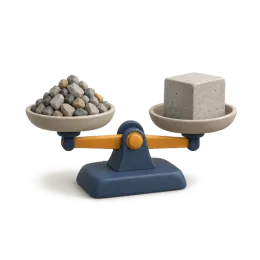
Key numbers
- Tons → yd³: tons ÷ tons per yd³
- yd³ → tons: yd³ × tons per yd³
- Gravel: about 1.4 t/yd³ (typical planning value; use your supplier's figure), so 1 ton ≈ 0.71 yd³
- US ton = 2,000 lb; metric tonne = 2,204.62 lb
On this page
- How to use the Tons to Cubic Yards
- How do you convert tons to cubic yards?
- Tons per cubic yard by material
- Tons to cubic yards chart
- Cubic yards to tons
- How much area does a ton cover?
- US tons, metric tonnes and cubic metres
- Why do suppliers sell by the ton and others by the yard?
- Why the same material weighs different amounts per yard
- Converting a price per ton to a price per yard
- How many tons do I need for my area?
- Tons to cubic feet
- How far does a ton spread?
- Pounds to cubic yards for bagged stone and sand
- Tonnes to cubic metres
- Concrete: yards to tons
- Common mistakes when converting tons to cubic yards
- Tons to cubic yards vs related calculators: which one to use
- Frequently asked questions
How to use the Tons to Cubic Yards
- 1Enter your numbersFill in amount, convert or material.
- 2Check the assumptionsDefaults are typical values. Replace them with your own measurements or quotes.
- 3Read the resultsThe calculator shows cubic yards or density used, updated as you type.
- 4Use the resultRound up to what your supplier sells, and keep a little extra for waste.
Results update as you type. Back to the calculator ↑
How do you convert tons to cubic yards?
Divide the weight in tons by the material’s density in tons per cubic yard. Tons measure weight and cubic yards measure volume, so there is no single conversion factor. Every material has its own.
Cubic yards = tons ÷ density (tons per yd³)
Tons = cubic yards × density (tons per yd³)
The converter above uses the typical densities in the table below. Pick your material, enter tons or yards, and it gives the other.
- Work out the volume you need in cubic yards with the cubic yard calculator.
- Ask the supplier for their density. Quarries know what their stone weighs per yard.
- Multiply or divide with that figure, or with the typical value below.
- Add 5–10% for compaction and spillage, then round up to how the supplier sells.
Worked example: gravel for a 12 × 20 ft parking pad, 4 in deep
- Volume: 12 × 20 × 4 ÷ 324 = 2.96 yd³
- Weight: 2.963 × 1.4 = 4.15 tons of gravel
- Add 10% for compaction: 4.56 tons, so order about 4½–5 tons
Worked example: how deep will 15 tons of sand spread over 20 × 30 ft?
- Volume: 15 tons ÷ 1.35 tons per yd³ = 11.11 yd³
- Area: 20 × 30 = 600 ft²
- Depth: 11.11 × 324 ÷ 600 = 6 in before compaction
Tons per cubic yard by material
These are typical loose, dry weights used by this site’s calculators. Moisture, stone type and grading all change the real number, so treat them as planning values and use your supplier’s figure when you have it.
| Material | Tons per yd³ | Pounds per yd³ | yd³ per ton | Tonnes per m³ |
|---|---|---|---|---|
| Wood mulch | 0.4 | 800 | 2.50 | 0.47 |
| Topsoil / fill dirt | 1.1 | 2,200 | 0.91 | 1.31 |
| Landscape rock | 1.3 | 2,600 | 0.77 | 1.54 |
| Sand (dry) | 1.35 | 2,700 | 0.74 | 1.60 |
| Crushed stone (#57) | 1.35 | 2,700 | 0.74 | 1.60 |
| River rock | 1.35 | 2,700 | 0.74 | 1.60 |
| Gravel / pea gravel | 1.4 | 2,800 | 0.71 | 1.66 |
| Crusher run / road base | 1.6 | 3,200 | 0.63 | 1.90 |
| Concrete | 2.025 | 4,050 | 0.49 | 2.40 |
Only two rows have a published source: dry sand (QUIKRETE Mason Sand: a 50 lb bag is about 0.5 ft³, so about 100 lb/ft³) and concrete (150 lb/ft³, WSDOT). The other loose-material figures are typical planning values, and gravel in particular varies by quarry. That is why the supplier’s own figure is always the best one to use.
Tons to cubic yards chart
Each value is tons ÷ the typical density from the table above.
| Tons | Gravel (1.4) | Crushed stone (1.35) | Crusher run (1.6) | Sand (1.35) | Topsoil (1.1) |
|---|---|---|---|---|---|
| 1 | 0.71 yd³ | 0.74 yd³ | 0.63 yd³ | 0.74 yd³ | 0.91 yd³ |
| 5 | 3.57 yd³ | 3.70 yd³ | 3.13 yd³ | 3.70 yd³ | 4.55 yd³ |
| 10 | 7.14 yd³ | 7.41 yd³ | 6.25 yd³ | 7.41 yd³ | 9.09 yd³ |
| 15 | 10.71 yd³ | 11.11 yd³ | 9.38 yd³ | 11.11 yd³ | 13.64 yd³ |
| 20 | 14.29 yd³ | 14.81 yd³ | 12.50 yd³ | 14.81 yd³ | 18.18 yd³ |
| 25 | 17.86 yd³ | 18.52 yd³ | 15.63 yd³ | 18.52 yd³ | 22.73 yd³ |
Cubic yards to tons
Multiply cubic yards by the density. 5 yd³ of gravel is 7 tons, 5 yd³ of crusher run is 8 tons and 5 yd³ of topsoil is 5.5 tons. 10 yd³ of sand is 13.5 tons.
| Cubic yards | Mulch (0.4) | Topsoil (1.1) | Sand (1.35) | Gravel (1.4) | Crusher run (1.6) |
|---|---|---|---|---|---|
| 1 | 0.4 t | 1.1 t | 1.35 t | 1.4 t | 1.6 t |
| 2 | 0.8 t | 2.2 t | 2.7 t | 2.8 t | 3.2 t |
| 3 | 1.2 t | 3.3 t | 4.05 t | 4.2 t | 4.8 t |
| 5 | 2 t | 5.5 t | 6.75 t | 7 t | 8 t |
| 10 | 4 t | 11 t | 13.5 t | 14 t | 16 t |
All values are US tons. Light materials change the picture: a ton of wood mulch is about 2.5 yd³ and covers 405 ft² at 2 in, while 3 tons of topsoil is only 2.73 yd³, enough for about 442 ft² at 2 in. When a landscape yard quotes mulch by the yard and topsoil by the ton, convert both to yards before deciding how much of each to buy.
Weight matters for delivery. Trucks and trailers have load limits, so a large order may come in several loads. If you plan to haul it yourself, compare the weight with your vehicle’s payload rating first: one cubic yard of gravel is about 2,800 lb.
How much area does a ton cover?
Convert the ton to cubic yards first, then use the coverage rule: one cubic yard covers 324 ft² at 1 in deep. One ton of gravel (0.71 yd³) covers about 115.7 ft² at 2 in deep or 77.1 ft² at 3 in deep. For sand, one ton is about 20 ft³.
US tons, metric tonnes and cubic metres
A US (short) ton is 2,000 lb. A metric tonne is 1,000 kg, or 2,204.62 lb, so it is about 10% heavier. Suppliers outside the US usually sell aggregate by the tonne and quote volume in cubic metres.
- Gravel: about 1.66 tonnes per m³, so 1 tonne is about 0.6 m³ (0.79 yd³). 20 tonnes is about 15.75 yd³.
- Topsoil: about 1.31 tonnes per m³, so 1 m³ weighs just over 1.3 tonnes.
- Concrete: about 2.4 tonnes per m³ at 150 lb/ft³.
Different gravels, such as 20 mm or ¾ in clean stone, can weigh different amounts per cubic metre, so ask the supplier for the figure for the exact product.
Why do suppliers sell by the ton and others by the yard?
Quarries weigh material on a truck scale, so stone, gravel and sand are often priced by the ton. Landscape yards that load with a bucket often sell by the cubic yard. Your project, though, is measured in volume: length, width and depth. That is why you need this conversion every time you compare quotes.
Why the same material weighs different amounts per yard
The densities on this page are typical loose, dry figures. Your supplier’s material can sit well above or below them, for four main reasons:
- Moisture. Water fills the gaps between grains. Damp sand and wet topsoil weigh more per yard than dry, so a ton of wet material is fewer cubic yards.
- Grading. Material with a range of sizes, like crusher run, packs tighter because the fines fill the spaces. Single-size stone, like #57, leaves more air between the stones, so it usually weighs less per yard than a well-graded mix of the same rock.
- Rock type. Different parent rock has a different weight per cubic foot, so two quarries’ “gravel” can differ even at the same size.
- Loose or compacted. A yard measured in the truck is loose. After a plate compactor, the same tons take up less volume.
The spread can be wide. If one supplier’s gravel is 1.2 tons per yard and another’s is 1.7, 5 yd³ weighs 6 tons from the first and 8.5 tons from the second. On a 10 ton order the difference is 8.33 yd³ against 5.88 yd³. That gap is why the supplier’s number matters more than any table. A 2.45 yd³ shortfall on a driveway is a second delivery, often with a second haul charge.
How to get the right density from your supplier
- Ask: “How many tons is one cubic yard of this product, as delivered?” Most quarries and landscape yards know the figure for each product.
- If they only sell by weight, ask whether the figure is for dry or as-delivered material.
- Enter that figure in the converter above instead of the typical value, then add your compaction allowance.
Converting a price per ton to a price per yard
Multiply the price per ton by the tons per cubic yard to get a price per yard. Divide a price per yard by the tons per yard to get a price per ton.
Price per yd³ = price per ton × tons per yd³
Use the density for the exact product being quoted. With crusher run at 1.6 tons per yard, the per-yard price is 1.6 times the per-ton price; with topsoil at 1.1, it is only 1.1 times. Add delivery to each quote before comparing, because one supplier’s lower material price can be offset by a higher haul charge. Prices vary by region and season, so use quotes from your own suppliers.
How many tons do I need for my area?
Combine the area formula and the density in one step:
Tons = square feet × depth (in) ÷ 324 × tons per yd³
- Sand bed for pavers, 400 ft² at 2 in: 400 × 2 ÷ 324 = 2.47 yd³, × 1.35 = 3.33 tons.
- Topsoil for a new lawn area, 600 ft² at 3 in: 5.56 yd³, × 1.1 = 6.11 tons.
- Gravel at 1 in deep for a top-up: one ton covers about 231 ft² (324 ÷ 1.4).
Add your compaction or settling allowance to the tons at the end, then round up to how the supplier sells. If you also need the cubic yards for a bulk yard that sells by volume, stop at the second step. The square feet to cubic yards calculator covers the area-to-volume step for any depth.
Tons to cubic feet
Divide 27 by the tons per cubic yard to get the cubic feet in one ton. This is handy for small jobs measured in cubic feet, and for checking a trailer or truck bed load.
| Material | Tons per yd³ | ft³ per ton | lb per ft³ |
|---|---|---|---|
| Wood mulch | 0.4 | 67.5 | 29.6 |
| Topsoil / fill dirt | 1.1 | 24.5 | 81.5 |
| Landscape rock | 1.3 | 20.8 | 96.3 |
| Sand, #57 stone, river rock | 1.35 | 20 | 100 |
| Gravel / pea gravel | 1.4 | 19.3 | 103.7 |
| Crusher run | 1.6 | 16.9 | 118.5 |
| Concrete | 2.025 | 13.3 | 150 |
Half a ton of gravel is 0.36 yd³, or about 9.6 ft³. If your truck bed or trailer box is measured in cubic feet, compare that volume with the material’s weight and your vehicle’s payload rating: the weight usually runs out first.
How far does a ton spread?
One ton covers the area its cubic feet allow at your chosen depth. The table uses the typical densities above and no allowance for compaction.
| Material | ft² per ton at 2 in | ft² per ton at 3 in | ft² per ton at 4 in |
|---|---|---|---|
| Wood mulch | 405 | 270 | 202.5 |
| Topsoil | 147.3 | 98.2 | 73.6 |
| Landscape rock | 124.6 | 83.1 | 62.3 |
| Sand or #57 stone | 120 | 80 | 60 |
| Gravel / pea gravel | 115.7 | 77.1 | 57.9 |
| Crusher run | 101.3 | 67.5 | 50.6 |
To size an order from this, divide your area by the coverage per ton. A 20 ton load of gravel at 4 in deep covers about 1,157 ft² before compaction.
Worked example: pea gravel path, 3 ft wide × 60 ft long, 3 in deep
- Area: 3 × 60 = 180 ft²
- Volume: 180 × 3 ÷ 324 = 1.67 yd³
- Weight: 1.67 × 1.4 = 2.34 tons; with 10% extra, 2.57 tons
- Order about 2½–3 tons, depending on how your supplier rounds
Worked example: crusher run for a 12 × 40 ft driveway, 6 in deep
- Volume: 480 ft² × 6 ÷ 324 = 8.89 yd³
- Weight at 1.6 tons per yard: 14.22 tons
- With 10% for compaction: 15.64 tons, so order about 16 tons
For driveway layers and a base-plus-surface build, the driveway gravel calculator splits the tons by layer.
Pounds to cubic yards for bagged stone and sand
Bagged gravel and sand are usually sold by weight. Divide the bag weight by the material’s pounds per cubic foot to get its volume.
- 50 lb bag of gravel at about 103.7 lb/ft³ is 0.48 ft³, so about 56 bags make a cubic yard.
- 50 lb bag of dry sand at about 100 lb/ft³ is 0.5 ft³, so 54 bags make a cubic yard.
- 500 lb of gravel is about 4.82 ft³, or 0.18 yd³.
Bag labels sometimes state a volume or coverage. When they do, use the label rather than these typical figures. Past roughly half a yard, the bag count usually makes a bulk delivery the easier option.
Tonnes to cubic metres
Metric suppliers quote tonnes and cubic metres. Divide tonnes by the tonnes per m³ for the material.
| Tonnes | Gravel (1.66 t/m³) | Sand (1.60 t/m³) | Topsoil (1.31 t/m³) | Crusher run (1.90 t/m³) |
|---|---|---|---|---|
| 1 | 0.60 m³ | 0.63 m³ | 0.76 m³ | 0.53 m³ |
| 2 | 1.20 m³ | 1.25 m³ | 1.53 m³ | 1.05 m³ |
| 5 | 3.01 m³ | 3.13 m³ | 3.82 m³ | 2.63 m³ |
| 10 | 6.02 m³ | 6.25 m³ | 7.63 m³ | 5.26 m³ |
| 20 | 12.05 m³ | 12.50 m³ | 15.27 m³ | 10.53 m³ |
Going the other way, multiply cubic metres by the tonnes per m³: 3 m³ of topsoil is about 3.9 tonnes and 3 m³ of crusher run about 5.7 tonnes, so check the weight against any trailer you plan to use. A 10 m² path with 5 cm of 20 mm gravel is 0.5 m³, about 0.83 tonnes at 1.66 t/m³. Bulk bags sold in the UK and elsewhere are often labelled by approximate weight, so ask the merchant what volume a bag fills.
Concrete: yards to tons
Concrete is ordered by volume, not weight, but the weight matters for hauling: a cubic yard is about 2.03 US tons at 150 lb/ft³. The concrete yards calculator has the full yards-to-tons table for ready-mix orders.
Common mistakes when converting tons to cubic yards
Most errors come from treating weight and volume as the same thing. Check these before you place the order.
- Assuming one ton equals one yard. At 1.4 tons per yard, 10 tons of gravel is 7.14 yd³. Ordering 10 tons when you need 10 yd³ leaves you 2.86 yd³ short.
- Using the gravel figure for every material. 10 yd³ of topsoil weighs about 11 tons, not the 14 tons a gravel density would give. Mulch at 0.4 tons per yard is in a different range altogether.
- Mixing tons and tonnes. A metric tonne is 2,204.62 lb, about 10% more than a US ton. 10 tonnes of gravel is about 7.87 yd³, against 7.14 yd³ for 10 US tons.
- Ignoring compaction. A base that is compacted needs more loose material. A 20% allowance turns the 2.96 yd³ parking pad above into 3.56 yd³, or about 4.98 tons.
- Ignoring moisture. Wet sand, soil and mulch weigh more per yard, so a ton of wet material is fewer yards than the table shows. Ask whether the supplier’s density is for dry or as-delivered material.
Tons to cubic yards vs related calculators: which one to use
- This converter when you have a quote in tons and need yards, or the reverse.
- Gravel calculator when you start from the area and depth and want tons of gravel directly.
- Driveway gravel calculator for driveways and parking pads with base layers.
- Sand calculator or topsoil calculator for those materials by area and depth.
- Cubic yard calculator when you only need the volume.
FAQ
Frequently asked questions
How many yards are in a ton of gravel?
About 0.71 cubic yards, using a typical 1.4 tons per yd³ for mixed gravel. Gravel density varies by quarry: if your supplier's figure is 1.2 tons per yard, one ton is 0.83 yd³; at 1.7 it is 0.59 yd³. Ask your quarry.
How many tons are in a yard of gravel?
About 1.4 US tons (2,800 lb) for typical mixed gravel (a typical planning value; ask your supplier). Crusher run is heavier at about 1.6 tons per yard, and #57 crushed stone is about 1.35 tons. Gravel density varies by quarry, rock type and moisture, so confirm the figure before you order.
How many cubic yards is 10 tons of gravel?
About 7.14 yd³ at 1.4 tons per yard. If your supplier's gravel weighs 1.2 tons per yard it is 8.33 yd³; at 1.7 tons per yard it is 5.88 yd³.
How many cubic yards is 15 tons of gravel?
About 10.71 yd³ at a typical 1.4 tons per yard. Spread 3 in deep, that covers roughly 1,157 ft². For #57 crushed stone at 1.35 tons per yard, 15 tons is 11.11 yd³.
How many cubic yards is 20 tons?
For gravel at 1.4 t/yd³, 20 tons is 14.29 yd³. For sand at 1.35 it is 14.81 yd³, and for topsoil at 1.1 it is 18.18 yd³.
How many tons is 10 yards of gravel?
About 14 US tons at a typical 1.4 tons per yard, or 28,000 lb. The same 10 yd³ of crusher run is about 16 tons, and 10 yd³ of topsoil about 11 tons.
How many tons of gravel do I need for a 10x10 area?
About 1.3 tons at 3 in deep: 10 × 10 × 3 ÷ 324 = 0.93 yd³, × 1.4 tons per yard. At 4 in deep it is 1.23 yd³, or about 1.73 tons before any compaction allowance.
How much area does a ton of gravel cover?
About 115.7 ft² at 2 in deep, 77.1 ft² at 3 in and 57.9 ft² at 4 in, using 1.4 tons per yard. One ton is 0.71 yd³, and a yard covers 324 ft² at 1 in deep.
How many tons in a yard of #57 stone?
About 1.35 US tons (2,700 lb) per cubic yard of #57 crushed stone, the typical loose weight this site uses. One ton is about 0.74 yd³. Washed and damp stone can weigh more, so confirm with the quarry.
How many tons of crusher run in a yard?
About 1.6 US tons (3,200 lb) per cubic yard (a typical planning value; ask your supplier), because the fines fill the gaps between stones. One ton of crusher run is about 0.63 yd³, so 10 tons is roughly 6.25 yd³.
How many tons is a yard of topsoil?
About 1.1 tons (2,200 lb) of typical loose topsoil (a typical planning value; ask your supplier). Wet soil is heavier. One ton of topsoil is about 0.91 yd³, so 5 tons is about 4.55 yd³.
How many tons is a yard of sand?
About 1.35 tons (2,700 lb) of dry sand. Damp sand weighs more. One ton of sand is about 0.74 yd³, or 20 ft³.
How many yards are in a ton of mulch?
About 2.5 cubic yards, using a typical 0.4 tons per yard for wood mulch. That ton covers about 270 ft² at 3 in deep. Wet mulch is heavier, so a ton of it is fewer yards.
How much does a cubic yard of concrete weigh in tons?
About 2.03 US tons (4,050 lb) at 150 lb/ft³, the normal-weight value WSDOT uses (FHWA gives a range of about 140–155 lb/ft³). QUIKRETE lists about 140 lb/ft³ for its bagged mix, which is 1.89 tons per cubic yard.
How many cubic metres are in a tonne of gravel?
About 0.6 m³, using a typical 1.66 tonnes per m³ for mixed gravel (the metric equivalent of 1.4 US tons per yd³). One tonne of gravel is about 0.79 yd³.
5 Sources
- QUIKRETE Concrete Mix (No. 1101) data sheet: density of bagged concrete
- QUIKRETE Mason Sand (No. 1952) data sheet: 50 lb bag ≈ 0.5 ft³
- WSDOT Bridge Design Memo 05-2010: concrete unit weight 150 lb/ft³
- FHWA-HRT-05-057 Appendix C: concrete unit weights about 140–155 lb/ft³
- NIST SP 811 Appendix B.9: ton, tonne, yd³ and m³ conversion factors
Last reviewed October 9, 2026 by M Bilal. Found an error? Tell us.