


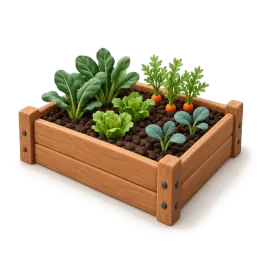
Key numbers
- Formula: L (ft) × W (ft) × depth (in) ÷ 12 = cubic feet
- 4 × 8 × 12 in bed: 32 ft³, about 1.2 yd³
- 27 ft³ = 1 cubic yard = 13.5 bags of 2 ft³
- Add 10–20% because new bed soil settles
On this page
- How to use the Raised Bed Soil Calculator
- How to calculate soil for a raised bed
- Soil for common raised bed sizes
- How deep should a raised bed be?
- Shallow and deep beds: bags by size
- Measure inside the frame and use the real board height
- Round and metal raised beds
- Raised bed soil in litres and metric sizes
- L-shaped, U-shaped and tiered raised beds
- Raised beds on concrete, paving or poor ground
- Mixing your own raised bed blend: how much of each
- Bags or bulk soil for raised beds?
- Filling tall beds for less
- Topping up and mulching raised beds
- Common mistakes when filling raised beds
- Raised bed soil calculator vs other calculators: which one to use
- Frequently asked questions
How to use the Raised Bed Soil Calculator
- 1Describe the areaChoose Rectangle (length × width), Circle (diameter) or Known area if you already have the square footage.
- 2Pick your unitsUse US (feet and inches) or Metric (meters and centimeters). Switching converts the numbers you typed, so the area stays the same.
- 3Enter the depthType how deep the topsoil should be, 12 in is a common starting point for this job.
- 4Choose the materialThe calculator uses 1.1 tons per cubic yard for topsoil. Use your supplier's figure if it differs.
- 5Allow for settlingChoose the extra: none, 5%, 10% (the default) or 20% for a base you will compact.
- 6Read and price the resultsSee cubic yards, cubic feet, cubic meters, US tons and metric tonnes and the number of 2 ft³ bags. Enter your supplier's price per cubic yard for the total cost.
Results update as you type. Back to the calculator ↑
How to calculate soil for a raised bed
A raised bed is a box, so the soil it holds is length × width × depth. Beds are measured in feet and depth in inches, and bagged soil is sold in cubic feet, so this formula works directly:
Cubic feet = length (ft) × width (ft) × depth (in) ÷ 12
Divide cubic feet by 27 for cubic yards if you are buying in bulk, or multiply by 28.3 for litres.
- Measure the inside of the frame, not the outside. Board thickness takes a few inches off each side.
- Measure the fill depth. Use the height you will fill to, usually an inch or two below the top edge.
- Run the formula or enter the numbers in the calculator above with the rectangle shape.
- Add 10–20%. Fresh soil and compost settle after the first few waterings.
Worked example: 4 × 8 ft bed, 12 in deep
- 4 × 8 × 12 ÷ 12 = 32 ft³ (1.19 yd³, 906 L)
- Add 10%: 32 × 1.10 = 35.2 ft³
- Bags: 35.2 ÷ 2 = 18 bags of 2 ft³, or 24 bags of 1.5 ft³
Soil for common raised bed sizes
These are the bed sizes people search for most. Figures are for 12 in deep. The bag columns already include 10% extra for settling and are rounded up to whole bags.
| Bed (inside) | Cubic feet | Cubic yards | Litres | 1 ft³ bags (+10%) | 1.5 ft³ bags (+10%) | 2 ft³ bags (+10%) |
|---|---|---|---|---|---|---|
| 2 × 4 ft | 8 | 0.30 | 227 | 9 | 6 | 5 |
| 2 × 8 ft | 16 | 0.59 | 453 | 18 | 12 | 9 |
| 3 × 6 ft | 18 | 0.67 | 510 | 20 | 14 | 10 |
| 4 × 4 ft | 16 | 0.59 | 453 | 18 | 12 | 9 |
| 4 × 6 ft | 24 | 0.89 | 680 | 27 | 18 | 14 |
| 4 × 8 ft | 32 | 1.19 | 906 | 36 | 24 | 18 |
| 4 × 10 ft | 40 | 1.48 | 1,133 | 44 | 30 | 22 |
| 4 × 12 ft | 48 | 1.78 | 1,359 | 53 | 36 | 27 |
| 8 × 8 ft | 64 | 2.37 | 1,812 | 71 | 47 | 36 |
At 6 in deep, halve the cubic feet. At 18 in, multiply by 1.5; at 24 in, double it. Metric beds work the same way: a 1.2 × 2.4 m bed filled 30 cm deep holds 0.864 m³, or 864 litres.
How deep should a raised bed be?
Bed depth depends on your crops and what is under the bed, so check with your local extension office for advice for your area. The University of Illinois Extension worked example uses 12-inch sides. Depth drives the order more than anything else:
| 4 × 8 ft bed depth | Cubic feet | Cubic yards | 2 ft³ bags (+10%) |
|---|---|---|---|
| 6 in | 16 | 0.59 | 9 |
| 10 in | 26.7 | 0.99 | 15 |
| 12 in | 32 | 1.19 | 18 |
| 18 in | 48 | 1.78 | 27 |
| 24 in | 64 | 2.37 | 36 |
Lumber beds are rarely their nominal height; the next sections show how much that changes the order.
Shallow and deep beds: bags by size
The 12 in table covers most garden beds, but kit beds and beds on paving often differ. These are 2 ft³ bag counts with 10% extra already added, for other common fill depths.
| Bed (inside) | 6 in deep | 8 in deep | 10 in deep | 18 in deep | 24 in deep |
|---|---|---|---|---|---|
| 2 × 4 ft | 3 | 3 | 4 | 7 | 9 |
| 2 × 8 ft | 5 | 6 | 8 | 14 | 18 |
| 3 × 3 ft | 3 | 4 | 5 | 8 | 10 |
| 3 × 6 ft | 5 | 7 | 9 | 15 | 20 |
| 4 × 4 ft | 5 | 6 | 8 | 14 | 18 |
| 4 × 6 ft | 7 | 9 | 11 | 20 | 27 |
| 4 × 8 ft | 9 | 12 | 15 | 27 | 36 |
| 4 × 10 ft | 11 | 15 | 19 | 33 | 44 |
| 4 × 12 ft | 14 | 18 | 22 | 40 | 53 |
| 8 × 8 ft | 18 | 24 | 30 | 53 | 71 |
For other bag sizes, divide the cubic feet plus 10% by the bag size; the calculator above counts 2 ft³ bags only. A 4 × 10 ft bed at 18 in, for example, is 60 ft³ (2.22 yd³) and takes 44 bags of 1.5 ft³ with extra.
Measure inside the frame and use the real board height
Two measuring habits cause most over-orders on raised beds: using the outside dimensions and using the lumber’s nominal size.
Inside vs outside. Boards 1.5 in thick take 3 in off each dimension. A bed that is 4 × 8 ft outside is 3.75 × 7.75 ft inside, so at 12 in deep it holds 29.06 ft³, not 32 ft³, about 9% less. Smaller beds lose more: a 4 × 4 ft bed drops from 16 to 14.06 ft³, about 12%. Thicker timbers, stone or block walls take even more.
Nominal vs actual height. Dimensional lumber is sold by nominal size. A 2 × 6 is 5.5 in wide, a 2 × 8 is 7.25 in, a 2 × 10 is 9.25 in and a 2 × 12 is 11.25 in. Stack two 2 × 6 boards and the bed is 11 in tall, not 12.
| 4 × 8 ft bed sides | Real height | Cubic feet | Cubic feet +10% | 2 ft³ bags (+10%) | 1.5 ft³ bags (+10%) |
|---|---|---|---|---|---|
| One 2 × 6 | 5.5 in | 14.67 | 16.13 | 9 | 11 |
| One 2 × 8 | 7.25 in | 19.33 | 21.27 | 11 | 15 |
| One 2 × 10 | 9.25 in | 24.67 | 27.13 | 14 | 19 |
| Two 2 × 6 | 11 in | 29.33 | 32.27 | 17 | 22 |
| One 2 × 12 | 11.25 in | 30.00 | 33.00 | 17 | 22 |
| Two 2 × 8 | 14.5 in | 38.67 | 42.53 | 22 | 29 |
| Three 2 × 6 | 16.5 in | 44.00 | 48.40 | 25 | 33 |
These use the 4 × 8 ft footprint, so they still slightly overstate a bed measured inside. If you fill to an inch below the top, subtract that inch too.
Round and metal raised beds
Round beds, stock-tank planters and many metal kits are not rectangles. For a circle, cubic feet = 3.1416 × (diameter ÷ 2)² × depth (in) ÷ 12; choose the circle shape in the calculator and it does this for you.
| Round bed diameter | Fill depth | Cubic feet | Litres | 2 ft³ bags (+10%) | 1.5 ft³ bags (+10%) |
|---|---|---|---|---|---|
| 2 ft | 12 in | 3.14 | 89 | 2 | 3 |
| 3 ft | 12 in | 7.07 | 200 | 4 | 6 |
| 4 ft | 12 in | 12.57 | 356 | 7 | 10 |
| 4 ft | 17 in | 17.80 | 504 | 10 | 14 |
| 6 ft | 12 in | 28.27 | 801 | 16 | 21 |
| 6 ft | 17 in | 40.06 | 1,134 | 23 | 30 |
Rectangular metal kits are filled like wooden beds. Check the kit’s listed height and inside size rather than the box label. If a 4 × 8 ft kit is 17 in tall and you fill it to the top, it holds 45.33 ft³ (1.68 yd³), or 25 bags of 2 ft³ with extra. Oval kits are close to a rectangle with round ends: measure the straight middle section as a rectangle and the two ends together as one circle.
Worked example: 4 × 10 ft bed, two 2 × 6 sides filled 10 in deep
- Volume: 4 × 10 × 10 ÷ 12 = 33.3 ft³ (1.23 yd³, 944 L)
- Add 10%: 33.3 × 1.10 = 36.7 ft³
- Bags: 19 bags of 2 ft³ or 25 bags of 1.5 ft³
- The boards are 11 in tall, so 10 in of soil leaves a 1 in lip to stop soil washing over
Raised bed soil in litres and metric sizes
In metric, multiply length × width × depth in metres to get cubic metres, then × 1,000 for litres. Bagged soil in metric countries is usually sold in litres.
| Bed (inside) | Fill depth | Litres | 40 L bags (+10%) | 50 L bags (+10%) | 70 L bags (+10%) |
|---|---|---|---|---|---|
| 1.2 × 1.2 m | 30 cm | 432 | 12 | 10 | 7 |
| 0.9 × 1.8 m | 30 cm | 486 | 14 | 11 | 8 |
| 1 × 2 m | 25 cm | 500 | 14 | 11 | 8 |
| 1.2 × 2.4 m | 30 cm | 864 | 24 | 20 | 14 |
| 1.2 × 3 m | 40 cm | 1,440 | 40 | 32 | 23 |
A US 4 × 8 ft bed 12 in deep is 906 L, close to the 1.2 × 2.4 m bed. Once a job passes about 1 m³, ask local suppliers whether they sell soil in bulk bags.
L-shaped, U-shaped and tiered raised beds
Split any shape into rectangles that do not overlap, work out each one, and add them. Run each rectangle through the calculator and add the volumes.
- L-shaped bed: a 4 × 8 ft arm plus a 4 × 4 ft return, 12 in deep, is 32 + 16 = 48 ft³ (1.78 yd³). With 10% extra that is 52.8 ft³, or 27 bags of 2 ft³. Measure the return from the inside edge of the first arm, or the corner gets counted twice.
- U-shaped bed: treat it as two arms plus the back section between them. Three 4 × 8 ft sections at 12 in hold 96 ft³ (3.56 yd³), at which point bulk delivery is worth pricing.
- Tiered bed: each tier sits on soil below it, so size each tier from its own top down to the level of the tier beneath. A 4 × 8 ft lower tier 12 in deep with a 4 × 4 ft upper box adding 12 in more holds 32 + 16 = 48 ft³ in all.
Raised beds on concrete, paving or poor ground
A bed set on a patio or driveway cannot drain into the ground below and roots cannot go deeper than the box, so these beds are usually built deeper than beds on open soil. Going from 12 in to 18 in on a 4 × 8 ft bed raises the soil from 32 ft³ to 48 ft³, or from 18 to 27 bags of 2 ft³ with extra. Leave drainage gaps at the base so water can escape, and check the weight before you build on a deck or balcony: at a typical loose, dry figure of about 1.1 tons per cubic yard (an assumption; ask your supplier for theirs), 48 ft³ of soil is roughly 3,900 lb before it is watered, and wet soil weighs more. A deck or balcony load is a question for the builder or a structural engineer, not a calculator.
Mixing your own raised bed blend: how much of each
Whatever recipe you follow, size the total first and split it by the recipe’s proportions. Using a 4 × 8 × 12 in bed with 10% extra (35.2 ft³):
- Equal thirds of three ingredients: 11.73 ft³ each, which is 6 bags of 2 ft³ or 8 bags of 1.5 ft³ per ingredient.
- 60% topsoil, 40% compost: 21.12 ft³ of topsoil (11 bags of 2 ft³) and 14.08 ft³ of compost (8 bags of 2 ft³).
Bags are rounded up per ingredient, so a mix needs a few more bags in total than a single pre-blended product. Recipes differ for vegetables, flowers and local soils, so take the proportions from your extension office or the product label; the arithmetic above works for any split.
Bags or bulk soil for raised beds?
For one or two small beds, bags are easier to carry and store. For several beds, bulk is usually quicker to fill, and often cheaper per cubic foot once you pass a yard or two.
- 1 yd³ = 27 ft³ = 13.5 bags of 2 ft³, 18 bags of 1.5 ft³ or 27 bags of 1 ft³.
- Prices vary by blend and region, so we do not quote averages. Enter your bag or per-yard price in the calculator to compare.
| Number of 4 × 8 ft beds, 12 in deep | Cubic feet | Cubic yards | Yards +10% | Yards +20% | 2 ft³ bags (+10%) |
|---|---|---|---|---|---|
| 2 | 64 | 2.37 | 2.61 | 2.84 | 36 |
| 3 | 96 | 3.56 | 3.91 | 4.27 | 53 |
| 4 | 128 | 4.74 | 5.21 | 5.69 | 71 |
| 6 | 192 | 7.11 | 7.82 | 8.53 | 106 |
If you buy bulk, check the delivery minimum and where the truck can tip, and have wheelbarrows ready: one 4 × 8 × 12 in bed of soil weighs roughly 2,600 lb at the 1.1 tons per cubic yard planning value our topsoil calculator assumes; moisture and blend change the weight, so ask your supplier for the weight of theirs.
Filling tall beds for less
Deep beds use a lot of soil. Some gardeners fill the bottom of very tall beds with coarse organic material such as logs, branches or leaves, then add soil on top. That lowers the volume you need to buy, but it settles more over time, so expect to top up. To size the soil layer only, enter the soil depth rather than the bed height.
For a 4 × 8 ft bed 24 in deep, filling to the top with soil takes 64 ft³, or 36 bags of 2 ft³ with 10% extra. With a 12 in base of wood and leaves, the soil layer is 32 ft³; allow 20% extra for the faster settling and it is 38.4 ft³, or 20 bags.
Topping up and mulching raised beds
Raised bed soil settles as compost and other organic matter break down, so more soil and compost may need to be added each year (University of Illinois Extension). Measure how far the level has dropped and top up by that depth. Each inch of top-up is the bed area ÷ 12 in cubic feet:
- 4 × 4 ft bed: 1.33 ft³ per inch; a 2 in top-up is 2.67 ft³, or 2 bags of 2 ft³.
- 4 × 8 ft bed: 2.67 ft³ per inch; a 2 in top-up is 5.33 ft³, or 3 bags of 2 ft³.
- 4 × 12 ft bed: 4 ft³ per inch; a 2 in top-up is 8 ft³, or 4 bags of 2 ft³.
A thin layer of mulch on top holds moisture. The mulch calculator uses the same bed area.
Common mistakes when filling raised beds
- Using outside dimensions. On a 4 × 8 ft bed with 1.5 in boards, outside measurements give 32 ft³ at 12 in; the inside holds 29.06 ft³. That is 2 extra bags of 2 ft³ with 10% extra (18 instead of 16) that you did not need.
- Trusting nominal lumber sizes. Two 2 × 6 boards make an 11 in bed, not 12 in. A 4 × 8 ft bed then holds 29.33 ft³ to the brim, not 32.
- Skipping the settling allowance. Fresh mixes sink after watering. A 4 × 8 × 12 in bed filled with exactly 16 bags of 2 ft³ will sit low; 18 bags (10% extra) brings it back up.
- Reading bag weight as bag volume. Soil bags are labelled by volume (cubic feet, quarts or litres), and the weight varies with moisture. Divide by the volume on the label.
- Filling every bed with the same depth. Short crops do not need a 24 in bed full of soil. Halving the depth of a 4 × 12 ft bed from 24 in to 12 in saves 48 ft³, or 26 bags of 2 ft³.
Raised bed soil calculator vs other calculators: which one to use
Use this page for framed beds where you want cubic feet and bag counts per bed. For other jobs:
- In-ground beds, lawns and grading: the topsoil calculator gives cubic yards and tons over open ground.
- Mulch over the finished bed: the mulch calculator uses the same area at mulch depths.
- Turning cubic feet into yards for a bulk order: the cubic feet to cubic yards converter does that single step.
- Building the bed from concrete block: the concrete block calculator counts the blocks; come back here for the soil.
FAQ
Frequently asked questions
How many bags of soil do I need for a 4×8 raised bed?
A 4 × 8 ft bed 12 in deep holds 32 ft³. That is exactly 16 bags of 2 ft³, or 21.3 bags of 1.5 ft³ (round up to 22); with 10% extra for settling, buy 18 × 2 ft³ or 24 × 1.5 ft³ bags.
How much soil do I need for a 4×4 raised bed?
A 4 × 4 ft bed 12 in deep holds 16 ft³ (0.59 yd³, 453 L). With 10% extra that is 17.6 ft³: 9 bags of 2 ft³ or 12 bags of 1.5 ft³. At 6 in deep it needs half as much.
How many cubic feet of soil are in a 4×8 raised bed 10 inches deep?
26.7 ft³ (0.99 yd³). With 10% extra, 29.3 ft³: 15 bags of 2 ft³ or 20 bags of 1.5 ft³. Measure the inside height of the boards, since actual lumber is narrower than its name.
How much soil for a 4×8 raised bed 18 inches deep?
48 ft³, or 1.78 yd³. With 10% extra that is 52.8 ft³, which is 27 bags of 2 ft³. At this volume one bulk yard plus bags, or 2 yd³ delivered, is often easier than bagging it all.
How many cubic yards of soil for a raised bed?
Divide the cubic feet by 27. A 4 × 8 ft bed 12 in deep is 1.19 yd³, a 4 × 12 ft bed is 1.78 yd³ and an 8 × 8 ft bed is 2.37 yd³. Add 10–20% for settling.
How much soil for a 3×6 raised bed?
At 12 in deep a 3 × 6 ft bed holds 18 ft³ (0.67 yd³). With 10% extra, buy 10 bags of 2 ft³ or 14 bags of 1.5 ft³. At 18 in it holds 27 ft³, exactly 1 yd³.
What soil should I use in a raised bed?
Use a blend sold for raised beds, or mix compost with garden soil or topsoil; University of Illinois Extension suggests equal parts (1:1). Recipes vary, so check guidance from your local extension office. The volume is the same whatever blend you choose: 32 ft³ for a 4 × 8 × 12 in bed.
How much soil do I need for a 2×4 raised bed?
A 2 × 4 ft bed 12 in deep holds 8 ft³ (0.30 yd³, 227 L). With 10% extra, buy 5 bags of 2 ft³ or 6 bags of 1.5 ft³. At 6 in deep it holds 4 ft³, or 3 bags.
How much soil for a 4×6 raised bed?
At 12 in deep a 4 × 6 ft bed holds 24 ft³ (0.89 yd³, 680 L). With 10% extra that is 14 bags of 2 ft³ or 18 bags of 1.5 ft³. At 18 in it holds 36 ft³, or 20 bags of 2 ft³.
How much soil for a 4×12 raised bed?
A 4 × 12 ft bed 12 in deep holds 48 ft³, or 1.78 yd³. With 10% extra buy 27 bags of 2 ft³ or 36 bags of 1.5 ft³. At about 1.8 yd³, a bulk delivery is often easier.
How much soil for an 8×8 raised bed?
At 12 in deep an 8 × 8 ft bed holds 64 ft³ (2.37 yd³). That is 36 bags of 2 ft³ with 10% extra, or about 2.61 yd³ in bulk. At 8 in deep it holds 42.7 ft³.
How many litres of soil does a raised bed need?
Multiply length × width × depth in metres, then × 1,000. A 1.2 × 2.4 m bed 30 cm deep needs 864 L, or 20 bags of 50 L with 10% extra. A 4 × 8 ft bed 12 in deep is 906 L.
How much soil for a round raised bed?
Use 3.1416 × radius² × depth. A 4 ft round bed 12 in deep holds 12.57 ft³ (356 L), or 7 bags of 2 ft³ with 10% extra. A 6 ft round bed at 12 in holds 28.27 ft³, or 16 bags.
Should I measure a raised bed inside or outside?
Inside. With 1.5 in boards, a 4 × 8 ft bed measured outside is 3.75 × 7.75 ft inside, so at 12 in deep it holds 29.06 ft³, not 32 ft³. Also use the real board height: two 2 × 6 boards make 11 in.
How much soil do I need for three 4×8 raised beds?
Three 4 × 8 ft beds 12 in deep hold 96 ft³, or 3.56 yd³. With 10% extra that is 3.91 yd³, or 53 bags of 2 ft³. At this volume, compare a bulk delivery price with the bag total.
3 Sources
- University of Illinois Extension: Raised Bed Gardening info sheet (L × W × H volume, 1:1 compost mix, settling)
- NIST Guide to the SI (SP 811), Appendix B: conversion factors (yd³, ft³ to m³)
- NIST / U.S. Dept. of Commerce Voluntary Product Standard DOC PS 20-25, American Softwood Lumber Standard, Table 3 (minimum dressed dry sizes)
Last reviewed October 9, 2026 by M Bilal. Found an error? Tell us.