


Key numbers
- Bedding layer: nominal 1 in (25 mm), not over 1½ in (40 mm) in a University of Houston paver spec
- 1 yd³ of sand beds 324 ft² at 1 in; 1 ton (about 1.35 t/yd³, typical) beds about 240 ft²
- 100 ft² at 1 in = 8.33 ft³ = about 17 bags of 0.5 ft³
- Polymeric joint sand: one Sika 50 lb bag covers 1.7–11.8 m² (about 18–127 ft²), set by joint width
On this page
- How to use the Paver Sand Calculator
- How to calculate paver sand
- How thick should paver sand be?
- Paver sand for common patio sizes
- What kind of sand to use under pavers
- How much polymeric sand do you need?
- Bedding sand in metric
- How the layers of a paver patio fit together
- Paver sand for walkways, landings and repairs
- Ordering, delivering and storing bedding sand
- Common mistakes when ordering paver sand
- Paver sand vs sand, gravel and slab calculators: which one to use
- Frequently asked questions
How to use the Paver Sand Calculator
- 1Describe the areaChoose Rectangle (length × width), Circle (diameter) or Known area if you already have the square footage.
- 2Pick your unitsUse US (feet and inches) or Metric (meters and centimeters). Switching converts the numbers you typed, so the area stays the same.
- 3Enter the depthType how deep the sand (dry) should be, 1 in is a common starting point for this job.
- 4Choose the materialThe calculator uses 1.35 tons per cubic yard for sand (dry). Use your supplier's figure if it differs.
- 5Allow for settlingChoose the extra: none, 5%, 10% (the default) or 20% for a base you will compact.
- 6Read and price the resultsSee cubic yards, cubic feet, cubic meters, US tons and metric tonnes and the number of 0.5 ft³ bags. Enter your supplier's price per ton for the total cost.
Results update as you type. Back to the calculator ↑
How to calculate paver sand
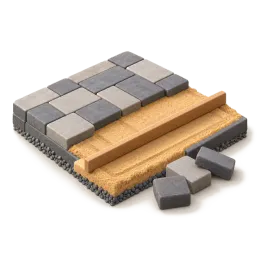
Paver sand, also called bedding sand, is the thin layer screeded flat over the compacted base so each paver sits at the same height. Because the layer is about 1 in thick, the math is short:
Cubic yards = area (ft²) × depth (in) ÷ 324
At 1 in: cubic yards = area ÷ 324; cubic feet = area ÷ 12
Tons = cubic yards × about 1.35 (typical; ask your supplier)
The calculator above starts at 1 in deep with 0.5 ft³ bags and returns cubic yards, cubic feet, tons, cubic metres and the bag count. Change the depth if your plans call for something different.
- Measure the paved area. Use the outside dimensions of the pavers, not the base, which usually extends past the edge.
- Set the depth. About 1 in for a standard bedding layer.
- Add 10% for screeding waste, sand left in the rails and sand that falls into gaps at the edge restraint.
- Order joint sand separately. It is a much smaller quantity and is sized by the bag coverage, covered below.
Worked example: 12 × 16 ft patio plus a 3 × 20 ft walkway
- Area: 192 ft² + 60 ft² = 252 ft²
- Bedding sand at 1 in: 252 ÷ 12 = 21 ft³, or 252 ÷ 324 = 0.78 yd³ (0.59 m³)
- Weight: 0.78 × 1.35 = 1.05 tons, or 1.16 tons with 10% extra
- In 0.5 ft³ bags: 42 bags, or 47 with 10% extra
At 47 bags, a bulk delivery of 1 yd³ is likely easier, as long as you can cover the pile to keep it dry for screeding.
How thick should paver sand be?
The bedding layer is thin on purpose. The University of Houston’s master specification for interlocking concrete unit pavers says to spread sand evenly over the base course and screed it to a nominal 1 in (25 mm) thickness, not exceeding 1½ in (40 mm). It also says screeded sand should not be disturbed and that bedding sand must not be used to fill depressions in the base surface.
That last rule matters for ordering. A thick sand bed does not stay put under load; it moves and leaves the pavers uneven. If the base is low, fix the base with more compacted aggregate before you screed. The cost of getting it wrong also shows up in the quantity: a 12 × 16 ft patio needs 0.59 yd³ of sand at 1 in but 1.19 yd³ at 2 in, an extra 0.8 tons of sand doing a job it is not suited to.
Paver sand for common patio sizes
The table gives the bedding sand for common patios and walkways at the nominal 1 in and at the 1½ in upper limit, using a typical 1.35 tons per cubic yard for dry sand (check your supplier’s figure). Every figure comes from the site’s calculation library.
| Patio or walk | Area (ft²) | 1 in: ft³ | 1 in: yd³ | 1 in: tons with 10% | 1 in: 0.5 ft³ bags with 10% | 1½ in: yd³ |
|---|---|---|---|---|---|---|
| 3 × 20 ft walk | 60 | 5.0 | 0.19 | 0.28 | 11 | 0.28 |
| 3 × 30 ft walk | 90 | 7.5 | 0.28 | 0.41 | 17 | 0.42 |
| 10 × 10 ft | 100 | 8.3 | 0.31 | 0.46 | 19 | 0.46 |
| 10 × 12 ft | 120 | 10.0 | 0.37 | 0.55 | 22 | 0.56 |
| 12 × 12 ft | 144 | 12.0 | 0.44 | 0.66 | 27 | 0.67 |
| 12 × 16 ft | 192 | 16.0 | 0.59 | 0.88 | 36 | 0.89 |
| 12 × 20 ft | 240 | 20.0 | 0.74 | 1.10 | 44 | 1.11 |
| 16 × 20 ft | 320 | 26.7 | 0.99 | 1.47 | 59 | 1.48 |
| 20 × 20 ft | 400 | 33.3 | 1.23 | 1.83 | 74 | 1.85 |
| 20 × 30 ft | 600 | 50.0 | 1.85 | 2.75 | 110 | 2.78 |
A quick rule falls out of the table: at 1 in, each 0.5 ft³ bag beds 6 ft², each cubic yard beds 324 ft² and each ton beds about 240 ft². At 1½ in, a ton beds about 160 ft².
What kind of sand to use under pavers
Ask for coarse, washed concrete sand. The University of Houston specification requires bedding and joint sand that is clean, non-plastic and free of deleterious or foreign matter, natural or manufactured from crushed rock, and states that limestone screenings or stone dust shall not be used. It sets the bedding sand grading to ASTM C33, the standard for concrete aggregates, with 100% passing the 3/8 in sieve and 95–100% passing the No. 4 sieve.
Joint sand is a different, finer grading. The same specification grades joint sand to ASTM C144, with 100% passing the No. 4 sieve. In practice that means two separate purchases:
- Bedding sand: the bulk of the order, sized by the table above.
- Joint sand or polymeric sand: swept into the gaps after the pavers are laid and compacted, sized by bag coverage.
The calculator’s sand preset uses 1.35 tons per cubic yard, a typical planning value for dry sand (QUIKRETE’s Mason Sand data sheet puts a 50 lb bag at about 0.5 ft³ (14 L), roughly 100 lb/ft³). Concrete sand from a yard can weigh more or less, so use your supplier’s figure. Damp sand from an open pile weighs more for the same volume, so if the supplier sells by the ton, ask for the weight per yard of their concrete sand and use it. Play sand and fine masonry sand are not substitutes for the bedding layer; size those jobs on the general sand calculator.
How much polymeric sand do you need?
Polymeric joint sand is sold by the bag, and its coverage depends on joint width and paver thickness, not on the patio area alone. For a bag count from your paver size, joint width and thickness, use the polymeric sand calculator. Sika Canada’s product data sheet for EVOLUTION Pro 1 polymeric sand says a 22.7 kg (50 lb) bag covers approximately 1.7 to 11.8 m² of pavers, depending on joint width and paver thickness, for joints from 3 to 25 mm (1/8 to 1 in) wide. In square feet that is about 18 to 127 ft² per bag. (The sheet’s printed square-foot figures read “18 and 27 ft²”; the metric range converts to 18–127 ft², so check the bag label before buying.)
| Paved area (ft²) | Bags, narrow joints (127 ft² per bag) | Bags, wide joints (18 ft² per bag) |
|---|---|---|
| 60 | 1 | 4 |
| 100 | 1 | 6 |
| 144 | 2 | 8 |
| 192 | 2 | 11 |
| 252 | 2 | 14 |
| 400 | 4 | 23 |
| 600 | 5 | 34 |
The spread is wide, so buy for the middle of the range and keep receipts for unopened bags. Other points from the same data sheet that affect how much you use:
- Fill the full depth. The sheet says to fill joints to the full depth of the paver, leaving a 1/8 in (3 mm) reveal, and not to partially fill joints with another material.
- Compact and top up. For joints under 1/4 in (6 mm) it calls for running a vibrating plate over the surface and repeating the fill until joints are filled to at least 1/8 in below the surface.
- Check the base. It says not to use the product with pavers installed directly over a concrete slab without a drainage base, and not to use it with clay pavers.
Other brands publish different coverage. Use the figure on the bag or data sheet of the product you actually buy.
Bedding sand in metric
At a typical 1.35 US tons per cubic yard, dry sand is about 1.6 tonnes per m³. The metric bedding layer is 25 mm, with 40 mm as the upper limit in the University of Houston specification.
| Paved area | Sand at 25 mm (m³) | Tonnes | Tonnes with 10% |
|---|---|---|---|
| 10 m² | 0.25 | 0.40 | 0.44 |
| 20 m² | 0.50 | 0.80 | 0.88 |
| 30 m² | 0.75 | 1.20 | 1.32 |
| 50 m² | 1.25 | 2.00 | 2.20 |
Each square metre takes about 40 kg of sand at 25 mm and 64 kg at 40 mm, so one tonne beds about 25 m² at 25 mm or 15.6 m² at 40 mm.
Worked example: 10 × 10 ft patio in bags
- Area: 100 ft²; at 1 in deep: 100 ÷ 12 = 8.33 ft³ (0.31 yd³, 0.24 m³)
- Weight: about 0.42 tons, or 0.46 tons with 10% extra
- Bags: 8.33 ÷ 0.5 = 17 bags, or 19 bags with 10% extra
- Polymeric joint sand: 1 bag with narrow joints, up to 6 with wide joints, per the Sika data sheet range
At this size bags are practical; above about 300 ft² a bulk load is usually less work.
How the layers of a paver patio fit together
A paver patio is built in layers, and the sand is the thinnest of them. From the bottom up there is the prepared soil, a compacted aggregate base, the screeded bedding sand, the pavers themselves and finally the joint sand swept into the gaps. Each layer has its own job and its own quantity.
- Base: carries the load and sets the slope. It is by far the largest volume, and its depth depends on your soil, climate, traffic and the paver maker’s installation guide. Size it on the gravel calculator.
- Bedding sand: gives each paver an even seat. It is a constant thickness, about 1 in, so its volume follows the paved area directly.
- Pavers: usually ordered by the square foot from the area you already measured, plus the cutting allowance the supplier recommends for your pattern.
- Joint sand: locks the pavers together. Its quantity depends on joint width and paver thickness, which is why it is sized per bag rather than per cubic yard.
Because the bedding sand is a constant thickness, any mistake in the base shows up as a temptation to vary the sand. That is the reason specifications such as the University of Houston’s limit the bed to 1½ in and forbid filling base depressions with sand.
Paver sand for walkways, landings and repairs
Narrow jobs follow the same rule as patios: at 1 in deep, one 0.5 ft³ bag beds 6 ft². A 3 × 20 ft walkway needs 5 ft³ of bedding sand, 10 bags, or 11 with the allowance. A 3 × 30 ft walk needs 7.5 ft³, 15 bags, or 17 with the allowance. At these sizes bags are usually the practical choice, because a bulk delivery minimum may be larger than the job.
Repairs are smaller still. When you lift a sunken section to reset it, the usual cause is a base that has settled, not missing sand. Re-compact or add base material first, then screed fresh bedding sand at the same 1 in so the reset pavers sit flush with their neighbors. Measure the lifted area, divide by 6 for 0.5 ft³ bags, and buy a bag or two of joint sand of the same type already in the patio.
Ordering, delivering and storing bedding sand
Cover the sand pile with a secured waterproof tarp, as the University of Houston specification requires, so rain does not soak it and wind does not blow it away. Wet sand also weighs more, so if you buy by the ton, ask your supplier how moisture affects the weight.
Ask the supplier for concrete sand, and if you need to confirm the grading, ask whether it meets ASTM C33. Some yards sell a product labeled for pavers; the name varies by region, so the grading is the useful question. Place the pile on a tarp or plywood near the patio but off the area to be paved, and keep it away from the base so the sand does not mix into the aggregate.
For curved patios, measure the paved area as a set of rectangles and part-circles and add them. The bedding sand follows the paved shape, so the cuts at the edge do not change the sand quantity, only the paver count. The 10% allowance covers the sand left in the screed rails and the strip along the edge restraint.
Common mistakes when ordering paver sand
- Using sand to fix the base. The bedding layer should be an even 1 in. Correct a low base with compacted aggregate, not extra sand.
- Buying stone dust or screenings for the bed. The University of Houston specification excludes limestone screenings and stone dust from the bedding layer. Ask for concrete sand graded to ASTM C33.
- Measuring the base instead of the pavers. The base extends past the paver edge; the sand does not need to. Measure the paved area.
- Forgetting joint sand. Bedding sand and joint sand are different gradings and separate purchases. Budget for both.
- Assuming one polymeric coverage. Coverage per bag can vary sevenfold with joint width. Read the bag, or size it on the polymeric sand calculator.
- Leaving the pile uncovered. Cover it against rain and wind.
Paver sand vs sand, gravel and slab calculators: which one to use
All of these use the same volume formula; the layer and the job decide which page fits.
- Paver sand calculator (this page): the 1 in bedding layer under pavers and the polymeric sand for the joints.
- Sand calculator: general sand for sandboxes, pool bases, lawn leveling and other jobs.
- Gravel calculator: the compacted aggregate base under the sand, the thickest layer in a paver patio.
- Driveway gravel calculator: layered base for a paver or gravel driveway.
- Concrete slab calculator: if you are comparing pavers with a poured concrete patio.
- Cubic yard calculator: any shape or material when you only need the volume.
FAQ
Frequently asked questions
How much sand do I need for a 10×10 paver patio?
A 10 × 10 ft patio with a 1 in bedding layer needs 8.3 ft³ of sand, which is 0.31 yd³ or about 0.42 tons. With 10% extra that is 0.46 tons, or 19 bags of 0.5 ft³. Joint sand is a separate, smaller purchase.
How much sand do I need for a 12×12 paver patio?
At 1 in deep a 12 × 12 ft patio needs 12 ft³ of bedding sand, 0.44 yd³ or about 0.6 tons. Add 10% and order 0.66 tons, or 27 bags of 0.5 ft³. If the bed runs 1½ in, it needs 0.67 yd³.
How much sand do I need for a 12×16 patio?
A 12 × 16 ft patio is 192 ft², so a 1 in sand bed needs 16 ft³, 0.59 yd³ or about 0.8 tons. With 10% extra order 0.88 tons or 36 bags of 0.5 ft³. At 1½ in it needs 0.89 yd³.
How much sand do I need for a 20×20 paver patio?
At 1 in deep, 400 ft² needs 33.3 ft³ of bedding sand, which is 1.23 yd³ or about 1.67 tons. With 10% extra order 1.83 tons. In bags that is 74 bags of 0.5 ft³, so bulk delivery is easier.
How thick should the sand be under pavers?
About 1 in. A University of Houston interlocking paver specification calls for sand screeded to a nominal 1 in (25 mm), not exceeding 1½ in (40 mm). At 1 in a cubic yard beds 324 ft²; at 1½ in it beds 216 ft².
How much paver sand do I need per square foot?
At 1 in deep each square foot takes 0.083 ft³ of sand, about 8.3 lb at a typical 1.35 tons per yard. So 100 ft² takes 8.33 ft³, roughly 833 lb or 17 bags of 0.5 ft³, before the 10% allowance.
How many bags of sand do I need for pavers?
Divide the patio area by 6 for 0.5 ft³ bags at 1 in deep, because each bag beds 6 ft². A 12 × 12 ft patio needs 24 bags, or 27 with 10% extra; a 16 × 20 ft patio needs 54 bags, or 59 with extra.
How much area does a ton of paver sand cover?
About 240 ft² at 1 in deep, using a typical 1.35 tons per cubic yard of dry sand; your supplier's weight may differ. At 1½ in a ton beds about 160 ft². Wet sand weighs more per yard, so a wet ton covers a little less.
How much polymeric sand do I need?
It depends on joint width and paver thickness. Sika's data sheet for EVOLUTION Pro 1 gives 1.7 to 11.8 m² per 50 lb bag, about 18 to 127 ft². A 12 × 16 ft patio may need 2 bags with tight joints or up to 11 with wide ones.
What kind of sand goes under pavers?
Coarse, washed concrete sand. The University of Houston paver specification requires bedding sand graded to ASTM C33 and says limestone screenings or stone dust shall not be used. A 1 in bed of it takes 0.31 yd³ per 100 ft².
Is bedding sand the same as joint sand?
No. Bedding sand is the 1 in layer under the pavers, graded to ASTM C33 in the University of Houston specification. Joint sand is finer, graded to ASTM C144, and fills the gaps between pavers. You need far more bedding sand by volume.
Can I use more sand to level the base?
No. The University of Houston specification says not to use bedding sand to fill depressions in the base. Fix the base instead. A 12 × 16 ft bed at 2 in uses 1.19 yd³, double the 0.59 yd³ at 1 in, and the thick spots settle unevenly.
How much sand do I need for a paver walkway?
A 3 × 20 ft walkway at 1 in needs 5 ft³ of bedding sand, about 0.25 tons, or 11 bags of 0.5 ft³ with 10% extra. A 3 × 30 ft walk needs 7.5 ft³, about 0.38 tons, or 17 bags.
How much bedding sand per square metre?
At 25 mm deep each square metre needs 0.025 m³, about 40 kg of dry sand at a typical 1.6 tonnes per m³. One tonne beds about 25 m². A 20 m² patio needs 0.5 m³, about 0.8 tonnes, or 0.88 with 10% extra.
Do I need gravel as well as sand for pavers?
Yes. Pavers sit on a thin sand bed over a compacted aggregate base, and the base is the thick layer. This page sizes the sand; size the base on the gravel calculator using the depth from your paver maker's guide or plans.
3 Sources
Last reviewed October 9, 2026 by M Bilal. Found an error? Tell us.