


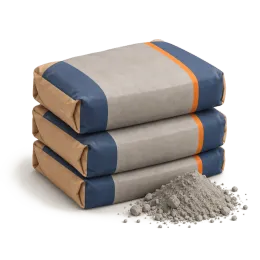
Key numbers
- 1 yd³ + 10% = 50 × 80 lb bags (4,000 lb) or a 1¼ yd³ truck order
- Truck mixers carry 8 to 12 yd³ (5 to 9 m³) (NRMCA)
- Order 4–10% extra ready-mix over the plan volume (NRMCA)
- A loaded truck weighs about 80,000 lb: check access first
On this page
- How to use the Ready-Mix vs Bagged Concrete Calculator
- Should I use ready-mix or bagged concrete?
- Bags vs truck for common pour sizes
- How do I find the break-even point?
- How much concrete does a ready-mix truck hold?
- When bags make more sense
- When a truck makes more sense
- Common mistakes when choosing
- This page vs the other concrete calculators
- Frequently asked questions
How to use the Ready-Mix vs Bagged Concrete Calculator
- 1Enter your numbersFill in concrete needed (before waste) (yd³), bag size, price per bag ($), ready-mix price ($/yd³), delivery + short-load fees ($) or extra for waste (%).
- 2Check the assumptionsUse your local prices. Ready-mix is rounded up to the next ¼ yd³; delivery and short-load fees vary by plant.
- 3Read the resultsThe calculator shows cheaper option, bags to buy, bagged total, ready-mix order, ready-mix total or dry mix you will lift, updated as you type.
- 4Use the resultRound up to what your supplier sells, and keep a little extra for waste.
Results update as you type. Back to the calculator ↑

Should I use ready-mix or bagged concrete?
Use bags for small pours and order a ready-mix truck once the job reaches about one cubic yard. The money matters, but so does the work: one yard plus 10% waste means 50 bags of 80 lb mix, 4,000 lb of dry material to carry, mix and place before the first batch sets.
The calculator above takes your volume and two local prices (bag price and ready-mix per yard, plus delivery fees) and gives:
- the number of bags to buy, with waste
- the ready-mix order, rounded up to the next ¼ yd³
- both totals, and which is cheaper
- the dry weight you will handle if you go with bags
This page does not print average prices. Bag prices and ready-mix rates vary by region, season and order size, so the comparison only means something with your own quotes. For what goes into a ready-mix quote, see ready-mix concrete price.
Bags = volume (ft³) × 1.10 ÷ 0.60, rounded up · Truck order = volume (yd³) × 1.10, rounded up to ¼ yd³
Bags vs truck for common pour sizes
This table shows the same pour both ways, with 10% extra on each. The weight column is the dry mix you would lift with 80 lb bags. Every figure is computed with the site’s calculator library.
| Concrete needed (yd³) | Cubic feet | 80 lb bags (+10%) | Dry mix to lift (lb) | US tons | Truck order (yd³) |
|---|---|---|---|---|---|
| 0.10 | 2.7 | 5 | 400 | 0.2 | ¼ |
| 0.25 | 6.8 | 13 | 1,040 | 0.5 | ½ |
| 0.50 | 13.5 | 25 | 2,000 | 1.0 | ¾ |
| 0.75 | 20.3 | 38 | 3,040 | 1.5 | 1 |
| 1 | 27.0 | 50 | 4,000 | 2.0 | 1¼ |
| 1.5 | 40.5 | 75 | 6,000 | 3.0 | 1¾ |
| 2 | 54.0 | 99 | 7,920 | 4.0 | 2¼ |
| 3 | 81.0 | 149 | 11,920 | 6.0 | 3½ |
| 5 | 135.0 | 248 | 19,840 | 9.9 | 5½ |
| 10 | 270.0 | 495 | 39,600 | 19.8 | 11 |
Three things jump out. Below ½ yd³ the bag count is manageable and a truck may charge a short-load fee for a tiny order. At 1 yd³ you are lifting two tons. By 3 yd³ it is nearly 150 bags, six tons and a full day of mixing, and a single truck delivery is the practical choice.
Worked example: 12 × 12 ft patio, 4 in thick
- Volume: 12 × 12 × 4 ÷ 324 = 1.78 yd³ (48 ft³)
- Bags: 48 × 1.10 ÷ 0.60 = 88 → 88 × 80 lb bags, 7,040 lb of dry mix
- Truck: 1.78 × 1.10 = 1.96 → order 2 yd³
- Bag total = 88 × your bag price; truck total = 2 × your yard price + delivery and short-load fees
How do I find the break-even point?
Divide the full truck cost by the number of bags you would need: if a bag costs less than that, bags are cheaper. For 1 yd³ (50 bags with waste, 1.25 yd³ ordered):
Break-even bag price = (1.25 × ready-mix $/yd³ + delivery and fees) ÷ 50
Fees dominate small orders, so the break-even bag price is high for a quarter yard and falls as the order grows. That is why the answer flips around the 1 yard mark for many buyers. Put your real numbers into the calculator rather than using a rule of thumb.
Money is not the only cost. Bags also mean renting or buying a mixer (QUIKRETE asks for at least 1 ft³ of mixer capacity per 80 lb bag per batch), extra helpers, and the risk of a cold joint if mixing falls behind the pour.
How much concrete does a ready-mix truck hold?
Truck mixers carry 8 to 12 cubic yards (5 to 9 m³), according to the National Ready Mixed Concrete Association’s CIP 31. A full truck is 360 to 540 bags of 80 lb premix.
Most homeowner jobs need far less than a full truck. Plants deliver partial loads, often with a short-load charge below a set yardage; ask your plant for its minimum and fee. For bigger pours, book several trucks back to back so the concrete does not set between loads.
Also check access. NRMCA notes that a loaded concrete truck weighs about 80,000 lb (36,000 kg) and may not be able to drive on loose dirt or over residential curbs and paths. If the truck cannot reach the forms, budget for wheelbarrows, a buggy or a concrete pump.
When bags make more sense
- Small, scattered pours: fence posts, a mailbox footing, a few steps. Each hole takes one to three bags; a truck would wait between them.
- Poor truck access: a backyard reached only through a gate.
- Working alone or slowly: you can mix one batch, place it, then mix the next.
- Repairs and patches under ¼ yd³.
When a truck makes more sense
- Anything above about 1 yd³: slabs, driveways, garage floors, footings for an addition.
- One continuous pour: a slab must be placed and finished before the first concrete sets. NRMCA says concrete normally sets within 2 to 8 hours of mixing; hand-mixing 100 bags rarely keeps up.
- Specified strength or air entrainment: ready-mix is ordered to a mix designation (strength, slump, air), commonly 3,500 to 5,000 psi for typical work per NRMCA.
Common mistakes when choosing
- Comparing bag price to the yard price without fees. A small truck order includes delivery and short-load charges; include them.
- Forgetting waste on the bag side. 1 yd³ is 45 bags exact, but you should buy 50.
- Ordering ready-mix with no extra. NRMCA advises 4–10% over the plan volume. Running short mid-pour leaves a cold joint.
- Adding water to either. It makes placing easier and the concrete weaker. Bagged mix has a water range on the bag; ready-mix should arrive at the slump you ordered.
- Underestimating the labor. 50 bags is about 25 two-bag mixer loads.
This page vs the other concrete calculators
Start with the volume: the concrete yards calculator or the slab calculator on the homepage. Then use this page to choose truck or bags. For the bag side, see how many bags of concrete in a yard and how many cubic feet are in an 80 lb bag. For the truck side, see ready-mix concrete price and concrete delivery cost.
Brand names are used descriptively; this site is independent and not affiliated with QUIKRETE, Sakrete or NRMCA.
FAQ
Frequently asked questions
Is it cheaper to mix your own concrete or buy ready-mix?
For small pours, bags are usually cheaper because ready-mix adds delivery and short-load fees. Past about a yard the truck often wins once labor is counted. Enter your bag price, ready-mix price per yard and fees in the calculator to compare your own quotes.
How much concrete does a truck hold?
Truck mixers carry 8 to 12 cubic yards (5 to 9 m³), according to the National Ready Mixed Concrete Association. That equals 360 to 540 bags of 80 lb premix. Larger pours need several trucks booked back to back.
At what point should I order a concrete truck instead of bags?
Many DIYers switch at about 1 cubic yard. That is 50 × 80 lb bags with 10% waste, 4,000 lb to lift and roughly 25 two-bag mixer batches. Below half a yard (25 bags) bags are usually simpler. Price both with your local quotes.
How many bags of concrete equal a yard of ready-mix?
45 bags of 80 lb, 60 bags of 60 lb or 90 bags of 40 lb make one cubic yard. With the usual 10% extra, buy 50 × 80 lb bags for each yard.
How many 80 lb bags of concrete for 2 yards?
90 bags exact, or 99 bags with 10% extra. That is 7,920 lb of dry mix. As ready-mix, 2 yd³ plus 10% is ordered as 2.25 yd³, a single small delivery.
How much extra ready-mix should I order?
NRMCA advises ordering 4% to 10% more than the volume from the plan dimensions, to cover uneven subgrade, form movement and spillage. This calculator uses 10% and rounds up to the next quarter yard, a common order increment.
Is bagged concrete as strong as ready-mix?
It can be. QUIKRETE Concrete Mix is rated 4,000 psi at 28 days when mixed and cured as directed. Ready-mix is ordered by strength, commonly 3,500 to 5,000 psi per NRMCA. Extra water weakens either one.
How long do I have to place ready-mix concrete?
Concrete normally sets and hardens within 2 to 8 hours after mixing (NRMCA), and the producer is responsible for slump for 30 minutes after the requested time or the truck's arrival, whichever is later. Have forms and crew ready before the truck arrives.
3 Sources
- NRMCA CIP 31, Ordering Ready Mixed Concrete: truck mixers 8–12 yd³ (5–9 m³), order 4–10% extra, loaded truck ≈80,000 lb, slump responsibility 30 min, set in 2–8 h
- QUIKRETE Concrete Mix (No. 1101) data sheet: 80 lb yields 0.60 ft³; 4,000 psi at 28 days; water 6–9 pints per 80 lb bag
- Sakrete High-Strength Concrete Mix technical data sheet: 80 lb 0.6 ft³
Last reviewed October 11, 2026 by M Bilal. Found an error? Tell us.