


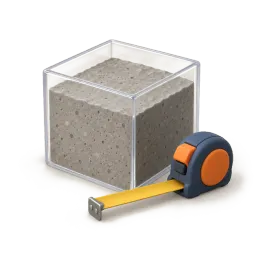
Key numbers
- Formula: L × W × D (all in feet) ÷ 27 = cubic yards
- Slab shortcut: L (ft) × W (ft) × T (in) ÷ 324
- 1 yd³ covers 81 ft² at 4 in, 54 ft² at 6 in
- 1 yd³ = 27 ft³ = 0.76 m³ = 45 × 80 lb bags
- Add 10%, then round up to the next ¼ yard
On this page
- How to use the Concrete Yards Calculator
- How do you calculate yards of concrete?
- How many yards of concrete for common slab sizes?
- How many square feet does a yard of concrete cover?
- What to tell the plant when you order
- How many yards for footings, Sonotubes, walls and steps?
- How many cubic feet are in a yard of concrete?
- How to figure concrete yardage for irregular shapes
- Combining several pours into one truck order
- How many yards of concrete for a driveway or sidewalk?
- How much extra concrete should I order?
- Concrete yards to tons: how much does the order weigh?
- Metric: cubic metres of concrete
- Should I order ready-mix or buy bags?
- Common mistakes when figuring concrete yardage
- Concrete yards calculator vs other concrete calculators: which one to use
- Frequently asked questions
How to use the Concrete Yards Calculator
- 1Choose the shapePick slab / pad, monolithic slab, round slab, footing, column / sonotube, post holes, steps, wall, curb & gutter, square / rect. column, beam or hollow cylinder. Each shape uses its own volume formula.
- 2Pick your unitsEvery dimension has its own unit menu (in, ft, yd, cm or m); changing one converts that number so the size stays the same. The US / Metric switch sets all fields to feet and inches or meters and centimeters and resets them to typical values.
- 3Enter the dimensionsType the length (default feet), width (default feet) or thickness (default inches). Measure the inside of the forms and the depth in several places.
- 4Set waste and quantityUse the waste slider (0 to 20%, default 10%) and allow more on uneven ground. If you have several identical pours, enter how many.
- 5Read the resultsSee the volume in cubic yards, cubic feet and cubic meters, the ready-mix order rounded up to ¼ yard, the number of 90, 80, 60, 50 and 40 lb bags rounded up, and the weight at the density you choose (150, 145 or 140 lb/ft³).
- 6Price it and save itPick a pricing basis (per cubic yard, per cubic meter or per bag of the highlighted size) and enter your local price for a material cost. Use Add to project to total several pours, and Copy link to share the exact result.
Results update as you type. Back to the calculator ↑
How do you calculate yards of concrete?
Find the volume in cubic feet, then divide by 27, because one cubic yard is 3 × 3 × 3 = 27 ft³. Ready-mix plants sell concrete by the cubic yard, so this is the number you give them on the phone.
Cubic yards = length (ft) × width (ft) × depth (ft) ÷ 27
Thickness is usually given in inches, which is where most mistakes happen. For flat pours you can skip the conversion with the slab shortcut:
Cubic yards = length (ft) × width (ft) × thickness (in) ÷ 324
The 324 is 12 inches per foot × 27. The calculator above does both and also shows cubic feet and cubic meters (1 yd³ = 0.76 m³).
- Measure inside the forms in feet and inches. Check the depth in several places and use the average.
- Add 10% for waste. Bases are never perfectly flat and forms bow a little.
- Round up to the next ¼ yard for ready-mix, or to the next whole bag.
Worked example: 20 × 20 ft patio, 4 in thick
- 20 × 20 × 4 ÷ 324 = 4.94 yd³ (133.3 ft³, 3.78 m³)
- Add 10%: 4.94 × 1.10 = 5.43 yd³
- Round up to the next ¼ yard: order 5½ yd³
- The same slab in bags would be 245 × 80 lb bags, so ready-mix is the sensible choice
How many yards of concrete for common slab sizes?
Most people search for their own slab size, so here are the answers worked out with the same formula the calculator uses. “Order” is the volume plus 10%, rounded up to the next ¼ yard.
| Slab size | yd³ at 4 in | Order at 4 in | yd³ at 5 in | Order at 5 in | yd³ at 6 in | Order at 6 in |
|---|---|---|---|---|---|---|
| 4 × 4 ft | 0.20 | ¼ | 0.25 | ½ | 0.30 | ½ |
| 10 × 10 ft | 1.23 | 1½ | 1.54 | 1¾ | 1.85 | 2¼ |
| 12 × 12 ft | 1.78 | 2 | 2.22 | 2½ | 2.67 | 3 |
| 16 × 16 ft | 3.16 | 3½ | 3.95 | 4½ | 4.74 | 5¼ |
| 20 × 20 ft | 4.94 | 5½ | 6.17 | 7 | 7.41 | 8¼ |
| 24 × 24 ft | 7.11 | 8 | 8.89 | 10 | 10.67 | 11¾ |
| 30 × 30 ft | 11.11 | 12¼ | 13.89 | 15½ | 16.67 | 18½ |
| 30 × 40 ft | 14.81 | 16½ | 18.52 | 20½ | 22.22 | 24½ |
Worked example: 12 × 12 ft shed pad, 4 in thick
- 12 × 12 × 4 ÷ 324 = 1.78 yd³ (48 ft³, 1.36 m³)
- Add 10%: 1.78 × 1.10 = 1.96 yd³
- Round up to the next ¼ yard: order 2 yd³ of ready-mix
- In bags: 88 × 80 lb or 118 × 60 lb including the 10%, which is more than 3½ tons of dry mix to lift
Going from 4 in to 6 in thick adds 50% more concrete. For one-off sizes, the concrete slab calculator also gives bag counts.
How many square feet does a yard of concrete cover?
One cubic yard covers 324 ft² at 1 in thick, so divide 324 by your thickness in inches. At 4 in that is 81 ft² per yard.
| Thickness | ft² per yd³ | yd³ per 100 ft² | m³ per 100 ft² |
|---|---|---|---|
| 3 in (7.5 cm) | 108 | 0.93 | 0.71 |
| 4 in (10 cm) | 81 | 1.23 | 0.94 |
| 5 in (12.5 cm) | 64.8 | 1.54 | 1.18 |
| 6 in (15 cm) | 54 | 1.85 | 1.42 |
| 8 in (20 cm) | 40.5 | 2.47 | 1.89 |
Bagged mixes such as QUIKRETE Concrete Mix are rated for pours 2 in thick or more, so thin toppings need a different product.
To go from square feet to yards of concrete, multiply the area by the thickness in inches and divide by 324. A 600 ft² pad at 4 in is 600 × 4 ÷ 324 = 7.41 yd³. Going the other way, multiply yards by 324 and divide by the thickness: 10 yd³ poured 6 in thick covers 540 ft². The square feet to cubic yards calculator has the full coverage chart for mulch, gravel and soil as well.
What to tell the plant when you order
A ready-mix order is more than a yardage. Have these ready when you call, so the dispatcher batches the right load:
- Total cubic yards, already including your waste allowance and rounded to their step.
- Strength or mix your plans or local code call for. If you are unsure, ask the plant what they normally supply for your type of slab.
- Pour time and access. Say how far the truck must reach and whether you need a pump or a chute extension.
- Split loads. If the job is larger than one truck, ask them to space the loads so the first one is not setting before the second arrives.
How many yards for footings, Sonotubes, walls and steps?
Every shape uses the same rule: volume in cubic feet ÷ 27. Only the volume formula changes. These examples come from the calculator’s own functions.
| Job | Volume (ft³) | Cubic yards | Order or bags |
|---|---|---|---|
| Footing 100 ft × 24 in wide × 12 in deep | 200 | 7.41 | 8¼ yd³ with 10% |
| Wall 40 ft × 8 ft high × 8 in thick | 213.3 | 7.90 | 8¾ yd³ with 10% |
| One 12 in Sonotube, 4 ft deep | 3.14 | 0.116 | 6 × 80 lb bags with 10% |
| Ten 12 in Sonotubes, 4 ft deep | 31.42 | 1.16 | 58 × 80 lb bags with 10% |
| One 8 in Sonotube, 4 ft deep | 1.40 | 0.052 | 3 × 80 lb bags with 10% |
| 4×4 post in a 10 in hole, 3 ft deep | 1.38 | 0.051 | 3 × 80 lb bags with 10% |
| 3 steps, 4 ft wide, 7 in rise, 11 in run, 3 ft landing | 33.83 | 1.25 | 63 × 80 lb bags with 10% |
For a round column or tube the volume is π × radius² × depth. The 4×4 post row subtracts the post itself (3.5 × 3.5 in actual size) from the hole. The Sonotube calculator and footing calculator handle these shapes directly.
How many cubic feet are in a yard of concrete?
A yard of concrete is 27 ft³, because a cubic yard is a cube 3 ft on each side. To turn cubic feet into yards, divide by 27; to go back, multiply by 27. Half a yard is 13.5 ft³ and a quarter yard is 6.75 ft³.
This matters when part of a job is measured in bags. A ¼ yd³ pour is 12 bags of 80 lb mix (0.60 ft³ each) and a ½ yd³ pour is 23 bags, so if your total lands just over the increment your plant batches in, a few bags for a separate small form can beat bumping the truck order up. For volumes you already have in cubic feet, the cubic feet to cubic yards converter has the full chart.
Cubic inches to yards of concrete
Divide cubic inches by 46,656 (27 × 1,728) to get cubic yards. This comes up with small forms measured with a tape in inches.
- A form 8 × 16 × 24 in is 3,072 in³, which is 1.78 ft³ or 0.066 yd³. Buy four 80 lb bags: three (1.80 ft³) cover the volume with almost no spare, and the fourth gives the 10% extra.
- A square pier 12 × 12 in and 48 in deep is 6,912 in³, exactly 4 ft³ or 0.148 yd³. Eight of them need 1.19 yd³.
Converting each dimension to feet first gives the same result with smaller numbers: 1 × 1 × 4 ft = 4 ft³.
How to figure concrete yardage for irregular shapes
Split the pour into rectangles, circles and triangles, work out the cubic feet of each, add them, then divide the total by 27. Add the waste allowance once, at the end.
L-shaped patio. A 20 × 12 ft section plus a 10 × 8 ft section, both 4 in thick, is 80 + 26.7 = 106.7 ft³. That is 3.95 yd³, or 4.35 yd³ with 10% extra, so the order is 4½ yd³.
Round patio. The area of a circle is 3.1416 × radius². A 12 ft round patio has a 6 ft radius and covers 113.1 ft². At 4 in thick it holds 37.7 ft³, or 1.40 yd³. With 10% it is 1.54 yd³, ordered as 1¾ yd³.
Uneven subgrade. Measure the depth inside the forms at four or more points and average them. Readings of 3½, 4, 4½ and 5 in average 4.25 in. On a 20 × 20 ft slab that is 5.25 yd³, not the 4.94 yd³ a flat 4 in assumption gives. The extra 0.31 yd³ would eat most of a 10% allowance before any spillage.
Combining several pours into one truck order
Most jobs have more than one shape. Calculate each part in cubic feet, add them, convert once and round once. Rounding each part separately to ¼ yard can add almost ¼ yd³ per part that you never use.
Worked example: 20 × 20 ft slab with thickened edge and six piers
- Slab: 20 × 20 × 4 ÷ 12 = 133.3 ft³ (4.94 yd³)
- Thickened edge: 80 ft of perimeter × 1 ft wide × 8 in extra depth = 53.3 ft³ (1.98 yd³)
- Six 12 in Sonotubes 4 ft deep: 18.85 ft³ (0.70 yd³)
- Total: 205.5 ft³ = 7.61 yd³; with 10% = 8.37 yd³
- Round up once: order 8½ yd³
The calculator’s Add to project button does this totalling for you. If the piers are poured on a different day from the slab, keep them as separate orders, because a truck delivers only what is batched for that pour.
How many yards of concrete for a driveway or sidewalk?
Use the same L × W × thickness ÷ 324 formula. Thickness changes the answer most, so check what your local code or engineer requires for vehicle traffic before you order.
| Job | Size | Thickness | yd³ | With 10% | Order |
|---|---|---|---|---|---|
| Single-car driveway | 12 × 40 ft | 5 in | 7.41 | 8.15 | 8¼ yd³ |
| Single-car driveway | 12 × 40 ft | 6 in | 8.89 | 9.78 | 10 yd³ |
| Sidewalk | 4 × 50 ft | 4 in | 2.47 | 2.72 | 2¾ yd³ |
| Two-car pad | 20 × 30 ft | 4 in | 7.41 | 8.15 | 8¼ yd³ |
The 4 × 50 ft sidewalk would take 123 bags of 80 lb mix including the 10%, which is why even modest walks are usually poured from a truck. For driveway inputs such as aprons and flares, use the concrete driveway calculator.
How much extra concrete should I order?
Ten percent is the default here and suits a well-graded base with straight forms. Go higher when the base is rough or the forms are long and flexible; go lower only when the subgrade has been checked with a string line.
On a 20 × 30 ft slab at 4 in (7.41 yd³), the allowance changes the order like this:
- 5% extra: 7.78 yd³, ordered as 8 yd³
- 10% extra: 8.15 yd³, ordered as 8¼ yd³
- 15% extra: 8.52 yd³, ordered as 8¾ yd³
The gap between 5% and 15% is ¾ yd³ on this slab. Running out usually costs more, because the second load leaves a cold joint and may carry its own delivery or small-load charge. Ask your plant how they handle a top-up load before pour day.
Concrete yards to tons: how much does the order weigh?
Multiply cubic yards by 4,050 lb, the normal-weight figure this site uses (150 lb/ft³ × 27), and divide by 2,000 for US tons. QUIKRETE states about 140 lb/ft³ for its bagged mix, which is 3,780 lb per yard.
| Cubic yards | Pounds (150 lb/ft³) | US tons | Metric tonnes | US tons at 140 lb/ft³ |
|---|---|---|---|---|
| ½ | 2,025 | 1.01 | 0.92 | 0.95 |
| 1 | 4,050 | 2.03 | 1.84 | 1.89 |
| 2 | 8,100 | 4.05 | 3.67 | 3.78 |
| 3 | 12,150 | 6.08 | 5.51 | 5.67 |
| 5 | 20,250 | 10.13 | 9.19 | 9.45 |
| 10 | 40,500 | 20.25 | 18.37 | 18.90 |
Weight matters if you plan to collect concrete in a towed mixer trailer or haul bags yourself: half a yard is already about a ton. Compare it with the payload rating of your vehicle and trailer. For gravel, sand and soil sold by weight, use the tons to cubic yards converter.
Metric: cubic metres of concrete
Multiply length × width × depth in metres to get m³. One cubic metre is 1.308 yd³, and one cubic yard is 0.7646 m³.
- A 6 × 4 m slab 100 mm thick is 2.4 m³ (3.14 yd³). With 10% it is 2.64 m³.
- A 5 × 5 m slab 150 mm thick is 3.75 m³ (4.90 yd³).
Suppliers that sell by the cubic metre may batch in set increments, so ask what increment they batch in before you round.
Should I order ready-mix or buy bags?
Under about ½ yd³, bags are practical. Above about 1 yd³, ready-mix is usually less work. Whether it also costs less depends on your plant’s price per yard and any small-load fee, so compare a quote with the bag price. One cubic yard equals 45 bags of 80 lb concrete (0.60 ft³ each) or 60 bags of 60 lb (0.45 ft³ each), and all that dry mix has to be lifted and mixed by hand.
Plants set their own order increments, minimums and small-load fees, so ask your plant when you call for a price. The concrete price per yard page explains what drives the quote.
Common mistakes when figuring concrete yardage
Most short or oversized loads come from one of these. Each one is easy to check before you call the plant.
- Using inches as feet. 4 in is 0.333 ft, not 0.4 ft. On a 10 × 10 ft slab, 0.4 ft gives 1.48 yd³ instead of 1.23 yd³, a 20% overorder. The ÷ 324 shortcut avoids this.
- Forgetting the waste allowance. A gravel base ½ in low over 400 ft² swallows an extra 0.62 yd³. Running short mid-pour leaves a cold joint where the second load meets the first.
- Guessing the thickness. Forms set at 5 in instead of the planned 4 in add 1.23 yd³ to a 20 × 20 ft slab. Measure the depth inside the forms in several places after the base is graded.
- Ignoring thickened edges. A turned-down edge 12 in wide and 8 in deeper than the slab, around all 80 ft of a 20 × 20 ft slab, adds 1.98 yd³. Calculate it as a footing and combine the two with Add to project.
- Measuring the outside of the forms. On a 20 × 20 ft slab, measuring over 1½ in form boards gives 20¼ ft each way and 5.06 yd³ instead of 4.94 yd³. Measure the inside, where the concrete actually goes.
- Confusing cubic and square yards. A square yard (9 ft²) is an area. Concrete is always ordered in cubic yards, so a slab needs a thickness before it has a yardage.
Concrete yards calculator vs other concrete calculators: which one to use
All of these use the same volume ÷ 27 math. Pick the one whose inputs match your job.
- This calculator when you need the ready-mix order in cubic yards for any shape, or want to total several pours into one truck order.
- Concrete slab calculator for a single patio, shed pad or driveway when you want the slab-specific tables and bag counts side by side.
- Concrete bag calculator for small jobs under about ½ yd³, where you are buying 40 to 90 lb bags rather than ready-mix.
- Concrete footing calculator and Sonotube calculator for trench footings, piers and round forms, where the shape inputs are set up for you.
- Cubic yard calculator when the material is not concrete, such as fill, mulch or gravel, and you only need the volume.
FAQ
Frequently asked questions
How many yards of concrete do I need for a 24×24 slab?
At 4 in thick a 24 × 24 ft slab needs 7.11 yd³, or 7.82 yd³ with 10% extra, so order 8 yd³. At 6 in it needs 10.67 yd³ (11.73 yd³ with extra), so order 11¾ yd³.
How many yards of concrete for a 20×20 slab?
4.94 yd³ at 4 in thick. Add 10% and you get 5.43 yd³, so order 5½ yd³. At 6 in thick the same slab takes 7.41 yd³, ordered as 8¼ yd³ with the extra.
How many yards of concrete for a 12×12 slab 4 inches thick?
1.78 yd³ (48 ft³). With 10% extra that is 1.96 yd³, so order 2 yd³ of ready-mix, or buy 88 bags of 80 lb concrete if you plan to mix it yourself.
How many yards of concrete for a 10×10 slab?
1.23 yd³ at 4 in thick (33.3 ft³). With 10% extra that is 1.36 yd³, so order 1½ yd³. At 6 in thick the slab needs 1.85 yd³, or 2¼ yd³ ordered with the extra.
How many yards of concrete for a 30×30 slab?
11.11 yd³ at 4 in thick (300 ft³). Add 10% and you get 12.22 yd³, so order 12¼ yd³. At 6 in thick a 30 × 30 ft slab needs 16.67 yd³, or 18½ yd³ with the extra.
How many yards of concrete for a 20×30 slab?
7.41 yd³ at 4 in thick (200 ft³). With 10% extra that is 8.15 yd³, so order 8¼ yd³. At 6 in thick it takes 11.11 yd³, ordered as 12¼ yd³ with the extra.
How much concrete do I need for a 4×8 slab?
0.40 yd³ (10.7 ft³) at 4 in thick. That is small enough for bags: 20 bags of 80 lb concrete or 27 bags of 60 lb, both including 10% extra. As ready-mix you would order ½ yd³.
How many 80 lb bags make a yard of concrete?
45 bags. Each 80 lb bag yields about 0.60 ft³ according to the QUIKRETE data sheet, and a cubic yard is 27 ft³, so 27 ÷ 0.60 = 45. With 10% extra, buy 50 bags.
How many 80 lb bags of concrete do I need for 3 yards?
135 bags. Three cubic yards is 81 ft³ and each 80 lb bag yields about 0.60 ft³. With 60 lb bags it is 180. At that volume ready-mix saves you lifting and mixing over 5 tons of dry mix.
How many 60 lb bags of Quikrete are in a yard?
60 bags. QUIKRETE's data sheet gives about 0.45 ft³ per 60 lb bag of Concrete Mix, and 27 ÷ 0.45 = 60. Buy 66 with 10% extra. The 40 lb bag (0.30 ft³) takes 90 per yard.
How many square feet does a yard of concrete cover?
81 ft² at 4 in thick. Divide 324 by the thickness in inches: 1 yd³ covers 108 ft² at 3 in, 64.8 ft² at 5 in, 54 ft² at 6 in and 40.5 ft² at 8 in.
What is the formula for concrete yardage?
Length (ft) × width (ft) × depth (ft) ÷ 27. With the thickness in inches, use length × width × thickness ÷ 324 instead. For example, 12 × 12 × 4 ÷ 324 = 1.78 yd³. Then add 10% and round up to the next ¼ yard.
How many yards of concrete is a 12 inch Sonotube?
A 12 in tube 4 ft deep holds 3.14 ft³, which is 0.116 yd³. Ten of them need 1.16 yd³. For a single tube, 6 bags of 80 lb concrete are enough.
How do you calculate yards of concrete for a footing?
Multiply length × width × depth in feet and divide by 27. A footing 100 ft long, 24 in wide and 12 in deep is 200 ft³, or 7.41 yd³. With 10% extra, order 8¼ yd³.
How much does a yard of concrete weigh?
About 4,050 lb (just over 2 US tons) at 150 lb/ft³, the normal-weight figure this site uses. QUIKRETE states about 140 lb/ft³ for its bagged mix, which is 3,780 lb per cubic yard.
3 Sources
Last reviewed October 9, 2026 by M Bilal. Found an error? Tell us.