


Key numbers
- Dry volume = wet volume × 1.54 (calculator assumption)
- 1:2:3 per yd³: 7 cement bags, 13.9 ft³ sand, 20.8 ft³ gravel
- 1:2:4 per yd³: 6 cement bags, 11.9 ft³ sand, 23.8 ft³ gravel
- Calculator assumption: one 94 lb bag of Portland cement is treated as about 1 ft³ (bag size per QUIKRETE; volume is a planning value)
On this page
- How to use the Concrete Mix Ratio Calculator
- What does a concrete mix ratio mean?
- Cement, sand and gravel per cubic yard
- Mix ratios per cubic metre
- Which mix ratio should I use?
- How much concrete does one bag of cement make?
- How much water goes into the mix?
- Cement per square foot of slab, by thickness
- Every ratio per cubic yard and per cubic metre
- Concrete strength: psi, MPa and the formula
- Hand-mixing in batches
- Ordering sand and gravel by the ton
- Ready-mix or mix your own?
- Small batches: buckets, wheelbarrows and slabs
- Common mistakes when mixing concrete by ratio
- Mix ratio calculator vs bag, yards and gravel calculators: which one to use
- Frequently asked questions
How to use the Concrete Mix Ratio Calculator
- 1Enter your numbersFill in concrete needed (yd³) or mix ratio (cement : sand : stone).
- 2Check the assumptionsUses the dry-volume method: dry materials = 1.54 × wet volume, and one 94 lb bag of Portland cement is taken as 1 ft³. Water assumes a 0.5 water-cement ratio. For a required strength, use a tested mix design or a rated premix.
- 3Read the resultsThe calculator shows portland cement (94 lb bags), sand, gravel / stone or water (approx., w/c 0.5), updated as you type.
- 4Use the resultRound up to what your supplier sells, and keep a little extra for waste.
Results update as you type. Back to the calculator ↑
What does a concrete mix ratio mean?
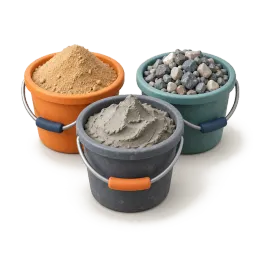
A mix ratio gives parts of cement : sand : gravel (coarse aggregate) by volume. In a 1:2:3 mix you add 1 bucket of cement, 2 buckets of sand and 3 buckets of gravel, then water. The ratio says nothing about quantity, so you also need the volume of concrete and the dry-volume factor.
Material (ft³) = finished volume (ft³) × 1.54 × part ÷ sum of parts
The 1.54 accounts for shrinkage. Sand fills the gaps between stones, and cement paste fills the gaps in the sand, so the dry pile is bigger than the concrete it makes. The calculator assumes one 94 lb bag of Portland cement fills about 1 ft³ (a planning assumption, not a manufacturer figure; check with your supplier), so cement cubic feet equal bags.
- Find the concrete volume in cubic feet or yards. The concrete yards calculator does this for slabs, footings and holes.
- Multiply by 1.54 for the dry volume.
- Split it by the ratio. For 1:2:3, cement is 1/6, sand 2/6 and gravel 3/6.
- Round cement up to whole bags and add a little extra sand and gravel for spillage.
Worked example: 1 cubic yard of 1:2:3 concrete
- Wet volume: 1 yd³ = 27 ft³. Dry volume: 27 × 1.54 = 41.6 ft³
- Cement: 41.6 ÷ 6 = 6.93 ft³ → 7 bags of 94 lb
- Sand: 41.6 × 2 ÷ 6 = 13.9 ft³ (0.51 yd³)
- Gravel: 41.6 × 3 ÷ 6 = 20.8 ft³ (0.77 yd³)
- Water at a 0.5 water-cement ratio: about 39 gallons
Worked example: 12 × 12 ft slab, 4 in thick, 1:2:3 mix
- Volume: 12 × 12 × 0.333 ft = 48 ft³ (1.78 yd³)
- Dry volume: 48 × 1.54 = 73.9 ft³
- Cement: 73.9 ÷ 6 = 12.32 ft³ → 13 bags of 94 lb
- Sand: 73.9 × 2 ÷ 6 = 24.6 ft³; gravel: 73.9 × 3 ÷ 6 = 37 ft³
- Same slab in premix: 80 bags of 80 lb
Cement, sand and gravel per cubic yard
This table covers the four ratios in the calculator, computed with the same function. Water is approximate, at a water-cement ratio of 0.5 by weight applied to the exact (unrounded) cement.
| Mix (cement : sand : gravel) | Cement (94 lb bags) | Sand (ft³) | Sand (yd³) | Gravel (ft³) | Gravel (yd³) | Water (gal) |
|---|---|---|---|---|---|---|
| 1 : 1.5 : 3 | 8 | 11.3 | 0.42 | 22.7 | 0.84 | 43 |
| 1 : 2 : 3 | 7 | 13.9 | 0.51 | 20.8 | 0.77 | 39 |
| 1 : 2 : 4 | 6 | 11.9 | 0.44 | 23.8 | 0.88 | 34 |
| 1 : 3 : 6 | 5 | 12.5 | 0.46 | 24.9 | 0.92 | 23 |
Cement bags are rounded up, so the 1:3:6 mix shows 5 bags for 4.2 ft³ of cement. Richer mixes (more cement per part of aggregate) are generally stronger and cost more; leaner mixes suit fill and blinding layers.
Mix ratios per cubic metre
Outside the US, cement comes in 25 kg or 50 kg bags and sand and gravel (often 20 mm) are bought by the cubic metre or tonne. The same method gives these quantities per 1 m³ of finished concrete:
| Mix | Cement (kg) | Sand (m³) | Gravel (m³) |
|---|---|---|---|
| 1 : 1.5 : 3 | 422 | 0.42 | 0.84 |
| 1 : 2 : 3 | 386 | 0.51 | 0.77 |
| 1 : 2 : 4 | 331 | 0.44 | 0.88 |
Cement kilograms assume loose cement weighs about 1,506 kg/m³ (the calculator’s 94 lb ≈ 1 ft³ assumption); bagged cement is sold by weight, so check the bag.
Divide the cement kilograms by your bag size to get bags: 1 m³ of 1:2:3 takes about 16 bags of 25 kg or 8 bags of 50 kg, and 1:2:4 takes 14 bags of 25 kg or 7 of 50 kg. Your supplier can convert sand and gravel to tonnes using the density of their material.
Which mix ratio should I use?
Use the mix your plans or product instructions call for. As a guide to how the common ratios are used:
- 1:1.5:3 has the most cement of the four and is chosen where a richer mix is wanted, such as slabs and driveways.
- 1:2:3 is a general-purpose mix for slabs, paths and pads.
- 1:2:4 (sometimes called the “4 2 1” mix, the ratio read backwards) is often used for footings and bases; follow your plans or local code.
- 1:3:6 is a lean mix for blinding layers under footings and mass fill.
Site-mixed concrete varies with the sand, the gravel, the water and how well it is mixed and cured, so no ratio guarantees a strength. When you need a known strength, buy a rated product. QUIKRETE Concrete Mix, for example, lists 4,000 psi at 28 days on its data sheet, or order ready-mix by psi from a plant.
How much concrete does one bag of cement make?
One 94 lb bag of Portland cement makes about 3.9 ft³ (0.14 yd³) of concrete at 1:2:3, with 2 ft³ of sand and 3 ft³ of gravel. At 1:2:4 the same bag makes about 4.55 ft³, and at 1:1.5:3 about 3.57 ft³. That is why richer mixes use more bags per yard. For a 4 in slab, one bag of 1:2:3 covers about 11.7 ft², or 13.6 ft² at 1:2:4.
How much water goes into the mix?
Add the least water that still lets you place and finish the concrete. Damp sand already carries water, so start with less and add slowly. A soupy mix is easier to pour but weaker and more prone to cracking.
Water-cement ratio = weight of water ÷ weight of cement (water ≈ 8.34 lb per US gallon, 1 kg per litre)
| Water-cement ratio | Water per 94 lb bag (lb) | Gallons per 94 lb bag | Litres per 50 kg bag | Litres per 25 kg bag |
|---|---|---|---|---|
| 0.40 | 37.6 | 4.5 | 20 | 10 |
| 0.45 | 42.3 | 5.1 | 22.5 | 11.3 |
| 0.50 | 47.0 | 5.6 | 25 | 12.5 |
| 0.55 | 51.7 | 6.2 | 27.5 | 13.8 |
| 0.60 | 56.4 | 6.8 | 30 | 15 |
To calculate the ratio of a batch you already mixed, weigh or measure the water: 5 gallons in one bag is 41.7 lb ÷ 94 = 0.44. These totals include water already in the sand, which is why wet sand calls for less from the hose.
Cement per square foot of slab, by thickness
A cement calculator by square feet needs the slab thickness, because cement scales with volume. Per 100 ft² of slab:
| Thickness | Concrete (ft³) | 1:2:3 cement (94 lb bags) | 1:2:3 sand / gravel (ft³) | 1:2:4 cement (94 lb bags) | 1:2:4 sand / gravel (ft³) | ft² per bag (1:2:3 / 1:2:4) |
|---|---|---|---|---|---|---|
| 3 in | 25 | 7 | 12.8 / 19.3 | 6 | 11.0 / 22.0 | 15.6 / 18.2 |
| 4 in | 33.3 | 9 | 17.1 / 25.7 | 8 | 14.7 / 29.3 | 11.7 / 13.6 |
| 5 in | 41.7 | 11 | 21.4 / 32.1 | 10 | 18.3 / 36.7 | 9.4 / 10.9 |
| 6 in | 50 | 13 | 25.7 / 38.5 | 11 | 22.0 / 44.0 | 7.8 / 9.1 |
| 8 in | 66.7 | 18 | 34.2 / 51.3 | 15 | 29.3 / 58.7 | 5.8 / 6.8 |
Bags are rounded up per 100 ft², so for a large slab work from the exact cubic feet (or use the calculator) rather than multiplying the rounded bag count. The slab volume itself, with waste, comes from the concrete slab calculator.
Every ratio per cubic yard and per cubic metre
Search terms such as 1 1 2, 1 4 8 or 1 2 3 concrete mix all mean the same method with different parts. This table extends the calculator’s presets:
| Ratio | Use | Cement per yd³ (94 lb bags) | Sand per yd³ (ft³) | Gravel per yd³ (ft³) | Cement per m³ (kg) | Sand / gravel per m³ (m³) |
|---|---|---|---|---|---|---|
| 1 : 1 : 2 | very rich mix | 11 | 10.4 | 20.8 | 580 | 0.39 / 0.77 |
| 1 : 1.5 : 3 | rich mix | 8 | 11.3 | 22.7 | 422 | 0.42 / 0.84 |
| 1 : 2 : 3 | general purpose | 7 | 13.9 | 20.8 | 386 | 0.51 / 0.77 |
| 1 : 2 : 4 | footings, bases | 6 | 11.9 | 23.8 | 331 | 0.44 / 0.88 |
| 1 : 3 : 6 | lean fill | 5 | 12.5 | 24.9 | 232 | 0.46 / 0.92 |
| 1 : 4 : 8 | blinding, mass fill | 4 | 12.8 | 25.6 | 178 | 0.47 / 0.95 |
The “Use” column is the usual role of each ratio, not a specification. Always take the ratio from your plans or product instructions.
Mortar ratios
Mortar is cement and sand only. Using the same dry-volume method per cubic yard: 1:2 takes 14 bags of cement and 27.7 ft³ of sand, 1:3 takes 11 bags and 31.2 ft³, and 1:4 takes 9 bags and 33.3 ft³. Masonry mortar types are often specified with lime or as bagged masonry cement, so follow the mix your plans or the bag call for. For bagged mortar mix counted by the number of blocks or bricks laid, use the mortar calculator.
Concrete strength: psi, MPa and the formula
Compressive strength is load divided by area. Test cylinders are crushed in a press, and strength = maximum load (lb) ÷ cross-section (in²).
Strength (psi) = load (lb) ÷ (π × diameter² ÷ 4)
A 6 in cylinder has 28.27 in² of section, so reaching 4,000 psi takes a load of 113,097 lb; a 4 in cylinder (12.57 in²) needs 50,265 lb for the same strength. To convert, 1 psi = 0.006895 MPa:
| psi | MPa | MPa | psi | |
|---|---|---|---|---|
| 2,500 | 17.2 | 20 | 2,901 | |
| 3,000 | 20.7 | 25 | 3,626 | |
| 3,500 | 24.1 | 30 | 4,351 | |
| 4,000 | 27.6 | 32 | 4,641 | |
| 5,000 | 34.5 | 40 | 5,802 |
European strength classes such as C25 or C40 are written in MPa; the class tells you the characteristic strength, not a ratio, so a C25 mix ratio calculator answer only makes sense once a supplier has designed the mix. A ratio alone cannot promise a psi or MPa figure. The QUIKRETE Concrete Mix data sheet, for comparison, lists 2,500 psi at 7 days and 4,000 psi at 28 days for its bagged product. For the minimum psi building codes set by use and exposure, see our concrete psi guide.
Hand-mixing in batches
A small mixer or wheelbarrow handles a few cubic feet at a time, so split the job into batches. Each row is a 1:2:3 batch with water at a 0.5 ratio:
| Batch (ft³ of concrete) | Cement (ft³ / lb) | Sand (ft³) | Gravel (ft³) | Water (gal) |
|---|---|---|---|---|
| 2 | 0.51 / 48 | 1.03 | 1.54 | 2.9 |
| 3 | 0.77 / 72 | 1.54 | 2.31 | 4.3 |
| 4 | 1.03 / 97 | 2.05 | 3.08 | 5.8 |
| 6 | 1.54 / 145 | 3.08 | 4.62 | 8.7 |
For bucket measuring, a 5 gallon bucket holds 0.668 ft³ when full to the brim, so one 94 lb bag of cement is about 1.5 buckets. A 1:2:3 batch is then 1 bucket of cement, 2 of sand and 3 of gravel, which makes about 2.6 ft³ of concrete.
Worked example: 40 ft strip footing, 16 in wide × 8 in deep, 1:2:4
- Volume: 40 × 1.333 × 0.667 = 35.6 ft³ (1.32 yd³)
- Dry volume: 35.6 × 1.54 = 54.8 ft³, split 1/7 : 2/7 : 4/7
- Cement: 7.82 ft³ → 8 bags of 94 lb
- Sand 15.6 ft³, gravel 31.3 ft³, water about 44 gallons (7.82 ft³ of cement at a 0.5 ratio)
Ordering sand and gravel by the ton
Yards sell loose aggregate by the cubic yard or the ton, so convert the volumes from the calculator before you call. Using 1.35 tons per yd³ for sand (QUIKRETE Mason Sand data sheet) and an assumed 1.4 tons per yd³ for gravel (use your supplier’s figure):
| Mix | Concrete | Sand (yd³ / tons) | Gravel (yd³ / tons) |
|---|---|---|---|
| 1 : 2 : 3 | 1 yd³ | 0.51 / 0.69 | 0.77 / 1.08 |
| 1 : 2 : 3 | 5 yd³ | 2.57 / 3.47 | 3.85 / 5.39 |
| 1 : 2 : 4 | 1 yd³ | 0.44 / 0.59 | 0.88 / 1.23 |
| 1 : 2 : 4 | 5 yd³ | 2.20 / 2.97 | 4.40 / 6.16 |
| 1 : 1.5 : 3 | 1 yd³ | 0.42 / 0.57 | 0.84 / 1.18 |
Density varies with moisture and stone size, so ask the yard for the figure for the exact material and use the gravel calculator to redo the conversion. Buy concrete sand (coarse, washed) rather than fine play or mortar sand, and a well-graded stone; aggregate that is all one size leaves more voids for cement paste to fill.
Portland cement bag sizes
US Portland cement comes in 94 lb bags (QUIKRETE also sells 47 lb bags). The calculator assumes a 94 lb bag is about 1 ft³, so it counts cement in bags and cubic feet interchangeably. Outside the US, cement is sold in 25 kg and 50 kg bags: 1 m³ of 1:2:3 needs 386 kg, which is 15.46 bags of 25 kg, so buy 16. Do not substitute bagged premix (cement, sand and gravel already blended) for Portland cement in a ratio recipe; premix counts are on the concrete bag calculator.
Ready-mix or mix your own?
The bigger the pour, the stronger the case for ready-mix. A 24 × 24 ft slab at 4 in is 192 ft³ (7.11 yd³). Mixed 1:2:3 by hand that is 50 bags of cement, 3.65 yd³ of sand and 5.48 yd³ of gravel, and 48 batches of 4 ft³, which is more than a small crew can place before the first batch sets. Ordered as ready-mix, it is one truck delivering about 8 yd³ with 10% extra. Hand-mixing makes sense for pads, posts and repairs under about a cubic yard, such as an 8 × 10 ft shed base at 4 in (0.99 yd³: 6 bags of cement at 1:2:4). Ask your plant about minimum orders and fees for small loads.
Small batches: buckets, wheelbarrows and slabs
For small jobs, work in cubic feet. Each figure below is computed at 1:2:3 with the 1.54 dry-volume factor:
| Concrete needed | Cement (ft³ / bags) | Sand (ft³) | Gravel (ft³) |
|---|---|---|---|
| 1 ft³ | 0.26 | 0.51 | 0.77 |
| 5.33 ft³ (4 × 4 ft pad, 4 in) | 1.37 / 2 bags | 2.74 | 4.11 |
| 10.67 ft³ (4 × 8 ft pad, 4 in) | 2.74 / 3 bags | 5.48 | 8.21 |
| 33.33 ft³ (10 × 10 ft slab, 4 in) | 8.56 / 9 bags | 17.11 | 25.67 |
For a pad this size, compare against premix: the concrete bag calculator shows a 10 × 10 ft slab at 4 in takes 56 bags of 80 lb mix, with no separate sand and gravel to buy or store.
Common mistakes when mixing concrete by ratio
- Skipping the 1.54 dry-volume factor. Splitting 1 yd³ straight by the ratio gives 4.5 ft³ of cement (5 bags) instead of 7, and every material comes out about 35% short.
- Confusing cement bags with premix bags. A yard of 1:2:3 takes 7 bags of 94 lb Portland cement, but 45 bags of 80 lb premix. The two products are not interchangeable in a recipe.
- Adding water by eye. One extra gallon per 94 lb bag raises the water-cement ratio from 0.5 to 0.59; two extra gallons take it to 0.68. The mix pours easily but ends up weaker.
- Reading the ratio in the wrong order. Ratios are written cement : sand : gravel. Swap the last two in a 1:2:4 mix and a yard gets 23.8 ft³ of sand and 11.9 ft³ of gravel, a sandy mix that needs more water and shrinks more as it dries.
- Measuring with a shovel. Shovel loads vary. Use the same bucket for every part so a 1:2:3 mix really is one bucket of cement to two of sand and three of gravel.
- Buying sand and gravel to the exact cubic foot. Loose material spills and some stays in the pile. Round up the order and use the leftover for the next batch.
Mix ratio calculator vs bag, yards and gravel calculators: which one to use
Use this page when you batch concrete yourself from cement, sand and gravel. For other ways to buy the same concrete:
- Concrete yards calculator to find the volume before you split it by ratio.
- Concrete bag calculator if you buy premix in 40, 60 or 80 lb bags instead.
- Bags of concrete per yard for the quick bag counts per cubic yard.
- Gravel calculator to convert the gravel volume to tons for your supplier.
FAQ
Frequently asked questions
What is the 4 2 1 rule for concrete?
It is the 1:2:4 mix read backwards: 4 parts gravel, 2 parts sand and 1 part cement by volume. One cubic yard of 1:2:4 needs about 6 bags (94 lb) of Portland cement, 11.9 ft³ of sand and 23.8 ft³ of gravel.
How many bags of cement are in a yard of concrete?
About 7 bags of 94 lb Portland cement for a 1:2:3 mix, 6 bags for 1:2:4, 8 bags for 1:1.5:3 and 5 bags for a lean 1:3:6 mix, using the dry-volume method (finished volume × 1.54).
How much cement do I need for a 10×10 slab?
A 10 × 10 ft slab 4 in thick is 33.3 ft³ (1.23 yd³). In a 1:2:3 mix that takes 9 bags of 94 lb cement, 17.1 ft³ of sand and 25.7 ft³ of gravel. In premix it is 56 bags of 80 lb concrete.
How much cement do I need for a 12×12 slab?
A 12 × 12 ft slab 4 in thick is 48 ft³ (1.78 yd³). In a 1:2:3 mix that takes 13 bags of 94 lb cement, 24.6 ft³ of sand and 37 ft³ of gravel; a 1:2:4 mix takes 11 bags. In premix it is 80 bags of 80 lb.
How much cement for a 20×20 slab?
A 20 × 20 ft slab 4 in thick is 133.3 ft³ (4.94 yd³). At 1:2:3 it needs 35 bags of 94 lb cement, 68.4 ft³ of sand and 102.7 ft³ of gravel. At 1:2:4 it needs 30 bags of cement.
How much cement for a 4×4 concrete pad?
A 4 × 4 ft pad 4 in thick is 5.33 ft³ (0.2 yd³). At 1:2:3 that is 2 bags of 94 lb cement (1.37 ft³ used), 2.7 ft³ of sand and 4.1 ft³ of gravel, or 9 bags of 80 lb premix.
How much cement, sand and gravel for 1 cubic metre of concrete?
For a 1:2:3 mix, about 386 kg of cement, 0.51 m³ of sand and 0.77 m³ of gravel. A 1:2:4 mix needs about 331 kg of cement, 0.44 m³ of sand and 0.88 m³ of gravel per cubic metre.
How many 25 kg bags of cement per cubic metre?
About 16 bags of 25 kg (386 kg) for 1 m³ of 1:2:3 concrete, or 8 bags of 50 kg. A 1:2:4 mix needs about 331 kg: 14 bags of 25 kg or 7 of 50 kg, using the 1.54 dry-volume method.
How much concrete does one bag of cement make?
One 94 lb bag of Portland cement mixed 1:2:3 with 2 ft³ of sand and 3 ft³ of gravel makes about 3.9 ft³ (0.14 yd³) of concrete. At 1:2:4 it makes about 4.55 ft³, because the dry materials shrink by the 1.54 factor.
How much cement per square foot of slab?
For a 4 in slab mixed 1:2:3, about 0.086 bags of 94 lb cement per ft², so one bag covers about 11.7 ft². A 1:2:4 mix stretches one bag to about 13.6 ft². Thicker slabs need proportionally more.
What is the mix ratio for mortar?
Mortar has no gravel; it is cement and sand, and masonry mortar often includes lime. With the calculator's 1.54 dry-volume method, 10 ft³ of 1:3 mortar takes 4 bags of 94 lb cement and 11.6 ft³ of sand. Follow the mortar type your plans specify.
How much water do you add to a bag of cement?
At a water-cement ratio of 0.5 by weight, about 5.6 gallons per 94 lb bag; at 0.45, about 5.1 gallons. Sand and gravel are often damp, so add water gradually. Extra water makes concrete easier to place but weaker.
What is the water-cement ratio formula?
Water-cement ratio = weight of water ÷ weight of cement. Water weighs about 8.34 lb per gallon, so 5 gallons in a 94 lb bag is 41.7 ÷ 94 = 0.44, and 6 gallons is 0.53. Lower ratios give stronger, less workable concrete.
What is the strongest concrete mix ratio?
Of the common site mixes, 1:1.5:3 has the most cement, about 8 bags per yd³, and a low water-cement ratio adds strength. Strength from site-batched mixes is not guaranteed; buy rated premix or ready-mix ordered by psi when strength matters.
How much cement do I need for a strip footing?
A 40 ft footing 16 in wide and 8 in deep is 35.6 ft³ (1.32 yd³). Mixed 1:2:4 it takes 8 bags of 94 lb cement, 15.6 ft³ of sand and 31.3 ft³ of gravel. The footing size itself comes from your plans or local code.
3 Sources
Last reviewed October 9, 2026 by M Bilal. Found an error? Tell us.