


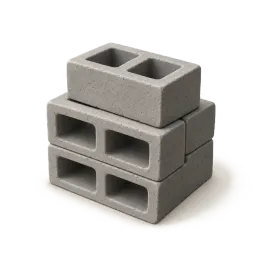
Key numbers
- 1.125 blocks per ft² of wall for 8 × 16 in face blocks
- 113 blocks per 100 ft² of wall (119 with 5% extra)
- 1.5 courses per foot of height: an 8 ft wall has 12 courses
- Add 5–10% for broken blocks and cuts
On this page
- How to use the Concrete Block Calculator
- How to calculate concrete blocks for a wall
- How many blocks for common wall sizes?
- How many cinder blocks for a shed, room or raised bed?
- Cinder block vs CMU vs concrete block: are they the same?
- Which block size should I count?
- Grout, rebar and mortar for a block wall
- Blocks per course for any wall length
- How many blocks for a building with 8 ft walls?
- Retaining walls, garden walls and block fences
- How much concrete or grout to fill block cores
- Mortar for a block wall
- Metric blocks per square metre
- ICF, AAC and other large-format blocks
- Pallets and delivery
- How to build a block wall cost estimate
- Is it cheaper to use blocks or poured concrete?
- Second worked example: a 20 × 20 ft block garage
- Common mistakes when estimating concrete blocks
- Concrete block calculator vs footing, rebar and mix calculators: which one to use
- Frequently asked questions
How to use the Concrete Block Calculator
- 1Enter your numbersFill in wall length (ft), wall height (ft), openings (doors, windows) (ft²), block face or extra for breakage (%).
- 2Check the assumptionsNominal block sizes include a 3/8 in mortar joint, so an 8×16 block covers exactly 8 × 16 in of wall face.
- 3Read the resultsThe calculator shows blocks to buy, blocks before breakage or courses (rows), updated as you type.
- 4Use the resultRound up to what your supplier sells, and keep a little extra for waste.
Results update as you type. Back to the calculator ↑
How to calculate concrete blocks for a wall
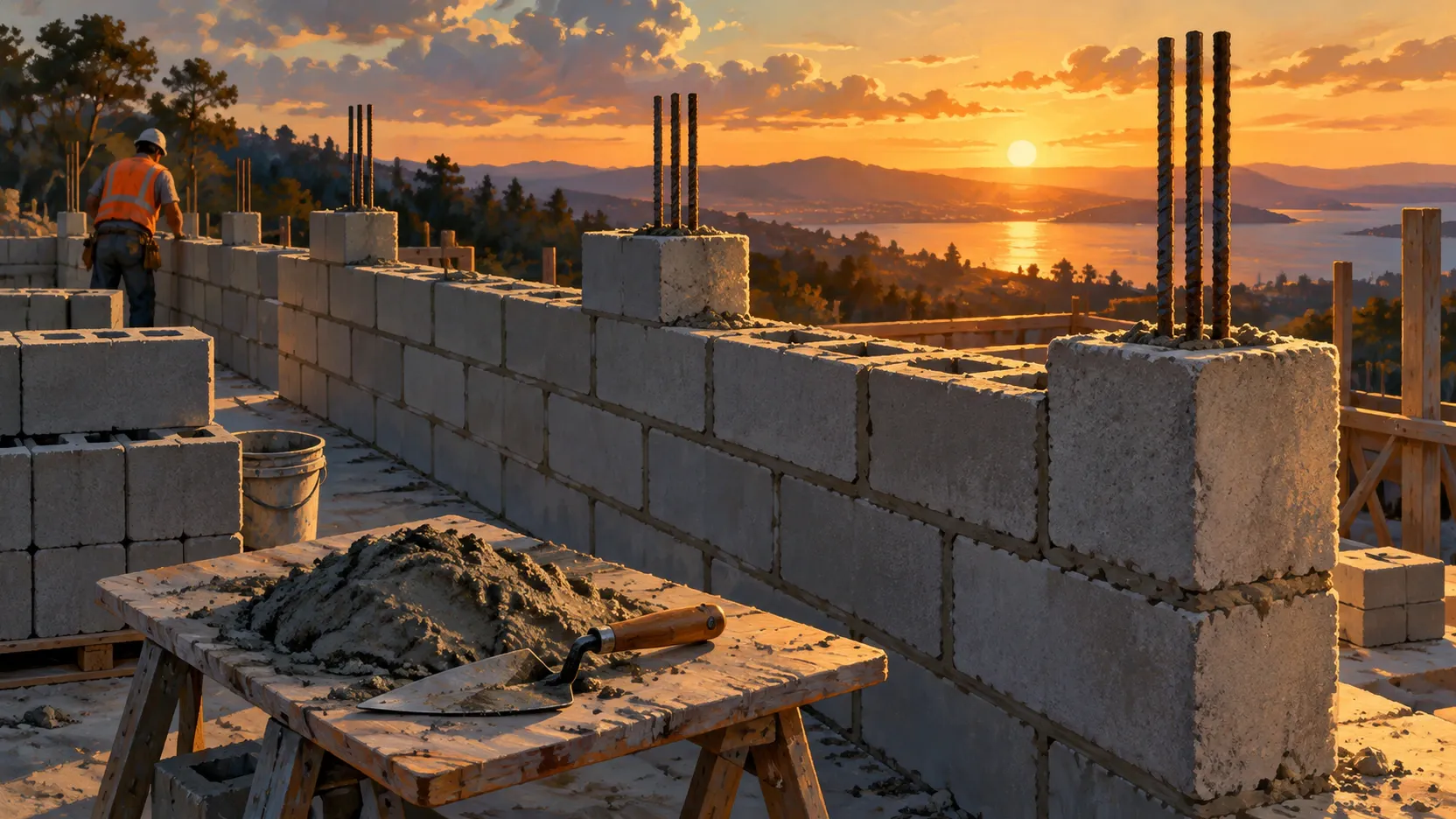
Find the wall area in square feet, subtract openings, and multiply by 1.125. A standard 8 × 8 × 16 in concrete masonry unit (CMU, often called a cinder block) covers 0.889 ft² of wall face, so 1.125 blocks fill each square foot.
Blocks = (wall length (ft) × wall height (ft) − openings (ft²)) × 1.125
Block sizes are nominal. The mortar joint makes up the difference between the actual block and the nominal size, so each block occupies exactly 8 × 16 in of wall face.
- Measure the wall length along the footing. For a building, add up all four sides.
- Measure the finished height in feet. Each course of 8 in blocks adds 8 in, so 1.5 courses make a foot.
- Subtract openings. A 3 × 7 ft door is 21 ft², a 3 × 4 ft window is 12 ft².
- Add 5–10% for broken blocks, cuts at corners and openings, and a few spares.
Worked example: 30 ft garden wall, 6 ft high, one 3 × 4 ft opening
- Wall area: 30 × 6 = 180 ft², minus 12 ft² opening = 168 ft²
- Blocks: 168 × 1.125 = 189 blocks
- Add 5%: 189 × 1.05 = 199 blocks to buy
- Courses: 6 ft × 12 ÷ 8 in = 9 courses of about 23 blocks each
How many blocks for common wall sizes?
Most people search for their own wall, so this table gives counts for common sizes using 8 × 16 in face blocks. Every figure is computed with the same function the calculator uses.
| Wall (length × height) | Wall area (ft²) | Courses | Blocks per course | Blocks (exact) | Blocks +5% | Blocks +10% |
|---|---|---|---|---|---|---|
| 10 × 4 ft | 40 | 6 | 8 | 45 | 48 | 50 |
| 20 × 4 ft | 80 | 6 | 15 | 90 | 95 | 99 |
| 40 × 4 ft | 160 | 6 | 30 | 180 | 189 | 198 |
| 10 × 8 ft | 80 | 12 | 8 | 90 | 95 | 99 |
| 12 × 8 ft | 96 | 12 | 9 | 108 | 114 | 119 |
| 20 × 8 ft | 160 | 12 | 15 | 180 | 189 | 198 |
| 30 × 6 ft | 180 | 9 | 23 | 203 | 214 | 224 |
| 100 × 6 ft | 600 | 9 | 75 | 675 | 709 | 743 |
By area alone: 100 ft² takes 113 blocks, 200 ft² takes 225 and 1,000 ft² takes 1,125. Blocks per course are rounded up, because a partial block still has to be cut from a whole one. In metric terms, a standard block face is about 0.083 m², which works out to roughly 12 blocks per square metre of wall.
How many cinder blocks for a shed, room or raised bed?
For a building, use the total length of all walls (the perimeter) as the wall length. The figures below assume 8 ft walls of standard blocks, with no openings unless stated.
| Project | Wall length | Wall area (ft²) | Blocks (exact) | Blocks +5% |
|---|---|---|---|---|
| 10 × 10 ft shed, 8 ft walls | 40 ft | 320 | 360 | 378 |
| 10 × 10 ft shed, minus 3 × 7 ft door | 40 ft | 299 | 337 | 354 |
| 10 × 12 ft shed, 8 ft walls | 44 ft | 352 | 396 | 416 |
| 12 × 12 ft room, 8 ft walls | 48 ft | 384 | 432 | 454 |
| 4 × 8 ft raised bed, 1 course | 24 ft | 16 | 18 | 19 |
| 4 × 8 ft raised bed, 2 courses | 24 ft | 32 | 36 | 38 |
Measuring the outside perimeter slightly overcounts, because corner blocks are shared between two walls. On a small building that is only a few blocks, and they become part of your breakage allowance.
Cinder block vs CMU vs concrete block: are they the same?
Yes, for counting and ordering. “Cinder block” is the older everyday name for a hollow masonry unit; suppliers today sell it as a concrete masonry unit (CMU) or concrete block, and dimensional tolerances for loadbearing units are governed by ASTM C90 (as block maker Angelus Block notes). So a cinder block calculator, a CMU calculator and this concrete block calculator give the same answer: 1.125 standard 8 × 8 × 16 in units per ft² of wall.
Order by nominal size. An 8 × 8 × 16 in CMU is specified at 7-5/8 × 7-5/8 × 15-5/8 in, and the 3/8 in mortar joint brings it to the nominal size. Confirm with the yard whether a quote is for hollow or solid units, and normal or lightweight. For prices per block and per pallet, see concrete block price.
Which block size should I count?
Count by the face size of the block you will buy. The calculator offers three common faces:
| Block (nominal) | Face (in) | Blocks per ft² | Blocks per 100 ft² |
|---|---|---|---|
| 8 × 8 × 16 standard CMU | 8 × 16 | 1.125 | 113 |
| 8 × 4 × 16 half-high | 4 × 16 | 2.25 | 225 |
| 8 × 8 × 12 | 8 × 12 | 1.5 | 150 |
The first number in a block size is usually its thickness. A 12 × 8 × 16 in block (12 in thick) still has an 8 × 16 in face, so it uses the same 1.125 blocks per ft² as an 8 in block. Thickness changes the weight, the core volume and the strength of the wall, not the count. The thickness a foundation or retaining wall needs comes from your plans and local building code.
Grout, rebar and mortar for a block wall
Block count is only part of the order. A structural block wall usually also needs:
- A footing. Size it with the concrete footing calculator. Footing width and depth come from your plans or local code.
- Vertical and horizontal steel. The rebar calculator gives bar length, 20 ft sticks and weight for #3 to #8 bar.
- Core fill. Cores holding rebar are filled with grout or concrete. Core volume depends on the block, so take the per-block fill figure from the block maker’s data sheet and multiply by the number of filled blocks.
- Mortar. Mortar quantity depends on joint size and block type. The QUIKRETE Mortar Mix data sheet says one 80 lb bag lays up to 13 standard 8 × 8 × 16 in blocks; the mortar calculator does the division.
If you are mixing fill concrete by hand, the concrete mix ratio calculator gives cement, sand and gravel quantities.
Blocks per course for any wall length
Divide the wall length in inches by 16 and round up. That gives the blocks in one course of standard 8 × 16 in face blocks, and half-high 4 × 16 in blocks use the same count per course (they just need twice as many courses). Multiply by the number of courses for the wall total.
| Wall length (ft) | 8 × 16 in face, per course | 8 × 12 in face, per course | 4 ft wall (6 courses) | 6 ft wall (9 courses) |
|---|---|---|---|---|
| 8 | 6 | 8 | 36 | 54 |
| 12 | 9 | 12 | 54 | 81 |
| 16 | 12 | 16 | 72 | 108 |
| 24 | 18 | 24 | 108 | 162 |
| 40 | 30 | 40 | 180 | 270 |
| 50 | 38 | 50 | 228 | 342 |
| 60 | 45 | 60 | 270 | 405 |
| 80 | 60 | 80 | 360 | 540 |
The last two columns multiply the rounded-up course count, so when the length is not a multiple of 16 in they can run a few blocks above the area method used by the calculator (a 50 ft wall 6 ft high is 342 here against 338 by area). Lay the first course dry before mortaring: if the last block in the course needs a cut of less than 4 in, shifting the wall length by a few inches can save a cut on every course.
How many blocks for a building with 8 ft walls?
Add the four sides to get the perimeter, then use that as the wall length. These counts are for 8 ft (12-course) walls with no openings; subtract 1.125 blocks for every square foot of door or window.
| Footprint | Perimeter (ft) | Wall area (ft²) | Blocks (exact) | Blocks +5% |
|---|---|---|---|---|
| 8 × 10 ft | 36 | 288 | 324 | 341 |
| 12 × 16 ft | 56 | 448 | 504 | 530 |
| 16 × 20 ft | 72 | 576 | 648 | 681 |
| 20 × 24 ft | 88 | 704 | 792 | 832 |
| 24 × 24 ft | 96 | 768 | 864 | 908 |
| 24 × 30 ft | 108 | 864 | 972 | 1,021 |
| 30 × 40 ft | 140 | 1,120 | 1,260 | 1,323 |
For a block foundation or crawlspace wall, measure height from the top of the footing, not from the ground. The footing itself is sized on the concrete footing calculator.
Retaining walls, garden walls and block fences
Low walls are counted the same way. The table shows plain 8 × 16 in face blocks with 5% extra; cap blocks are a separate item.
| Wall length | 2 ft high (3 courses) | 3 ft high (4½ courses) | 4 ft high (6 courses) |
|---|---|---|---|
| 10 ft | 25 | 36 | 48 |
| 20 ft | 48 | 72 | 95 |
| 30 ft | 72 | 108 | 142 |
| 40 ft | 95 | 142 | 189 |
| 50 ft | 119 | 178 | 237 |
A 3 ft wall is 4.5 courses, so the table counts 4½ courses by area. In practice you either build 5 courses (40 in), which adds half a course of blocks, or finish with a 4 in half-high course or cap. For a block fence, 100 ft at 4 ft high is 450 blocks (473 with 5%), and 150 ft at 6 ft high is 1,013 blocks (1,064 with 5%). A cinder block retaining wall holds back soil, so footing size, wall thickness, steel and drainage come from your plans, the block maker or an engineer, not from a block count.
How much concrete or grout to fill block cores
Block fill (core fill) volume is the number of filled blocks times the fill volume per block. The per-block figure depends on the block thickness and core shape, so take it from the block maker’s data sheet. Then convert:
Fill (ft³) = filled blocks × fill per block (ft³); yd³ = ft³ ÷ 27; 80 lb bags = ft³ ÷ 0.60
| Fill per block on data sheet (ft³) | Fill for 100 blocks (ft³) | Fill for 100 blocks (yd³) | 80 lb bags per 100 blocks | Blocks filled per yd³ |
|---|---|---|---|---|
| 0.20 | 20 | 0.74 | 34 | 135 |
| 0.25 | 25 | 0.93 | 42 | 108 |
| 0.30 | 30 | 1.11 | 50 | 90 |
| 0.40 | 40 | 1.48 | 67 | 67 |
| 0.50 | 50 | 1.85 | 84 | 54 |
The rows are a lookup, not block specifications: find your block’s figure and read across. Thicker blocks (a 12 in block versus an 8 in block) have bigger cores, so a 12 inch block fill calculation always needs its own per-block number. Bag counts use the 0.60 ft³ yield of an 80 lb bag of concrete mix; core grout or a bagged block-fill product has its own yield printed on the bag.
Worked example: filling a 30 ft × 4 ft wall
- Blocks: 30 × 4 = 120 ft² × 1.125 = 135 blocks
- Every core filled at 0.30 ft³ per block (from the data sheet): 135 × 0.30 = 40.5 ft³ = 1.5 yd³
- Add 10% for spill and voids: 1.65 yd³, or 75 bags of 80 lb mix
- If only cells about every 48 in are filled instead: roughly 8 cell columns × 6 courses = 48 blocks, so 14.4 ft³ before waste
Whether every core or only the cells with steel get filled is a design decision. The difference is large: in the example, partial filling uses about a third of the concrete.
Mortar for a block wall
Mortar is ordered by the bag, and each bag lists how many blocks it lays. QUIKRETE Mortar Mix states up to 13 standard 8 × 8 × 16 in blocks per 80 lb bag, so 90 blocks take 7 bags (8 with 10% extra). Divide your block count by your bag’s figure and round up. Joint thickness, block type and how much mortar is dropped all change the real yield, so add 10% and keep the receipt for returns. If you mix mortar yourself, the concrete mix ratio calculator handles sand-only ratios such as 1:3. Facing the block with brick or covering it with stucco? Count the units with the brick calculator or the base and finish bags with the stucco calculator.
Metric blocks per square metre
Count metric blocks from the face size plus one joint. Divide 1 m² by the face area.
| Face incl. 10 mm joint | Blocks per m² | Blocks for 10 m² | Blocks for 25 m² |
|---|---|---|---|
| 450 × 225 mm | 9.88 | 99 | 247 |
| 400 × 200 mm | 12.5 | 125 | 313 |
| 500 × 250 mm | 8 | 80 | 200 |
A US 8 × 16 in nominal face works out at about 12.1 per m². Check the actual block and joint size with your supplier before ordering.
ICF, AAC and other large-format blocks
The count method works for any block: area divided by face area. Insulated concrete form (ICF) and AAC blocks have much larger faces than a CMU, so the counts are far lower. As an example of the arithmetic, a block with a 48 × 16 in face covers 5.33 ft², so 100 ft² takes 19 blocks and a 20 × 8 ft wall takes 30. Use the face size and the corner, end and course rules in the maker’s installation guide; ICF walls are then filled with ready-mix, which you size on the concrete yards calculator.
Pallets and delivery
Blocks are delivered on pallets, and the number per pallet depends on the block size and the yard. Divide your total by the supplier’s count and round up: 594 blocks are 7 pallets at 90 per pallet or 9 at 72. A pallet of 90 standard 8 in blocks weighs about 3,600 lb; see cinder block weight before loading a trailer. Ask how they charge for broken pallets, whether the truck can drop where the wall goes, and whether unopened pallets can be returned.
How to build a block wall cost estimate
A block wall cost calculator is only as good as the prices you feed it. Build the estimate from five lines, each priced with a local quote:
- Blocks: block count with 5–10% extra × price per block, plus specials (corners, caps, bond beams).
- Mortar: blocks ÷ blocks per bag × price per bag.
- Fill and steel: fill yards or bags from the table above, plus bar from the rebar calculator.
- Footing: concrete yards from the footing calculator × your ready-mix or bag price.
- Delivery and labor: pallet delivery, plus a mason’s quote if you are not laying it yourself.
We do not publish national block prices because they vary by size, region and supplier; concrete block price shows how to turn a pallet quote into a price per block and per square foot. For poured-concrete pricing, see concrete price per yard.
Is it cheaper to use blocks or poured concrete?
Neither is always cheaper. Blocks need no wall forms, can be laid a course at a time by one person, and arrive on a pallet. Poured walls need forms on both sides and usually a ready-mix truck, but the wall itself can be poured in one day. Compare the two with local quotes: use this page for the block count and the concrete yards calculator for a poured wall of the same size.
Second worked example: a 20 × 20 ft block garage
Worked example: 20 × 20 ft garage, 8 ft walls, one 16 × 7 ft door
- Wall length: 4 × 20 ft = 80 ft; area 80 × 8 = 640 ft²
- Minus the door: 640 − 112 = 528 ft²
- Blocks: 528 × 1.125 = 594 blocks
- Add 5%: 624 blocks to buy (654 with 10%)
- Courses: 96 in ÷ 8 in = 12 courses of up to 60 blocks
Without the door the same garage takes 720 blocks, so leaving out one large opening changes the order by 126 blocks. Add a 3 × 7 ft side door as well and the count falls to 571 (600 with 5%).
Common mistakes when estimating concrete blocks
- Forgetting courses below grade. Foundation walls start on the footing, not at ground level. On a 24 × 24 ft foundation (96 ft of wall), two buried courses you forgot to count are 144 blocks.
- Using 1 block per square foot. A standard block covers 0.889 ft², not 1 ft². On a 12 × 12 ft room with 8 ft walls (384 ft²) that rule of thumb leaves you 48 blocks short.
- Counting half-high blocks as full blocks. A 4 × 16 in face needs 2.25 per ft². For 100 ft² that is 225 blocks, not 113.
- Counting openings twice, or not at all. A 3 × 7 ft door is 24 blocks. Subtract each opening once, and only if it will not be filled later.
- Ignoring special blocks. Corners, bond beams, lintels and caps are often different units. Count them separately and take them off the plain block total.
- No spare blocks. A few blocks crack in transport or cutting. 5% is a sensible minimum (22 extra on a 432-block foundation), 10% on walls with many cuts.
Concrete block calculator vs footing, rebar and mix calculators: which one to use
Use this calculator when the question is how many blocks to buy. The other parts of a block wall have their own tools:
- Concrete footing calculator for the footing under the wall, in cubic yards and bags.
- Rebar calculator for the steel in the footing and the slab, in feet, 20 ft sticks and pounds.
- Concrete mix ratio calculator when you batch your own core fill or footing concrete from cement, sand and gravel.
- Concrete yards calculator when you are pricing a poured wall of the same size instead of block.
FAQ
Frequently asked questions
How many cinder blocks do I need for a 10×10 shed?
About 360 standard 8 × 8 × 16 in blocks for four 10 ft walls 8 ft high (40 ft × 8 ft = 320 ft²). Leaving a 3 × 7 ft door opening drops it to 337 blocks, or 354 with 5% extra.
How many cinder blocks for a 10×12 shed?
396 blocks for walls 8 ft high around a 10 × 12 ft footprint (44 ft of wall × 8 ft = 352 ft²), or 416 with 5% extra. Subtract door and window areas in the calculator to lower the count.
How many cinder blocks for a 12 by 12 room?
432 standard blocks for 8 ft walls (48 ft of wall × 8 ft = 384 ft²), or 454 with 5% extra. Each door or window you subtract saves 1.125 blocks per square foot of opening.
How many cinder blocks for a 20×20 garage?
720 standard blocks for 8 ft walls around a 20 × 20 ft footprint (80 ft × 8 ft = 640 ft²), or 756 with 5% extra. Leaving a 16 × 7 ft garage door opening drops it to 594 blocks, or 624 with 5%.
How many cinder blocks for a 4×8 raised bed?
18 blocks for one course laid around the 24 ft perimeter (19 with 5% extra), or 36 for two courses (16 in tall). Corners overlap, so lay out the first course dry and count before you buy the full amount.
How many blocks for a 24×24 block foundation?
432 standard blocks for a 96 ft perimeter wall 4 ft high (6 courses), or 454 with 5% extra. A 32 in wall (4 courses) takes 288 blocks, or 303 with extra. Measure height from the top of the footing.
How many blocks for a 20 ft retaining wall?
60 standard blocks for a wall 20 ft long and 4 courses (32 in) high: 15 blocks per course. Buy 63 with 5% extra. Retaining walls hold back soil, so take height, thickness and steel from your plans or an engineer.
How many cinder blocks for a 100 ft wall?
75 blocks per course, so a 100 ft wall 6 ft high (9 courses, 600 ft²) needs 675 standard blocks, or 709 with 5% extra and 743 with 10%. Every extra course adds another 75 blocks.
How many cinder blocks per square foot?
1.125 blocks per square foot for standard 8 × 8 × 16 in blocks, because each block covers 0.889 ft² of wall including the mortar joint. Half-high 4 × 16 in face blocks need 2.25 per ft², and 8 × 12 in face blocks need 1.5.
How many concrete blocks per square metre?
About 12.1 blocks per square metre for an 8 × 16 in (nominal) face, which covers 0.0826 m² including the joint. A 10 m² wall needs 122 blocks before breakage. Metric blocks of other face sizes need their own count.
How many 12 inch blocks will 1 yard of concrete fill?
Divide 27 ft³ by the fill volume per block on the maker's data sheet. If the sheet lists 0.4 ft³ per block, one yard fills about 67 blocks; at 0.5 ft³ it fills 54. Add about 10% for waste and spill into the cores.
How many courses of block for an 8 ft wall?
12 courses of standard 8 in high blocks, because each course adds 8 in and 96 in ÷ 8 = 12. A 4 ft wall is 6 courses and a 6 ft wall is 9. Half-high 4 in blocks double the course count.
What is the formula for blocks per course?
Wall length in inches ÷ 16, rounded up. A 20 ft wall is 240 in ÷ 16 = 15 blocks per course, a 30 ft wall takes 23 and a 50 ft wall 38. Multiply by the number of courses for the wall total.
How many cinder blocks are on a pallet?
It depends on the block width and the supply yard, so ask for the count per pallet before you order. Divide your total by it and round up: 594 blocks are 7 pallets at 90 per pallet or 9 at 72.
Is a cinder block calculator different from a CMU calculator?
No. Cinder block, CMU and concrete block are names for the same hollow masonry unit, and the count is identical: 1.125 standard 8 × 8 × 16 in blocks per ft² of wall, so 100 ft² takes 113 blocks.
How much would 1,000 cinder blocks cost?
Multiply 1,000 by your local price per block, then add mortar, core grout, rebar and delivery. Block prices vary by size, region and supplier, so get a quote for the exact block (8 in or 12 in, solid or hollow) you need.
Is it cheaper to pour concrete or use cinder blocks?
It depends on the job and local prices. Blocks need little formwork and suit DIY walls built one course at a time. Poured walls need forms and usually a ready-mix delivery. Price both with 2 or 3 real quotes; our calculators give the block count and concrete yards.
2 Sources
Last reviewed October 9, 2026 by M Bilal. Found an error? Tell us.