


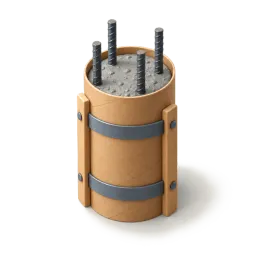
Key numbers
- Formula: 3.1416 × (D ÷ 2)² × H, all in feet
- 12 in tube: 0.785 ft³ per foot = 1.31 × 80 lb bags per foot
- 8 in tube: 0.349 ft³ per foot = 0.58 × 80 lb bags per foot
- 1 yd³ fills 34.4 ft of 12 in tube or 77.3 ft of 8 in tube
- Weight: a filled 12 in tube is about 118 lb per foot at 150 lb/ft³
On this page
- How to use the Sonotube Concrete Calculator
- How do you calculate concrete for a Sonotube?
- How much concrete per foot of Sonotube?
- How many bags of concrete per Sonotube?
- Quikrete or Sakrete calculator for Sonotubes
- How many Sonotubes does a yard of concrete fill?
- Sonotube concrete in metric (litres per metre)
- How much does a concrete-filled Sonotube weigh?
- Belled piers: how much concrete does the bell add?
- Above-grade height, and pouring without a tube
- Caissons, large piers and concrete columns
- What size Sonotube do I need?
- Concrete pier cost: what to multiply
- Tips for filling Sonotubes
- Common mistakes when calculating Sonotube concrete
- Sonotube calculator vs related calculators: which one to use
- Frequently asked questions
How to use the Sonotube Concrete Calculator
- 1Pick your unitsEvery dimension has its own unit menu (in, ft, yd, cm or m); changing one converts that number so the size stays the same. The US / Metric switch sets all fields to feet and inches or meters and centimeters and resets them to typical values.
- 2Enter the dimensionsType the diameter (default inches), height / depth (default feet) or number of tubes. Measure the inside of the forms and the depth in several places.
- 3Set waste and quantityUse the waste slider (0 to 20%, default 10%) and allow more on uneven ground. If you have several identical pours, enter how many.
- 4Read the resultsSee the volume in cubic yards, cubic feet and cubic meters, the ready-mix order rounded up to ¼ yard, the number of 90, 80, 60, 50 and 40 lb bags rounded up, and the weight at the density you choose (150, 145 or 140 lb/ft³).
- 5Price it and save itPick a pricing basis (per cubic yard, per cubic meter or per bag of the highlighted size) and enter your local price for a material cost. Use Add to project to total several pours, and Copy link to share the exact result.
Results update as you type. Back to the calculator ↑
How do you calculate concrete for a Sonotube?
A Sonotube is a cylinder, so the concrete it holds is the area of the circle times the height. Measure the inside diameter in inches and the height in feet, convert the diameter to feet, then apply:
Cubic feet = 3.1416 × (diameter in ft ÷ 2)² × height in ft
Divide by 27 for cubic yards, or by the bag yield for bags: about 0.60 ft³ per 80 lb bag, 0.45 ft³ per 60 lb, 0.375 ft³ per 50 lb and 0.30 ft³ per 40 lb. Those yields are from the QUIKRETE Concrete Mix data sheet; use the yield printed on your bag if it differs.
“Sonotube” is a brand name that people use for any cardboard concrete form tube; Quik-Tube and other brands work the same way. We are independent and not affiliated with any tube or concrete maker. The same formula gives the volume of any concrete cylinder, round pier, pillar or column, with or without a form.
If you prefer to keep the diameter in inches, a shortcut gives the same answer: cubic feet = diameter (in)² × height (ft) × 0.005454, and cubic yards = diameter (in)² × height (ft) × 0.000202. For a 12 in tube 4 ft tall, 144 × 4 × 0.005454 = 3.14 ft³; for a 10 in tube 5 ft tall, 100 × 5 × 0.005454 = 2.73 ft³. The constant is π ÷ 4 ÷ 144.
- Use the full height of concrete, including the part in the ground and the part above grade.
- Measure the inside diameter. Tube sizes are nominal; the label is close enough for ordering.
- Enter the number of tubes so the calculator totals the whole job.
- Add the footing pad or bell under each tube as a separate line if your plans have one.
Worked example: 4 deck piers, 12 in tubes, 4 ft deep
- One tube: 3.1416 × 0.5² × 4 = 3.14 ft³
- Four tubes: 12.57 ft³ = 0.47 yd³ (0.36 m³)
- Bags: 12.57 ÷ 0.60 = 20.9 → 21 × 80 lb (28 × 60 lb); with 10% extra, 24 × 80 lb
- Wet weight at 150 lb/ft³: about 1,885 lb
How much concrete per foot of Sonotube?
The table gives the concrete per foot of tube height for each common diameter, and the bags for one 4 ft tube. Multiply the per-foot figure by your height and tube count, then round up once for the whole job.
| Tube diameter | ft³ per ft | Litres per metre | 80 lb bags per ft | 60 lb bags per ft | 50 lb bags per ft | 4 ft tube (ft³) | 4 ft tube: 80 lb bags | 4 ft tube: 60 lb bags |
|---|---|---|---|---|---|---|---|---|
| 6 in | 0.196 | 18 | 0.33 | 0.44 | 0.52 | 0.79 | 2 | 2 |
| 8 in | 0.349 | 32 | 0.58 | 0.78 | 0.93 | 1.40 | 3 | 4 |
| 10 in | 0.545 | 51 | 0.91 | 1.21 | 1.45 | 2.18 | 4 | 5 |
| 12 in | 0.785 | 73 | 1.31 | 1.75 | 2.09 | 3.14 | 6 | 7 |
| 14 in | 1.069 | 99 | 1.78 | 2.38 | 2.85 | 4.28 | 8 | 10 |
| 16 in | 1.396 | 130 | 2.33 | 3.10 | 3.72 | 5.59 | 10 | 13 |
| 18 in | 1.767 | 164 | 2.95 | 3.93 | 4.71 | 7.07 | 12 | 16 |
| 24 in | 3.142 | 292 | 5.24 | 6.98 | 8.38 | 12.57 | 21 | 28 |
Doubling the diameter quadruples the concrete. Going from a 10 in to a 12 in tube adds 44% more concrete, and an 8 in to a 12 in tube is 2.25 times the volume, so check the size on your plans before buying bags.
How many bags of concrete per Sonotube?
Most tubes are not exactly 4 ft. This table gives the bags to buy for one tube at common heights, rounded up for that single tube. For several tubes, add the cubic feet first and round once; the total is often a bag or two less.
| Tube | 2 ft tall | 3 ft tall | 4 ft tall | 5 ft tall | 6 ft tall |
|---|---|---|---|---|---|
| 8 in, 80 lb bags | 2 (0.70 ft³) | 2 (1.05 ft³) | 3 (1.40 ft³) | 3 (1.75 ft³) | 4 (2.09 ft³) |
| 8 in, 50 lb bags | 2 | 3 | 4 | 5 | 6 |
| 10 in, 80 lb bags | 2 (1.09 ft³) | 3 (1.64 ft³) | 4 (2.18 ft³) | 5 (2.73 ft³) | 6 (3.27 ft³) |
| 10 in, 50 lb bags | 3 | 5 | 6 | 8 | 9 |
| 12 in, 80 lb bags | 3 (1.57 ft³) | 4 (2.36 ft³) | 6 (3.14 ft³) | 7 (3.93 ft³) | 8 (4.71 ft³) |
| 12 in, 50 lb bags | 5 | 7 | 9 | 11 | 13 |
| 16 in, 80 lb bags | 5 (2.79 ft³) | 7 (4.19 ft³) | 10 (5.59 ft³) | 12 (6.98 ft³) | 14 (8.38 ft³) |
| 16 in, 50 lb bags | 8 | 12 | 15 | 19 | 23 |
If you use a fast-setting or other specialty mix, its yield is printed on the bag and can differ from regular concrete mix, so check it before relying on the 50 lb rows, and follow the mixing directions on that bag. For brand-specific counts, the Quikrete calculator and Sakrete calculator list each product’s bag sizes.
Quikrete or Sakrete calculator for Sonotubes
Brand searches for a “Quikrete Sonotube calculator” come down to the bag yield. QUIKRETE’s data sheet for its Concrete Mix lists about 0.60 ft³ per 80 lb bag, 0.45 ft³ per 60 lb and 0.30 ft³ per 40 lb, which is what the tables on this page use. A 12 in tube therefore takes 1.31 × 80 lb bags per foot of height whichever standard concrete mix you buy, as long as the yield on the bag matches. Sakrete and store-brand bags print their own yield; if it differs, divide the tube’s cubic feet by that number instead.
Plan the haul as well as the count. Twenty-one 80 lb bags for four 12 in deck piers are 1,680 lb of dry mix, and the 50 bags for six belled piers in the example below are 4,000 lb, more than many pickups should carry in one trip. Check your vehicle’s payload before you load.
How many Sonotubes does a yard of concrete fill?
One cubic yard is 27 ft³. Divide it by the per-foot volume to get feet of tube:
| Tube diameter | Feet of tube per yd³ | 4 ft tubes per yd³ |
|---|---|---|
| 6 in | 137.5 ft | 34 |
| 8 in | 77.3 ft | 19 |
| 10 in | 49.5 ft | 12 |
| 12 in | 34.4 ft | 8 |
| 16 in | 19.3 ft | 4 |
| 18 in | 15.3 ft | 3 |
| 24 in | 8.6 ft | 2 |
Use this when you are deciding between bags and ready-mix. Nine 12 in tubes 4 ft deep need 28.27 ft³ (1.05 yd³), which is 48 × 80 lb bags, a lot to mix by hand.
Sonotube concrete in metric (litres per metre)
Metric form tubes are sold by diameter in millimetres. The volume per metre of height is π × (diameter in m ÷ 2)², in m³; multiply by 1,000 for litres. An 80 lb bag yields about 17 litres.
| Tube diameter | Litres per metre | Litres in 1.2 m | 80 lb bags per metre |
|---|---|---|---|
| 200 mm | 31.4 | 37.7 | 1.85 |
| 250 mm | 49.1 | 58.9 | 2.89 |
| 300 mm | 70.7 | 84.8 | 4.16 |
| 400 mm | 125.7 | 150.8 | 7.40 |
| 450 mm | 159.0 | 190.9 | 9.36 |
| 600 mm | 282.7 | 339.3 | 16.64 |
For bags sold in kilograms, divide the litres by the yield printed on the bag. Enter millimetres and metres in the calculator to get m³ and litres directly.
How much does a concrete-filled Sonotube weigh?
Multiply the volume by the density of concrete. This site uses 150 lb/ft³ for normal-weight concrete; QUIKRETE states about 140 lb/ft³ for its bagged Concrete Mix, so the second column shows that figure. Weight matters when you plan how many bags to carry, or how much a precast column you pour on the ground will weigh when you lift it.
| Diameter | ft³ per ft | lb per ft at 150 lb/ft³ | lb per ft at 140 lb/ft³ | 4 ft tube at 150 lb/ft³ |
|---|---|---|---|---|
| 8 in | 0.349 | 52 | 49 | 209 lb |
| 10 in | 0.545 | 82 | 76 | 327 lb |
| 12 in | 0.785 | 118 | 110 | 471 lb |
| 16 in | 1.396 | 209 | 195 | 838 lb |
| 18 in | 1.767 | 265 | 247 | 1,060 lb |
| 24 in | 3.142 | 471 | 440 | 1,885 lb |
Belled piers: how much concrete does the bell add?
A belled pier (the “concrete pier calculator” case) is a round column that flares out at the bottom. Add the bell to the tube: a 24 in base tapering to 10 in over 12 in adds 1.67 ft³, which is 76% of a 10 in × 48 in tube (2.18 ft³). Whether a pier needs a bell, and how big, is a structural decision for your plans, not this calculator.
Many piers sit on a wider base so the load spreads over more soil. The base can be a square or round pad poured first, or a plastic flared footing form that the tube sits on top of (Bigfoot is one brand people search for). For a branded form, use the concrete volume the maker prints for that size. For a generic cone-shaped base, use the volume of a truncated cone:
Bell ft³ = 3.1416 × h ÷ 12 × (D² + D × d + d²), with D the bottom diameter, d the top diameter and h the height, all in feet
- 24 in to 12 in, 12 in tall: 1.83 ft³ = 3.05 × 80 lb bags.
- 24 in to 10 in, 12 in tall: 1.67 ft³ = 2.78 × 80 lb bags.
- 30 in to 12 in, 16 in tall: 3.40 ft³ = 5.67 × 80 lb bags.
| Tube preset | Tube only (ft³) | 80 lb bags | With 24 in → tube-size bell, 12 in tall (ft³) |
|---|---|---|---|
| 8 in × 48 in | 1.40 | 2.33 | 1.40 + bell from your form maker |
| 10 in × 48 in | 2.18 | 3.64 | 2.18 + 1.67 = 3.85 |
| 12 in × 48 in | 3.14 | 5.24 | 3.14 + 1.83 = 4.97 |
Four 10 in × 48 in piers with that bell hold 15.39 ft³: 26 × 80 lb bags, or 29 with 10% extra. Bell volumes in metric: the 24 → 12 in bell is 51.9 litres and the 24 → 10 in bell is 47.2 litres.
Pier and bell sizing is engineering
Estimates only; structural design must follow your local code and a licensed engineer. Bell diameter, pier depth and any reinforcement depend on the load and the soil bearing capacity, which this calculator does not check.
A flat round pad is a short cylinder: a 24 in pad 8 in thick is 2.09 ft³, about 3.5 × 80 lb bags. Square pads are covered on the concrete footing calculator.
Worked example: 6 deck piers with bell bases
- Tube: 12 in diameter, 4 ft tall = 3.14 ft³
- Bell: 24 in to 12 in, 12 in tall = 1.83 ft³
- One pier: 4.97 ft³ → 9 × 80 lb bags if bought one pier at a time
- Six piers: 29.85 ft³ (1.11 yd³) → 50 × 80 lb bags, or 55 with 10% extra
- At over a cubic yard, price a ready-mix short load against 50 to 55 bags
Above-grade height, and pouring without a tube
Count the whole tube. If a 12 in tube runs 4 ft in the ground and 1 ft above it, enter 5 ft: the extra foot adds 0.785 ft³, or 1.31 × 80 lb bags per tube. A porch with six 10 in tubes 4 ft deep and 1 ft above grade holds 16.36 ft³ (0.61 yd³), or 28 × 80 lb bags; rounding each tube separately would give 30.
The hole is usually wider than the tube, and the gap is backfilled with soil after the pour. If you pour the hole without a form, you fill the whole hole. A 16 in hole 4 ft deep holds 5.59 ft³ (10 × 80 lb bags); a 12 in tube in that hole holds 3.14 ft³ (6 bags), leaving a 2.44 ft³ gap for soil. Whether a pier can be poured without a form depends on your plans and soil; the tube also gives a clean, round top above grade.
Caissons, large piers and concrete columns
Large-diameter piers, sometimes called caissons or drilled piers, use the same formula; only the scale changes. They are engineered, so the size and depth come from the drawings.
- 24 in × 10 ft: 31.42 ft³ = 1.16 yd³.
- 30 in × 12 ft: 2.18 yd³.
- 36 in × 15 ft: 3.93 yd³.
- Four 24 in × 10 ft piers: 4.65 yd³; with 10% extra, order 5¼ yd³.
For a square column, use length × width × height instead; the concrete column calculator does square and rectangular columns and beams. A round column holds 78.5% of a square column of the same width: a 12 in round column 8 ft tall is 6.28 ft³, while a 12 × 12 in square column is 8 ft³. Vertical rebar in a column takes up very little volume and does not change the order; see the rebar calculator for bar lengths and weight.
What size Sonotube do I need?
Tube diameter and depth come from your plans, the load on the post and your soil, not from a calculator. Deck and porch piers are often 8 to 12 in, and larger tubes are used for heavier loads. Depth usually has to reach below your local frost line in cold climates. Your building department or a deck plan approved for your area sets the size, depth and any footing pad or bell.
Searches for a “Sonotube load calculator” are asking a structural question: how much weight a pier can carry depends on the soil bearing capacity under it and on the base area, not on the tube. A designer or your building department answers that; this calculator only tells you how much concrete the chosen size takes.
Concrete pier cost: what to multiply
We do not publish a price per bag or per yard, because both vary by store, region and season. For bagged piers, the material cost is the bag count times your price per bag, so every $1 per bag adds $21 to the four-pier deck above and $50 to the six belled piers. Add the tubes themselves, any bell forms, anchors and rebar. For ready-mix piers, multiply the yards you order by your quoted price and add delivery and any short-load fee your plant charges; the concrete price per yard page explains what moves that quote.
Tips for filling Sonotubes
- Brace the tube plumb and backfill around it before you pour so it does not shift or float.
- Fill in lifts and rod or tap the sides to work out air pockets.
- Set anchors while the top is wet. Post bases and anchor bolts go in right after you strike off the top.
- Buy one or two spare bags. Holes widen at the bottom and tubes bulge slightly under the weight of wet concrete.
Common mistakes when calculating Sonotube concrete
- Using the diameter as the radius. A 12 in tube treated as a 12 in radius gives 12.57 ft³ for 4 ft instead of 3.14 ft³, four times too much.
- Mixing inches and feet. Convert the diameter to feet first: 10 in is 0.833 ft, not 10 or 0.10.
- Rounding bags per tube. Six porch tubes at 10 in × 5 ft need 28 × 80 lb bags in total, but 30 if you round each tube.
- Leaving out the bell or pad. A 24 to 12 in bell adds 1.83 ft³ per pier, 58% more than a 12 in × 4 ft tube alone.
- Forgetting the above-grade foot. On nine 12 in piers, one extra foot each is 7.07 ft³, about 12 more 80 lb bags.
- Assuming a bigger tube is a small change. A 12 in tube holds 1.44 times what a 10 in tube holds at the same height.
Sonotube calculator vs related calculators: which one to use
Use this page for a formed round pier or column, above or below grade, where concrete fills the whole cylinder and no post is subtracted (deck footings, porch piers, tube presets such as 8, 10 and 12 in × 48 in). Use the fence post page for a post set in a dug, unformed hole. Switch when:
- A post is set in the concrete, as with fence posts: the fence post concrete calculator subtracts the post.
- The base is a square pad or a continuous wall footing: the concrete footing calculator.
- The shape is hollow (a ring, pipe section or tank wall) or a round pad: the concrete cylinder calculator subtracts the core.
- You know the cubic feet and only need bags: the concrete bag calculator.
- You are adding piers to a larger pour and need the total in yards: the concrete yards calculator.
FAQ
Frequently asked questions
How many bags of concrete for a 12 inch Sonotube?
A 12 in tube takes 1.31 bags of 80 lb concrete per foot of height (0.785 ft³). A 4 ft tube needs 3.14 ft³, which is 5.2 bags, so buy 6 × 80 lb or 7 × 60 lb bags per tube.
How many bags for an 8 inch Sonotube?
An 8 in tube takes 0.58 bags of 80 lb concrete per foot (0.349 ft³). A 4 ft tube holds 1.40 ft³, so buy 3 × 80 lb or 4 × 60 lb bags. A 3 ft tube needs 2 × 80 lb bags.
How much concrete does a 10 inch Sonotube take?
0.545 ft³ per foot, or 0.91 bags of 80 lb concrete. A 4 ft tube holds 2.18 ft³: 4 × 80 lb or 5 × 60 lb bags. Six 10 in tubes 4 ft deep need 13.09 ft³ (0.48 yd³), or 22 × 80 lb bags.
How much concrete for a 6 inch Sonotube?
A 6 in tube holds 0.196 ft³ per foot, a third of an 80 lb bag. A 4 ft tube holds 0.79 ft³, so buy 2 × 80 lb or 3 × 50 lb bags. One cubic yard fills 137.5 ft of 6 in tube.
How many bags of concrete for a 16 or 18 inch Sonotube?
A 16 in tube takes 1.396 ft³ per foot (2.33 × 80 lb bags); a 4 ft tube needs 10 bags. An 18 in tube takes 1.767 ft³ per foot (2.95 bags); a 4 ft tube needs 12 bags.
How much concrete for a 24 inch Sonotube?
A 24 in tube holds 3.142 ft³ per foot, or 5.24 bags of 80 lb concrete. A 4 ft tube needs 12.57 ft³, which is 21 × 80 lb bags. A 10 ft deep 24 in pier holds 1.16 yd³, a ready-mix job.
How many Sonotubes does a yard of concrete fill?
One cubic yard (27 ft³) fills about 34.4 ft of 12 in tube, so 8 tubes 4 ft deep. It fills 77.3 ft of 8 in tube, 49.5 ft of 10 in tube or 15.3 ft of 18 in tube.
How do you calculate concrete for a cylinder?
Multiply π (3.1416) by the radius squared and by the height, all in feet. A 12 in cylinder 4 ft tall is 3.1416 × 0.5 × 0.5 × 4 = 3.14 ft³. Divide by 27 for cubic yards: 0.12 yd³.
How much does a concrete-filled Sonotube weigh?
At 150 lb/ft³, a filled 12 in tube weighs about 118 lb per foot, so a 4 ft pier is about 471 lb. An 8 in tube is about 52 lb per foot and a 16 in tube about 209 lb per foot.
How much concrete for a 12 inch Sonotube in metric?
A 12 in (305 mm) tube holds about 73 litres per metre of height. A 300 mm tube holds 70.7 litres per metre, so 1.2 m holds about 85 litres. A 200 mm tube holds 31.4 litres per metre.
How much concrete for a bell footing form under a Sonotube?
Use the volume printed by the form maker. As a guide, a cone-shaped base 24 in wide at the bottom, 12 in at the top and 12 in tall holds 1.83 ft³, or 3.05 × 80 lb bags (round up to 4 if you mix it as a separate batch), in addition to the tube.
Do I count the part of the tube above ground?
Yes. Concrete fills the whole tube, so use the full height from the bottom of the hole to the top of the tube. Each extra foot of 12 in tube above grade adds 0.785 ft³, or 1.31 × 80 lb bags.
How much more concrete if I pour the hole without a tube?
The hole is usually wider than the tube. A 16 in hole 4 ft deep holds 5.59 ft³ (10 × 80 lb bags), while a 12 in tube in it holds 3.14 ft³ (6 bags). Whether you can skip the tube is up to your plans.
How many Sonotubes for a deck?
Your deck plan sets the number of piers by beam span and post spacing. Once you know it, multiply: nine 12 in tubes 4 ft deep hold 28.27 ft³ (1.05 yd³), which is 48 × 80 lb bags.
Should I fill a Sonotube with bags or ready-mix?
Bags suit most deck and porch jobs. Four 12 in tubes 4 ft deep need 0.47 yd³, which is 21 × 80 lb bags. Above about ½ to 1 yd³, compare a short-load ready-mix delivery and ask your plant about minimums.
3 Sources
Last reviewed October 9, 2026 by M Bilal. Found an error? Tell us.