


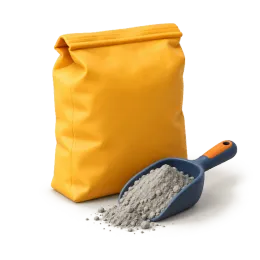
Key numbers
- 80 lb bag of QUIKRETE Concrete Mix ≈ 0.60 ft³ (17 L)
- 45 × 80 lb or 60 × 60 lb bags per cubic yard
- 4,000 psi (27.5 MPa) at 28 days, per the data sheet
- About 6 pints (2.8 L) of starting water per 80 lb bag
On this page
- How to use the Quikrete Calculator
- How many bags of Quikrete do I need?
- Quikrete bags for common slabs
- Quikrete per 100 square feet at different thicknesses
- How much Quikrete for posts and Sonotubes?
- What does the Quikrete data sheet say?
- How much water per batch of Quikrete?
- Quikrete strength by day 7 and day 28
- Planning a Quikrete pour day
- Common mistakes when buying Quikrete
- Quikrete 90 lb bags
- Other Quikrete products: mortar, 5000, fast-setting and more
- Quikrete calculator vs related calculators: which one to use
- When to switch from Quikrete bags to ready-mix
- Frequently asked questions
How to use the Quikrete Calculator
- 1Choose the shapePick slab / pad, monolithic slab, round slab, footing, column / sonotube, post holes, steps, wall, curb & gutter, square / rect. column, beam or hollow cylinder. Each shape uses its own volume formula.
- 2Pick your unitsEvery dimension has its own unit menu (in, ft, yd, cm or m); changing one converts that number so the size stays the same. The US / Metric switch sets all fields to feet and inches or meters and centimeters and resets them to typical values.
- 3Enter the dimensionsType the length (default feet), width (default feet) or thickness (default inches). Measure the inside of the forms and the depth in several places.
- 4Set waste and quantityUse the waste slider (0 to 20%, default 10%) and allow more on uneven ground. If you have several identical pours, enter how many.
- 5Read the resultsSee the volume in cubic yards, cubic feet and cubic meters, the ready-mix order rounded up to ¼ yard, the number of 90, 80, 60, 50 and 40 lb bags (Quikrete yields) rounded up, and the weight at the density you choose (150, 145 or 140 lb/ft³).
- 6Price it and save itPick a pricing basis (per cubic yard, per cubic meter or per bag of the highlighted size) and enter your local price for a material cost. Use Add to project to total several pours, and Copy link to share the exact result.
Results update as you type. Back to the calculator ↑
This is an independent calculator. QUIKRETE is a trademark of The QUIKRETE Companies; we are not affiliated with or endorsed by them. Yields and strength figures come from the published QUIKRETE Concrete Mix (No. 1101) data sheet.
How many bags of Quikrete do I need?
Divide the volume in cubic feet by the bag yield and round up. For QUIKRETE Concrete Mix the yield is about 0.60 ft³ per 80 lb bag, so a pour of 16 ft³ needs 27 bags.
Bags of Quikrete = volume (ft³) ÷ yield per bag, rounded up
| QUIKRETE Concrete Mix bag | Yield per bag | Bags per cubic yard | Bags per cubic meter | ft² per bag at 4 in |
|---|---|---|---|---|
| 80 lb (36.3 kg) | 0.60 ft³ (17 L) | 45 | 59 | 1.8 |
| 60 lb (27.2 kg) | 0.45 ft³ (12.7 L) | 60 | 79 | 1.35 |
| 50 lb (22.7 kg) | 0.375 ft³ (10.6 L) | 72 | 95 | 1.13 |
| 40 lb (18.1 kg) | 0.30 ft³ (8.5 L) | 90 | 118 | 0.9 |
Kilogram weights are converted at 1 lb = 0.45359237 kg and rounded to 0.1 kg; the QUIKRETE data sheet lists the 50 lb and 80 lb bags as 22.6 kg and 36.2 kg.
The data sheet notes the 90 lb bag (about 0.675 ft³) is sold only in some regions. These yields apply to Concrete Mix No. 1101. Other QUIKRETE products, such as fast-setting or high-strength mixes, can have different yields, so check the yield on the bag you buy and enter your own volume above.
Quikrete bags for common slabs
These counts are for QUIKRETE Concrete Mix at 4 in thick. The second number in each column adds 10% for waste.
| Slab (4 in thick) | Cubic feet | Cubic yards | 80 lb bags | 60 lb bags | 50 lb bags |
|---|---|---|---|---|---|
| 4 × 4 ft | 5.33 | 0.20 | 9 / 10 | 12 / 14 | 15 / 16 |
| 4 × 8 ft | 10.67 | 0.40 | 18 / 20 | 24 / 27 | 29 / 32 |
| 8 × 8 ft | 21.33 | 0.79 | 36 / 40 | 48 / 53 | 57 / 63 |
| 10 × 10 ft | 33.33 | 1.23 | 56 / 62 | 75 / 82 | 89 / 98 |
| 12 × 12 ft | 48.00 | 1.78 | 80 / 88 | 107 / 118 | 128 / 141 |
| 16 × 16 ft | 85.33 | 3.16 | 143 / 157 | 190 / 209 | 228 / 251 |
| 20 × 20 ft | 133.33 | 4.94 | 223 / 245 | 297 / 326 | 356 / 392 |
Per area at 4 in: 100 ft² takes 56 × 80 lb bags, 200 ft² takes 112, and 1,000 ft² takes 556. In metric, a 3 × 3 m slab at 10 cm needs 53 × 80 lb bags.
Small pads take only a handful of bags. At 4 in thick a 2 × 2 ft pad (1.33 ft³) needs 3 × 80 lb bags, a 3 × 3 ft pad (3 ft³) needs 5, and a 5 × 5 ft pad (8.33 ft³) needs 14, or 16 with 10% extra. In metric, one square metre of Concrete Mix takes 3 × 80 lb bags at 5 cm, 6 at 10 cm and 9 at 15 cm. Since the data sheet lists 2 in (50 mm) as the minimum thickness, 5 cm is as thin as these counts should go.
Worked example: 4 × 8 ft landing, 4 in thick
- 4 × 8 × (4 ÷ 12) = 10.67 ft³ (0.40 yd³)
- 10.67 ÷ 0.60 = 17.8 → 18 × 80 lb bags of Concrete Mix
- Add 10% → buy 20 bags, mixed with about 6 pints of starting water each (120 pints, 15 gallons in total)
Quikrete per 100 square feet at different thicknesses
If you know the area, this is the fastest way to size an order of QUIKRETE Concrete Mix. Each row is 100 ft², so scale it to your area before rounding. Water is the data sheet’s 6-pint starting amount per 80 lb bag, for the 10%-extra bag count.
| Thickness (per 100 ft²) | Cubic feet | 80 lb bags | 80 lb bags +10% | 60 lb bags | Starting water for +10% count |
|---|---|---|---|---|---|
| 2 in | 16.67 | 28 | 31 | 38 | 23.25 gal (88.0 L) |
| 3 in | 25.00 | 42 | 46 | 56 | 34.5 gal (130.6 L) |
| 4 in | 33.33 | 56 | 62 | 75 | 46.5 gal (176.0 L) |
| 5 in | 41.67 | 70 | 77 | 93 | 57.75 gal (218.6 L) |
| 6 in | 50.00 | 84 | 92 | 112 | 69 gal (261.2 L) |
So a 250 ft² patio at 4 in is 2.5 times the 4 in row: 83.33 ft³, or 139 × 80 lb bags (138.9 exactly, rounded up). At that size you are past 3 yd³, and a single pour by hand is a big crew job. The data sheet’s 2 in minimum sets the top row; for anything thinner use a product the manufacturer rates for thin toppings or resurfacing and follow the coverage on its label.
How much Quikrete for posts and Sonotubes?
Post holes and Sonotubes are cylinders. The calculator subtracts the post from the hole volume. Bag counts for one hole with QUIKRETE Concrete Mix:
| Hole or tube | Concrete | 80 lb bags | 60 lb bags | 50 lb bags |
|---|---|---|---|---|
| 8 in × 2 ft, 4×4 post | 0.53 ft³ | 1 | 2 | 2 |
| 10 in × 2 ft, 4×4 post | 0.92 ft³ | 2 | 3 | 3 |
| 10 in × 3 ft, 4×4 post | 1.38 ft³ | 3 | 4 | 4 |
| 12 in × 3 ft, 6×6 post | 1.73 ft³ | 3 | 4 | 5 |
| 8 in tube × 4 ft | 1.40 ft³ | 3 | 4 | 4 |
| 10 in tube × 4 ft | 2.18 ft³ | 4 | 5 | 6 |
| 12 in tube × 4 ft | 3.14 ft³ | 6 | 7 | 9 |
For many posts, total the exact volumes first and round once. The fence post concrete calculator and Sonotube calculator do this for you.
What does the Quikrete data sheet say?
The QUIKRETE Concrete Mix (No. 1101) data sheet gives these figures:
- Strength: 2,500 psi (17.2 MPa) at 7 days and 4,000 psi (27.5 MPa) at 28 days, tested to ASTM C39.
- Water: start with about 6 pints (2.8 L) per 80 lb bag; final water is about 6 to 9 pints (2.8 to 4.3 L), adjusted to a 2 to 3 in (50 to 75 mm) slump.
- Minimum thickness: for pours 2 in (50 mm) thick or more.
- Density: about 140 lb/ft³ (2,242.5 kg/m³) once placed.
- Uses listed: footings, foundation walls, sidewalks, curbs, steps, ramps, slabs, patios, post footings and driveway repairs. It can be mixed by hand or in a machine.
Whether 4,000 psi is enough for your project depends on your plans and local building code, not the bag.
How much water per batch of Quikrete?
Measure water by the bag, not by eye. The data sheet calls for starting with about 6 pints (2.8 L) per 80 lb bag of Concrete Mix and adding water only as needed, up to about 9 pints (4.3 L), for a 2 to 3 in slump. The starting amount scales like this:
| 80 lb bags in the batch | Water (pints) | Water (gallons) | Water (litres) |
|---|---|---|---|
| 1 | 6 | 0.75 | 2.8 |
| 2 | 12 | 1.5 | 5.7 |
| 3 | 18 | 2.25 | 8.5 |
| 4 | 24 | 3 | 11.4 |
For a 60 lb bag the data sheet’s Table 2 gives a starting amount of 4 pints (1.9 L), with a maximum expected of 7 pints (3.3 L). Check the instructions printed on your bag, which take priority. A practical routine:
- Mark a bucket at the water line for one bag, so every batch gets the same amount.
- Add the starting water first (about 6 pints / 2.8 L per 80 lb bag), then the dry mix, and add more only if the mix is too stiff to work, up to about 9 pints (4.3 L) per bag.
- Mix until uniform with no dry pockets, then place the batch before starting the next so the pour stays continuous.
- Size batches to your mixer: the data sheet says to allow at least 1 ft³ (28.3 L) of mixer capacity for each 80 lb bag mixed at one time.
Slump is a measure of how stiff the mix is. A 2 to 3 in slump holds its shape when you tip a shovelful but can still be screeded flat. If it pours like soup, it is far wetter than the data sheet’s 2 to 3 in slump, and the sheet’s strength figures may not be reached. Keep the water within the sheet’s maximum of about 9 pints (4.3 L) per 80 lb bag.
Quikrete strength by day 7 and day 28
Concrete Mix reaches 2,500 psi (17.2 MPa) at 7 days, 62.5% of its 4,000 psi (27.5 MPa) rating at 28 days, according to the data sheet. In practice that means the slab gains strength for weeks after it looks hard. Keep heavy loads off until it has had time to cure, and keep it curing (damp under plastic or wet burlap, or sealed with a curing compound) for 5 days in warm weather (70 °F / 21 °C or higher) or 7 days at 50 to 70 °F (10 to 21 °C), and protect it from freezing for the first 48 hours, as the data sheet directs. How soon you can drive or build on it depends on your project, weather and local guidance, so ask your supplier or inspector for that timing.
Planning a Quikrete pour day
Bag counts are only half the plan; the other half is getting every bag mixed and placed before the earlier batches start to stiffen.
- Count batches, not just bags. If your mixer takes two 80 lb bags at a time, the 62 bags for a 10 × 10 ft slab with extra mean 31 batches and about 46.5 gallons of starting water.
- Place in one direction. Start at the far end of the form and work back toward the mixer so you never wheel across fresh concrete.
- Have one person screed while others mix. QUIKRETE’s data sheet says to fill the form working continuously from one end to the other, then strike off and float immediately, so keep someone free to screed and float as each section is filled.
- Keep spare bags dry and returnable. Ask your store about its return policy for unopened bags before you buy the 10% extra.
Footings and deep holes follow the same yield math; the concrete footing calculator sizes trench and pad footings.
Common mistakes when buying Quikrete
The data sheet figures are reliable; most shortfalls come from how they are applied.
- Using Concrete Mix yields for a different product. The 0.60 ft³ per 80 lb figure is for Concrete Mix No. 1101. Fast-setting, high-strength and other mixes print their own yield on the bag, so a count based on the wrong product can come up short.
- Counting 60 lb bags as if they were 80 lb. 56 bags covers a 10 × 10 ft slab at 4 in only in 80 lb bags. The same number of 60 lb bags gives 25.2 ft³, 24% short.
- Adding water until it pours easily. The data sheet says to start with about 6 pints (2.8 L) per 80 lb bag and adjust for a 2 to 3 in slump, with a final water content of about 6 to 9 pints (2.8 to 4.3 L) per bag. A soupy mix is easier to place but weaker than the 4,000 psi rating.
- Pouring under 2 in. Concrete Mix is rated for pours 2 in (50 mm) thick or more. At 2 in an 80 lb bag covers 3.6 ft²; anything thinner needs a product made for toppings or resurfacing.
- Rounding each post hole. Ten 10 in holes 2 ft deep with 4×4 posts take 16 × 80 lb bags when you total first, but 20 if you round each hole to 2 bags.
- Mixing big pours in batches by hand. A 12 × 12 ft slab is 80 bags. If the first batches set before the last arrive, you get cold joints, so line up a mixer and helpers or switch to ready-mix.
Worked example: 12 × 12 ft patio, 4 in thick
- 12 × 12 × (4 ÷ 12) = 48 ft³ (1.78 yd³)
- 48 ÷ 0.60 = 80 → 80 × 80 lb bags of Concrete Mix, or 107 × 60 lb bags
- Add 10% → buy 88 × 80 lb bags, about 7,040 lb of dry mix
- Starting water at about 6 pints per bag: 88 × 6 = 528 pints, or 66 gallons
At 1.78 yd³ this pour is well past the point where most people compare bags with a truck.
Quikrete 90 lb bags
The data sheet lists about 0.675 ft³ per 90 lb bag of Concrete Mix, a size sold only in some regions. If your store stocks it, these are the counts at 4 in thick:
| Pour (4 in thick) | Cubic feet | 90 lb bags | 90 lb bags +10% | Compare: 80 lb bags |
|---|---|---|---|---|
| 4 × 4 ft | 5.33 | 8 | 9 | 9 |
| 4 × 8 ft | 10.67 | 16 | 18 | 18 |
| 8 × 8 ft | 21.33 | 32 | 35 | 36 |
| 10 × 10 ft | 33.33 | 50 | 55 | 56 |
| 12 × 12 ft | 48.00 | 72 | 79 | 80 |
| 10 × 20 ft | 66.67 | 99 | 109 | 112 |
One cubic yard is 40 × 90 lb bags and a cubic metre is 53 (52.3 exactly). The bigger bag saves trips, not material: the dry weight per cubic foot is the same 133 lb for every size, so 50 × 90 lb bags for a 10 × 10 ft slab weigh 4,500 lb, close to the 4,480 lb of 56 × 80 lb bags.
Other Quikrete products: mortar, 5000, fast-setting and more
The yields on this page are for QUIKRETE Concrete Mix No. 1101 only, because that is the data sheet we checked. Quikrete also sells Mortar Mix, 5000 Concrete Mix, Fast-Setting Concrete Mix, Countertop Mix, self-leveling and resurfacing products, and others; each prints its own yield or coverage on the bag and on its own data sheet. To use this calculator with one of them:
- Find the yield on the bag in cubic feet (or litres; divide litres by 28.32 to get cubic feet).
- Work out your volume with the calculator above in cubic feet.
- Divide volume by that yield and round up, then add your waste allowance.
Mortar is a different job: you count it by the number of blocks or bricks laid, not by a slab volume. Count the units on the concrete block calculator, then turn that count into bags of Mortar Mix on the mortar calculator. For gravel under a slab, the gravel calculator gives tons and cubic yards.
Quikrete calculator vs related calculators: which one to use
Use this page when you will buy QUIKRETE Concrete Mix and want the data-sheet figures alongside the bag count. For other questions:
- Concrete bag calculator if you have not chosen a brand or are comparing bag sizes across stores.
- Sakrete calculator if your store stocks Sakrete; it uses Sakrete’s own data-sheet yields (for example 0.66 ft³ per 90 lb bag, so 41 bags per cubic yard before waste) and reminds you to check the bag label.
- Fence post concrete calculator for a fence line with many holes of the same size.
- Sonotube calculator for deck piers and round columns poured in form tubes, with counts per foot of depth.
When to switch from Quikrete bags to ready-mix
There is no fixed cut-off. For reference, ½ yd³ takes 23 × 80 lb bags and 1 yd³ takes 45 (at Quikrete’s 0.60 ft³ yield per bag). As the bag count grows, compare the mixing effort and bag cost with a delivered ready-mix quote. A 12 × 12 ft slab 4 in thick is 1.78 yd³: 80 bags and 6,400 lb of dry mix.
Water is the other thing to plan. At the starting rate of about 6 pints per 80 lb bag, ½ yd³ (23 bags) needs roughly 17 gallons and a full yard (45 bags) about 33.75 gallons (128 L). Measure it per bag with a marked bucket rather than a hose, so every batch has the same slump and the finished slab reaches the strength on the data sheet.
Get a delivered quote from a local plant, multiply your bag count by your store’s bag price, and compare. The concrete price per yard page explains what drives a ready-mix quote.
FAQ
Frequently asked questions
How many 80 lb bags of Quikrete do I need?
Divide your volume in cubic feet by 0.60. A 4 × 4 ft pad 4 in thick (5.33 ft³) needs 9 × 80 lb bags, a 10 × 10 ft slab needs 56 and a 12 × 12 ft slab needs 80. Add 10% for waste.
How many bags of Quikrete for a 10×10 slab?
At 4 in thick a 10 × 10 ft slab is 33.3 ft³: 56 × 80 lb bags or 75 × 60 lb bags of QUIKRETE Concrete Mix. With 10% extra buy 62 × 80 lb bags, mixed with about 46.5 gallons of starting water in total.
How many bags of Quikrete for a 4×4 slab?
A 4 × 4 ft slab 4 in thick is 5.33 ft³: 9 × 80 lb bags of QUIKRETE Concrete Mix, or 10 with 10% extra. In 60 lb bags it takes 12, or 14 with extra. At 6 in thick it takes 14 × 80 lb bags.
How many bags of Quikrete for a 12×12 slab?
A 12 × 12 ft slab 4 in thick is 48 ft³ (1.78 yd³): 80 × 80 lb bags of Concrete Mix, or 88 with 10% extra. In 60 lb bags it takes 107. At 6 in thick it needs 120 × 80 lb bags.
How many bags of Quikrete for a 4×4 post?
For a 4×4 post in a 10 in hole 2 ft deep, 2 × 80 lb bags of Concrete Mix (1.53 bags exactly) or 3 × 60 lb bags. In an 8 in hole 2 ft deep, 1 × 80 lb bag is enough.
How many bags of Quikrete for 10 fence posts?
Ten 4×4 posts in 10 in holes 2 ft deep need 9.21 ft³ in total: 16 × 80 lb bags of Concrete Mix, or 21 × 60 lb bags. Rounding each hole up separately would mean buying 20 × 80 lb bags.
How many bags of Quikrete for a 12 inch Sonotube?
A 12 in Sonotube 4 ft deep holds 3.14 ft³: 6 × 80 lb bags or 7 × 60 lb bags. Each foot of 12 in tube holds 0.785 ft³. A 10 in tube 4 ft deep needs 4 × 80 lb bags.
How many 80 lb bags of Quikrete are in a yard?
45 bags. An 80 lb bag of QUIKRETE Concrete Mix yields about 0.60 ft³ and a cubic yard is 27 ft³. With 10% extra for waste, buy 50 bags per yard, which is 4,000 lb of dry mix.
How many 60 lb bags of Quikrete are in a yard?
60 bags. A 60 lb bag of QUIKRETE Concrete Mix yields about 0.45 ft³ and a cubic yard is 27 ft³. In 80 lb bags the same yard takes 45, and in 40 lb bags it takes 90.
How many 90 lb bags of Quikrete are in a yard?
40 bags. The data sheet lists about 0.675 ft³ per 90 lb bag, and 27 ÷ 0.675 = 40. The 90 lb size is sold only in some regions; a 10 × 10 ft slab 4 in thick needs 50 of them.
How many cubic feet is an 80 lb bag of Quikrete?
About 0.60 ft³, or 17 litres, according to the QUIKRETE Concrete Mix data sheet. That is 0.022 yd³, so 45 bags make a cubic yard and 59 bags make a cubic metre.
How many square feet does an 80 lb bag of Quikrete cover?
About 1.8 ft² at 4 in thick, 2.4 ft² at 3 in and 3.6 ft² at 2 in, the minimum thickness the data sheet lists. A 60 lb bag covers 1.35 ft² at 4 in.
How much water do you put in an 80 lb bag of Quikrete?
Start with about 6 pints (2.8 L) per 80 lb bag of Concrete Mix, according to the data sheet, and add water as needed to reach a 2 to 3 in slump. The sheet puts the final amount at about 6 to 9 pints (2.8 to 4.3 L). At the starting rate a full cubic yard of 45 bags takes about 33.75 gallons (128 L).
How strong is Quikrete Concrete Mix?
The data sheet lists 2,500 psi (17.2 MPa) at 7 days and 4,000 psi (27.5 MPa) at 28 days, tested to ASTM C39. It is rated for pours 2 in (50 mm) thick or more.
How many bags of Quikrete in a cubic metre?
About 59 × 80 lb bags (58.9 exactly), 79 × 60 lb or 118 × 40 lb bags of Concrete Mix. One square metre at 10 cm thick is 0.1 m³ and takes 6 × 80 lb bags.
2 Sources
Last reviewed October 9, 2026 by M Bilal. Found an error? Tell us.