


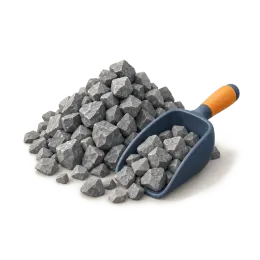
Key numbers
- Formula: L (ft) × W (ft) × depth (in) ÷ 324 = cubic yards
- #57 stone is figured at about 1.35 tons per yd³ (2,700 lb), a typical planning value, not a measured one; ask your quarry for its own weight
- 1 ton of #57 covers about 120 ft² at 2 in, 80 ft² at 3 in and 60 ft² at 4 in
- #57 is open-graded: 95–100% passes 1 in, 25–60% passes 1/2 in and only 0–5% passes the No. 8 sieve, so it drains
On this page
- How to use the Crushed Stone Calculator
- How to calculate how much crushed stone you need
- How much crushed stone for common sizes?
- How much does a ton of crushed stone cover?
- #57 stone calculator: tons per yard and coverage
- What size is #57 stone, and what are the other sizes?
- How many tons of crushed stone in a yard?
- Crushed stone for drains, sheds, pavers and driveways
- How deep should crushed stone be?
- Crushed stone behind a retaining wall
- Common mistakes when ordering crushed stone
- Crushed stone calculator vs gravel, crusher run and driveway calculators: which one to use
- Frequently asked questions
How to use the Crushed Stone Calculator
- 1Describe the areaChoose Rectangle (length × width), Circle (diameter) or Known area if you already have the square footage.
- 2Pick your unitsUse US (feet and inches) or Metric (meters and centimeters). Switching converts the numbers you typed, so the area stays the same.
- 3Enter the depthType how deep the crushed stone (#57) should be, 4 in is a common starting point for this job.
- 4Choose the materialPick crushed stone (#57), crusher run / road base or gravel (mixed). Each uses its own weight per cubic yard to work out tons.
- 5Allow for settlingChoose the extra: none, 5%, 10% (the default) or 20% for a base you will compact.
- 6Read and price the resultsSee cubic yards, cubic feet, cubic meters, US tons and metric tonnes. Enter your supplier's price per ton for the total cost.
Results update as you type. Back to the calculator ↑
How to calculate how much crushed stone you need
Crushed stone is ordered by the ton or the cubic yard, and both come from three measurements. Measure length and width in feet and depth in inches, then:
Cubic yards = length (ft) × width (ft) × depth (in) ÷ 324
Tons = cubic yards × 1.35 (for #57 crushed stone)
The 324 is 12 inches per foot × 27 cubic feet per cubic yard, so you never convert the depth by hand. The calculator above defaults to #57 crushed stone and also has presets for crusher run (about 1.6 tons per yd³) and mixed gravel (about 1.4). These are typical planning values, not tested figures, so enter your supplier’s weight per yard when it gives one.
- Measure the area. Split odd shapes into rectangles and add them.
- Set the finished depth. Decide it before calling for quotes; depth drives the order more than anything else.
- Pick the stone. Washed, single-size #57 is the default. Choose crusher run if the stone contains dust and fines.
- Add 10% for settling, spillage and an uneven subgrade.
Worked example: 12 × 16 ft shed base, 4 in of #57
- 12 × 16 × 4 ÷ 324 = 2.37 yd³ (64 ft³, 1.81 m³)
- Weight: 2.37 × 1.35 = 3.2 tons of #57 stone
- Add 10%: about 3.52 tons to order
- With a 1 ft border on every side (14 × 18 ft): 3.11 yd³, 4.2 tons, or 4.62 tons with 10%
A border wider than the shed keeps drip water from the roof edge on stone instead of soil.
How much crushed stone for common sizes?
Most searches name a size: “crushed stone for a 10×10”, “20×20”, “1,000 sq ft”. This table answers them for #57 stone at 1.35 tons per yd³. Every figure comes from the same calculation the tool runs.
| Area | Cubic yards at 4 in | Tons at 3 in | Tons at 4 in | Tons at 6 in | Order at 4 in with 10% (tons) |
|---|---|---|---|---|---|
| 10 × 10 ft (100 ft²) | 1.23 | 1.25 | 1.67 | 2.50 | 1.83 |
| 10 × 20 ft (200 ft²) | 2.47 | 2.50 | 3.33 | 5.00 | 3.67 |
| 12 × 20 ft (240 ft²) | 2.96 | 3.00 | 4.00 | 6.00 | 4.40 |
| 20 × 20 ft (400 ft²) | 4.94 | 5.00 | 6.67 | 10.00 | 7.33 |
| 24 × 24 ft (576 ft²) | 7.11 | 7.20 | 9.60 | 14.40 | 10.56 |
| 12 × 50 ft (600 ft²) | 7.41 | 7.50 | 10.00 | 15.00 | 11.00 |
| 20 × 40 ft (800 ft²) | 9.88 | 10.00 | 13.33 | 20.00 | 14.67 |
| 1,000 ft² | 12.35 | 12.50 | 16.67 | 25.00 | 18.33 |
| 2,000 ft² | 24.69 | 25.00 | 33.33 | 50.00 | 36.67 |
| 5,000 ft² | 61.73 | 62.50 | 83.33 | 125.00 | 91.67 |
A handy check: at the 1.35 tons per yard this calculator assumes, #57 works out to 100 lb per cubic foot, so 1 ton is 20 ft³. A 20 ft² strip at 12 in deep, or 60 ft² at 4 in, is one ton.
How much does a ton of crushed stone cover?
One ton of #57 crushed stone covers about 120 ft² at 2 in deep, 80 ft² at 3 in and 60 ft² at 4 in. Heavier stone covers less: a ton of crusher run, at a typical 1.6 tons per yard, covers about 101 ft² at 2 in. The tons-per-yard figures in this table are typical planning values; check your supplier’s figure.
| Depth | ft² per yd³ (any stone) | ft² per ton, #57 (1.35) | ft² per ton, gravel (1.4) | ft² per ton, crusher run (1.6) | lb of #57 per ft² |
|---|---|---|---|---|---|
| 1 in | 324 | 240 | 231 | 203 | 8.3 |
| 2 in | 162 | 120 | 116 | 101 | 16.7 |
| 3 in | 108 | 80 | 77 | 68 | 25.0 |
| 4 in | 81 | 60 | 58 | 51 | 33.3 |
| 6 in | 54 | 40 | 39 | 34 | 50.0 |
| 8 in | 40.5 | 30 | 29 | 25 | 66.7 |
| 12 in | 27 | 20 | 19 | 17 | 100.0 |
To turn coverage into an order, divide your area by the figure for your depth. A 450 ft² patio base at 4 in of #57 needs 450 ÷ 60 = 7.5 tons, or 8.25 tons with 10%. The per-yard column is the same for any stone because it is pure volume; only the per-ton columns depend on weight.
#57 stone calculator: tons per yard and coverage
To use this as a #57 stone calculator, keep the material on crushed stone (#57) and enter the area and depth. At the 1.35 tons per yard planning value, one ton of #57 covers about 60 ft² at 4 in deep, and one cubic yard covers 81 ft².
| Depth | ft² per yd³ | ft² per ton | yd³ per 100 ft² | Tons per 100 ft² |
|---|---|---|---|---|
| 2 in | 162 | 120 | 0.62 | 0.83 |
| 3 in | 108 | 80 | 0.93 | 1.25 |
| 4 in | 81 | 60 | 1.23 | 1.67 |
| 6 in | 54 | 40 | 1.85 | 2.50 |
- 10 × 12 ft shed base, 4 in: 1.48 yd³ = 2 tons, or 2.2 tons with 10% extra.
- 12 × 20 ft pad, 4 in: 2.96 yd³ = 4 tons, or 4.4 tons with extra.
- French drain 12 in wide, 18 in deep, 50 ft long: 2.78 yd³ = 3.75 tons, or 4.13 tons with extra (less the volume of the pipe and fabric wrap, which is small).
If your quarry sells #57 at a different weight per yard, multiply the yards by its figure instead.
What size is #57 stone, and what are the other sizes?
#57 is a size number, not a rock type. The number comes from the AASHTO coarse-aggregate size system that state DOTs use, and it describes how much of the stone passes each sieve. An FHWA study of open-graded backfill lists the #57 band as:
| Sieve | Percent passing, #57 |
|---|---|
| 1 in | 95–100 |
| 1/2 in | 25–60 |
| No. 4 (about 3/16 in) | 0–10 |
| No. 8 (about 3/32 in) | 0–5 |
In plain terms, almost everything is smaller than 1 inch, roughly 40–75% by weight is bigger than 1/2 inch, and there is next to no dust. That is what makes #57 “open-graded”: the angular pieces touch each other and leave voids that water can move through. It is the reason #57 is chosen for French drains, behind retaining walls, under pavers and as the middle layer of many driveways.
Other size numbers follow the same system. In the same FHWA table, 90–100% of #67 passes a 3/4 in sieve and all of #8 passes a 1/2 in sieve (85–100% passes 3/8 in), so both are finer than #57. Product names differ by region; some yards sell #57 as “3/4 in clean” or “1 in clean”. When the name is unclear, ask for the size number and whether the stone is washed. The weight per yard changes a little between sizes, so use the supplier’s figure when you have it.
Crusher run is different again. It is a dense-graded blend of crushed stone and stone dust that compacts hard. It has its own page: the crusher run calculator explains why its compacted weight per yard is higher than the loose figure.
How many tons of crushed stone in a yard?
This calculator uses 1.35 tons per cubic yard for #57 crushed stone, which is 2,700 lb, or 100 lb per cubic foot. It is a typical planning value, not a published standard. Rock type (limestone, granite, trap rock), moisture and how the stone is loaded all change it, so use your supplier’s figure when it gives one.
Converting quotes is the common need:
| Tons of #57 | Cubic yards | Cubic feet | ft² covered at 4 in |
|---|---|---|---|
| 1 | 0.74 | 20 | 60 |
| 2 | 1.48 | 40 | 120 |
| 5 | 3.70 | 100 | 300 |
| 10 | 7.41 | 200 | 600 |
| 15 | 11.11 | 300 | 900 |
| 20 | 14.81 | 400 | 1,200 |
The reverse is just as simple: 10 yd³ of #57 at 1.35 tons per yard is 13.5 tons. If the quarry quotes a different weight per yard, multiply by that figure instead; the tons to cubic yards converter does the same with any weight.
Compacted, dense-graded aggregate is heavier than this. A Wisconsin DOT study measured compacted dense graded base at 1.78 to 1.98 tons per cubic yard. That figure applies to stone with fines, not to clean #57, but it explains why crusher run tonnage needs more allowance than #57.
Crushed stone for drains, sheds, pavers and driveways
The calculator handles all of these; what changes is the shape and depth.
French drains and trenches. Treat the trench as a long box. Each 10 ft of a 12 in wide trench takes 0.37 yd³ (0.5 tons) of #57 per foot of stone depth. A 4 in perforated pipe takes up about 0.087 ft² of the cross-section, so subtract 0.87 ft³ per 10 ft on long runs.
Worked example: 40 ft French drain, 12 in wide, 12 in of #57
- Gross volume: 40 × 1 × 12 ÷ 12 = 40 ft³ (1.48 yd³)
- Less a 4 in pipe: 40 ft × 0.087 ft² = 3.49 ft³
- Net stone: 36.5 ft³, 1.35 yd³, about 1.83 tons
- Add 10%: about 2 tons of #57 to order
Only count the depth that is actually stone. If the top 4 in of the trench is soil or decorative rock, leave it out.
Shed and paver bases. A 4–6 in compacted stone base is common under sheds and pavers; follow the product’s or your designer’s instructions for paver bedding. A 12 × 12 ft base at 4 in is 2.4 tons of #57, and a 24 × 24 ft garage-sized pad at 4 in is 9.6 tons.
Driveways. Gravel driveways are built in layers: a coarse base, a middle layer such as #57 and often a crusher run top that packs down. On a 12 × 60 ft drive, a 4 in #57 layer is 8.89 yd³ (12 tons) and a 2 in crusher run top is 4.44 yd³ (7.11 tons). The driveway gravel calculator walks through every layer; this page sizes the #57 layer.
Crushed stone per square metre
Outside the US crushed stone is sold by the tonne, often as 20 mm or 40 mm stone. At the 1.35 US tons per yd³ this calculator assumes, it is about 1.6 tonnes per m³. That gives about 80 kg per m² at 50 mm and 160 kg per m² at 100 mm. A 5 × 4 m area at 50 mm is 1 m³, about 1.6 tonnes, or 1.76 tonnes with 10%.
How deep should crushed stone be?
Depth depends on what the stone has to do, and it is the single biggest driver of the order: 4 in uses twice as much stone as 2 in. Each extra inch of #57 adds 4.17 tons per 1,000 ft².
- Walkways and drainage beds: often 2–4 in of clean stone over landscape fabric. At 3 in, 1,000 ft² takes 12.5 tons.
- Shed and paver bases: usually 4–6 in, compacted in layers. A 12 × 16 ft base is 3.2 tons at 4 in and 4.8 tons at 6 in.
- Driveways: several layers adding up to more than any single-layer job, sized on the driveway gravel calculator.
- French drains and wall backfill: the depth is the trench or the wall height, often 12 in or more.
When a plan gives a finished depth, measure it after the stone is placed and settled. Clean #57 does not compact like crusher run, but it does settle into soft ground, which is part of what the 10% allowance covers.
Crushed stone behind a retaining wall
Many wall systems call for a zone of clean crushed stone directly behind the blocks so water can reach the drain instead of pushing on the wall. Follow the wall manufacturer’s drawing for the width and height of that zone; the volume is then a long box like a trench.
For a wall 30 ft long with a drainage zone 12 in wide and 3 ft high, the stone is 30 × 1 × 3 = 90 ft³, or 3.33 yd³. At 1.35 tons per yard that is 4.5 tons of #57, or 4.95 tons with 10%. A 4 in drain pipe at the base takes about 2.6 ft³ out of that, which is small enough to ignore at ordering time.
Enter the wall length as the length, the zone width as the width and the height in inches as the depth (36 in for 3 ft). The calculator then returns the same 3.33 yd³ and 4.5 tons.
Common mistakes when ordering crushed stone
Most orders go wrong on names and units rather than arithmetic. These are the costly ones, with their size.
- Ordering by name instead of size. “Gravel”, “clean stone” and “crushed rock” mean different things at different yards. Ask for the size number (such as #57) and whether it is washed.
- Using #57 where you need a packed surface. Clean #57 stays loose underfoot. For a firm top layer use crusher run, which on a 20 × 20 ft area at 4 in is about 7.9 tons at a typical 1.6 tons per yd³, versus 6.67 tons of #57.
- Confusing tons and yards. Ordering 4.94 tons for a 4.94 yd³ job (20 × 20 ft at 4 in) brings only 3.66 yd³, about 26% short.
- Entering depth in feet. A 10 × 10 ft area at 4 in is 1.23 yd³; typed as 4 ft it becomes 14.81 yd³.
- Forgetting the border. A 12 × 16 ft shed on a pad with a 1 ft border needs 4.2 tons, not 3.2.
- Skipping the extra. Stone settles into soft subgrade and spills at edges. On a 1,000 ft² base at 4 in, the 10% allowance is 1.67 tons.
Crushed stone calculator vs gravel, crusher run and driveway calculators: which one to use
This calculator is for angular crushed stone sized by number, with #57 as the default. Use a related tool when the job or the material is different:
- Gravel calculator: general gravel, pea gravel and landscape rock, with bag counts and circle and trench tables.
- Crusher run calculator: dense-graded base with fines, including the compacted-weight allowance it needs.
- Driveway gravel calculator: every layer of a new or refreshed gravel driveway.
- Pea gravel calculator and river rock calculator: rounded decorative stone for paths and beds.
- Tons to cubic yards: converting a quote between tons and yards for any stone.
FAQ
Frequently asked questions
How much crushed stone do I need for a 10×10 area?
At 4 in deep a 10 × 10 ft area needs 1.23 yd³ of #57 crushed stone, about 1.67 tons, or 1.83 tons with 10% extra. At 3 in it needs 0.93 yd³ (1.25 tons), or 1.38 tons ordered.
How much crushed stone do I need for a 12×12 shed base?
At 4 in deep a 12 × 12 ft base needs 1.78 yd³, about 2.4 tons of #57 stone, or 2.64 tons with 10% extra. Extending the pad 1 ft on each side (14 × 14 ft) raises that to about 3.27 tons before the extra, or 3.59 tons with 10%.
How much crushed stone do I need for a 20×20 area?
A 20 × 20 ft area at 4 in needs 4.94 yd³, about 6.67 tons of #57 stone, or 7.33 tons with 10% extra. At 6 in it needs 7.41 yd³ (10 tons), or 11 tons ordered.
How much crushed stone for 1,000 square feet?
At 3 in deep, 1,000 ft² needs 9.26 yd³, about 12.5 tons of #57 stone, or 13.75 tons with 10%. At 4 in it needs 12.35 yd³ (16.67 tons), or 18.33 tons ordered.
How many tons of crushed stone are in a yard?
About 1.35 tons (2,700 lb) of #57 crushed stone per cubic yard is the planning figure this calculator uses. Stone type and moisture change it, so multiply by your quarry's stated weight per yard when it gives one.
How many yards are in a ton of crushed stone?
About 0.74 yd³, or 20 ft³, per ton of #57 stone at 1.35 tons per yard. Five tons is about 3.7 yd³ and 10 tons about 7.41 yd³. Divide tons by the weight per yard to convert.
How much does a ton of #57 stone cover?
One ton of #57 stone covers about 240 ft² at 1 in, 120 ft² at 2 in, 80 ft² at 3 in and 60 ft² at 4 in. Divide 324 by the depth in inches, then by 1.35.
What size is #57 stone?
Under the AASHTO size number used by DOTs, 95–100% of #57 passes a 1 in sieve, 25–60% passes 1/2 in and only 0–10% passes the No. 4 sieve (about 3/16 in). Almost all of it is under 1 in, and roughly 40–75% by weight is retained on the 1/2 in sieve.
Is #57 stone good for drainage?
Yes. #57 is an open-graded stone: the specification allows only 0–5% passing the No. 8 sieve, so there are almost no fines to fill the gaps. That is why it is used in French drains and under pavers.
How much #57 stone do I need for a French drain?
A 40 ft trench 12 in wide filled 12 in deep holds 1.48 yd³. Subtracting a 4 in pipe leaves 1.35 yd³, about 1.83 tons of #57 stone, or about 2 tons with 10% extra.
How much crushed stone for a gravel driveway?
For a 12 × 60 ft drive, a 4 in layer of #57 is 8.89 yd³, about 12 tons, and a 2 in crusher run top layer adds 7.11 tons. Size every layer separately on the driveway gravel calculator.
How deep should crushed stone be?
Paths and drainage beds often use 2–4 in, shed and paver bases 4–6 in compacted, and driveways several layers. Each inch adds 4.17 tons of #57 per 1,000 ft², so set the depth before you order.
Does crushed stone compact?
Clean #57 stone settles a little but does not pack hard like crusher run, because it has no fines to fill the voids. Add about 10% for settling and spillage, and more if you are building a compacted base.
What is the difference between crushed stone and gravel?
Crushed stone is quarried rock broken by a crusher, so the pieces are angular and lock together. Gravel often means naturally rounded stone. This calculator uses typical planning weights of 1.35 tons per yd³ for #57 and 1.4 for mixed gravel; your supplier's figure may differ.
How much crushed stone per square metre?
At the typical 1.6 tonnes per m³ (1.35 US tons per yd³) this calculator assumes, crushed stone weighs about 80 kg per m² at 50 mm and 160 kg per m² at 100 mm. One tonne covers about 12.5 m² at 50 mm.
2 Sources
Last reviewed October 9, 2026 by M Bilal. Found an error? Tell us.