


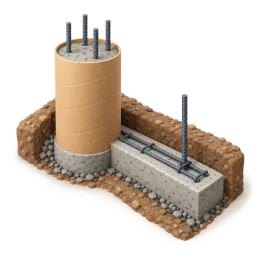
Key numbers
- Formula: width (ft) × depth (ft) × height (ft) × number of columns = ft³; ÷ 27 = yd³
- 12 × 12 in column: 1 ft³ per foot = 1.67 × 80 lb bags per foot, about 150 lb per foot
- Beam: the same box math laid flat; a 12 × 18 in beam 20 ft long is 30 ft³ (1.11 yd³)
- Round column: holds π ÷ 4 = 78.5% of a square column of the same width; use the Sonotube calculator
- Sizing and rebar come from your engineer or plans, not from this calculator
On this page
- How to use the Concrete Column Calculator
- How do you calculate concrete for a column?
- How much concrete per foot of column? (chart)
- How many bags of concrete for one column?
- How do you calculate concrete for a beam?
- Square vs round columns: which takes more concrete?
- Concrete columns in metric
- Bags or ready-mix for columns?
- Common column and beam estimating mistakes
- Frequently asked questions
How to use the Concrete Column Calculator
- 1Choose the shapePick square / rect. column or beam. Each shape uses its own volume formula.
- 2Pick your unitsEvery dimension has its own unit menu (in, ft, yd, cm or m); changing one converts that number so the size stays the same. The US / Metric switch sets all fields to feet and inches or meters and centimeters and resets them to typical values.
- 3Enter the dimensionsType the width (default inches), depth (default inches), height (default feet) or number of columns. Measure the inside of the forms and the depth in several places.
- 4Set waste and quantityUse the waste slider (0 to 20%, default 10%) and allow more on uneven ground. If you have several identical pours, enter how many.
- 5Read the resultsSee the volume in cubic yards, cubic feet and cubic meters, the ready-mix order rounded up to ¼ yard, the number of 90, 80, 60, 50 and 40 lb bags rounded up, and the weight at the density you choose (150, 145 or 140 lb/ft³).
- 6Price it and save itPick a pricing basis (per cubic yard, per cubic meter or per bag of the highlighted size) and enter your local price for a material cost. Use Add to project to total several pours, and Copy link to share the exact result.
Results update as you type. Back to the calculator ↑

How do you calculate concrete for a column?
A square or rectangular column is a box standing on end. Multiply its width by its depth by its height, all in feet, and you have cubic feet. Multiply by the number of columns, add a little extra, and divide by 27 for cubic yards.
Volume (ft³) = width (ft) × depth (ft) × height (ft) × number of columns
Cubic yards = ft³ ÷ 27 · Cubic metres = ft³ × 0.0283
80 lb bags = ft³ ÷ 0.60, rounded up
Inches are the usual trap. A 12 in column is 1 ft wide, but a 10 in column is 0.833 ft and a 16 in column is 1.333 ft. Convert first, or let the calculator do it: each field takes inches, feet, yards, centimetres or metres.
Worked example: four 12 × 12 in columns, 8 ft tall
- One column: 1 × 1 × 8 = 8 ft³
- Four columns: 8 × 4 = 32 ft³ (1.19 yd³, 0.91 m³)
- With 10% extra: 35.2 ft³ = 1.30 yd³ (0.997 m³)
- 80 lb bags at 0.60 ft³ each (QUIKRETE data sheet): 35.2 ÷ 0.6 = 58.7, so 59 bags; or 79 bags of 60 lb
- Weight in place at 150 lb/ft³: 4,800 lb for the four columns, before the extra
Fifty-nine bags is a lot of hand mixing. At 1.3 yd³, price a short-load ready-mix delivery before you buy bags.
The calculator has two shapes: Square / rect. column (width, depth, height, count) and Beam (width, depth, length, count). For a round column or pier, use the Sonotube calculator, which handles tube sizes.
How much concrete per foot of column? (chart)
The table gives the concrete in one foot of height for common column sections. Multiply by your height and the number of columns.
| Section (in) | ft³ per ft | yd³ per ft | 80 lb bags per ft | Weight per ft (lb) | Litres per metre |
|---|---|---|---|---|---|
| 8 × 8 | 0.444 | 0.0165 | 0.74 | 67 | 41.3 |
| 10 × 10 | 0.694 | 0.0257 | 1.16 | 104 | 64.5 |
| 12 × 12 | 1.000 | 0.0370 | 1.67 | 150 | 92.9 |
| 12 × 16 | 1.333 | 0.0494 | 2.22 | 200 | 123.9 |
| 12 × 24 | 2.000 | 0.0741 | 3.33 | 300 | 185.8 |
| 16 × 16 | 1.778 | 0.0658 | 2.96 | 267 | 165.2 |
| 18 × 18 | 2.250 | 0.0833 | 3.75 | 338 | 209.0 |
| 24 × 24 | 4.000 | 0.1481 | 6.67 | 600 | 371.6 |
Weights use 150 lb/ft³, the normal-weight concrete figure in WSDOT’s Bridge Design Memo 05-2010; FHWA gives a range of about 140–155 lb/ft³. These are plain-concrete weights; WSDOT uses 155 lb/ft³ for reinforced concrete, so a column with rebar weighs a few percent more. Dead loads for design come from your engineer. Bag counts use the QUIKRETE Concrete Mix yield of 0.60 ft³ per 80 lb bag.
How many bags of concrete for one column?
Here are single columns at two common heights, with and without the 10% extra. Bags are 80 lb, rounded up.
| Section (in) | 8 ft tall: ft³ | 8 ft: bags (no extra / +10%) | 10 ft tall: ft³ | 10 ft: bags (no extra / +10%) |
|---|---|---|---|---|
| 8 × 8 | 3.56 | 6 / 7 | 4.44 | 8 / 9 |
| 10 × 10 | 5.56 | 10 / 11 | 6.94 | 12 / 13 |
| 12 × 12 | 8.00 | 14 / 15 | 10.00 | 17 / 19 |
| 16 × 16 | 14.22 | 24 / 27 | 17.78 | 30 / 33 |
| 18 × 18 | 18.00 | 30 / 33 | 22.50 | 38 / 42 |
| 24 × 24 | 32.00 | 54 / 59 | 40.00 | 67 / 74 |
Height means the full poured height: from the top of the footing (or wherever the pour starts) to the underside of whatever sits on top. If the column is poured with its footing, add the footing with the concrete footing calculator.
How do you calculate concrete for a beam?
A beam uses the same math as a column, laid on its side: width × depth × length. Depth here is the beam’s height from bottom to top.
Worked example: 12 × 18 in beam, 20 ft long
- Volume: 1 × 1.5 × 20 = 30 ft³ (1.11 yd³)
- With 10% extra: 33 ft³ = 1.22 yd³ (0.93 m³)
- 80 lb bags: 33 ÷ 0.6 = 55 bags; or 74 bags of 60 lb
- Weight at 150 lb/ft³: about 4,500 lb
Some more beam sizes, each with 10% extra:
| Beam (W × D × L) | ft³ | ft³ +10% | yd³ +10% | m³ +10% | 80 lb bags | Weight (lb, no extra) |
|---|---|---|---|---|---|---|
| 8 × 12 in × 16 ft | 10.67 | 11.73 | 0.43 | 0.332 | 20 | 1,600 |
| 12 × 18 in × 20 ft | 30.00 | 33.00 | 1.22 | 0.934 | 55 | 4,500 |
| 12 × 24 in × 40 ft (grade beam) | 80.00 | 88.00 | 3.26 | 2.492 | 147 | 12,000 |
A beam that carries a slab, a wall or a deck is a structural member. Its size, reinforcement, supports and how long the forms stay in place belong on drawings from an engineer or the plans your building department approved. This page only measures the concrete.
Square vs round columns: which takes more concrete?
A square column takes more. A circle fits inside a square of the same width and fills π ÷ 4 of it, about 78.5%. So a 12 in square column 8 ft tall is 8 ft³, while a 12 in round column the same height is 6.28 ft³.
| Same width, 8 ft tall | Square column | Round column (Sonotube) | Round ÷ square |
|---|---|---|---|
| 12 in | 8.00 ft³ | 6.28 ft³ | 78.5% |
That is why this page handles square and rectangular columns, and the Sonotube calculator handles round ones with standard tube sizes. A hollow round shape (pipe, ring, tank wall) is on the concrete cylinder calculator.
Concrete columns in metric
The method is the same in metres. A 300 × 300 mm column 3 m tall is 0.3 × 0.3 × 3 = 0.27 m³.
Worked example: four 300 × 300 mm columns, 3 m tall
- Volume: 0.27 × 4 = 1.08 m³ (1.41 yd³)
- With 10% extra: 1.188 m³ (1.55 yd³)
- Weight of the 1.08 m³ (before extra) at 150 lb/ft³ (about 2,403 kg/m³): about 2,595 kg
- 80 lb (36.3 kg) bags: 70
A 300 × 300 mm column holds 90 litres per metre of height. For bagged mix sold in kilograms, divide the volume by the yield printed on your bag.
Bags or ready-mix for columns?
Columns add up fast. One cubic yard fills 27 ft of 12 × 12 in column, or 3.38 columns 8 ft tall. Four of them already need more than a yard, and the 24 × 24 in column in the table needs 59 bags on its own.
NRMCA’s guide to ordering ready-mixed concrete says to order 4–10% extra and lists truck mixers holding 8–12 yd³, so a column job is often a partial load. Ask your plant about its minimum order and any short-load charge before deciding. For one or two small columns, bags are practical; have every bag on site before you start mixing.
What this calculator does not size
It measures concrete volume only. Column and beam size, reinforcing bar size and spacing, ties, concrete cover over the steel, concrete strength and how the column connects to its footing are structural decisions. They come from an engineer or from approved plans that follow your local building code (in the US, usually based on ACI 318). Do not size a load-bearing column or beam from a volume calculator.
Common column and beam estimating mistakes
- Mixing inches and feet. 12 × 12 × 8 means 12 in by 12 in by 8 ft. Typing 12 ft by mistake multiplies the order by 144.
- Measuring the drawing, not the form. Measure inside the forms you built; boards are not always the nominal size.
- Forgetting the count. The calculator multiplies by the number of columns or beams; check it.
- Leaving out the footing. Columns poured with their footings need both volumes.
- No extra. Spills, form bulges and the last bit left in the mixer add up. 5–10% is usual.
- Using round math for square columns. A square column holds about 27% more than a round one of the same width.
All results are volume estimates for ordering. Structural sizing comes from your engineer or approved plans.
FAQ
Frequently asked questions
How much concrete do I need for a 12 × 12 column?
A 12 × 12 in column holds 1 ft³ per foot of height. An 8 ft column is 8 ft³ (0.30 yd³): 14 bags of 80 lb concrete, or 15 with 10% extra. A 10 ft column is 10 ft³: 17 bags, or 19 with 10% extra.
How many bags of concrete for a 16 × 16 column?
A 16 × 16 in column holds 1.78 ft³ per foot, or 2.96 bags of 80 lb concrete per foot. An 8 ft column is 14.22 ft³: 24 bags, or 27 with 10% extra. A 10 ft column is 17.78 ft³: 30 bags, or 33 with extra.
How much concrete is in a 24 × 24 column?
4 ft³ per foot of height. An 8 ft, 24 × 24 in column is 32 ft³ (1.19 yd³), which is 54 bags of 80 lb concrete, or 59 with 10% extra. At that size, compare a ready-mix delivery.
How do you calculate concrete for a beam?
Multiply width × depth × length, all in feet. A 12 × 18 in beam 20 ft long is 1 × 1.5 × 20 = 30 ft³, or 1.11 yd³. With 10% extra that is 33 ft³ (1.22 yd³, 0.93 m³), or 55 bags of 80 lb concrete.
How much does a concrete column weigh per foot?
At 150 lb/ft³ (plain concrete), a 12 × 12 in column weighs about 150 lb per foot, a 16 × 16 in about 267 lb and a 24 × 24 in about 600 lb. An 8 ft, 12 × 12 in column weighs about 1,200 lb. WSDOT uses 155 lb/ft³ for reinforced concrete, about 3% more.
Does a square or a round column take more concrete?
A square column takes more. A round column holds π ÷ 4, or 78.5%, of a square column the same width. A 12 in square column 8 ft tall is 8 ft³; a 12 in round one is 6.28 ft³.
How many 12 × 12 columns does a yard of concrete fill?
One cubic yard (27 ft³) fills 27 ft of 12 × 12 in column, so 3.38 columns 8 ft tall. Three 8 ft columns use 24 ft³; four need 32 ft³, more than one yard.
How much concrete for a column in metric?
Multiply width × depth × height in metres. A 300 × 300 mm column 3 m tall is 0.27 m³. Four of them are 1.08 m³, or 1.19 m³ with 10% extra, The 1.08 m³ of concrete weighs about 2,595 kg at 150 lb/ft³ (2,403 kg/m³), or a little more with reinforcing steel.
5 Sources
Last reviewed October 10, 2026 by M Bilal. Found an error? Tell us.